


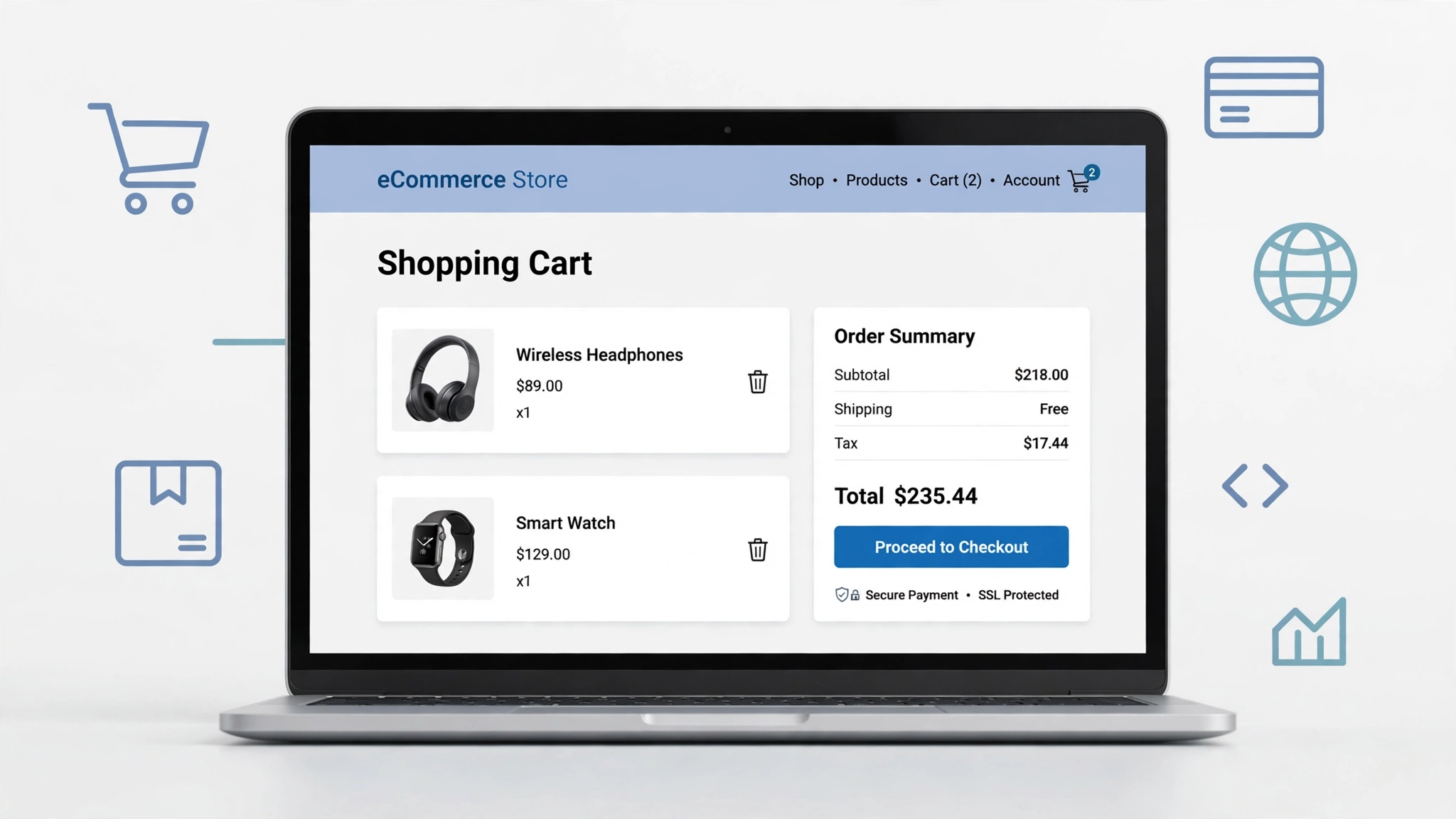
A professional ecommerce website is more than a digital catalog with a checkout button. It is a complete online sales platform that connects products, customers, payments, inventory, marketing, analytics, and business operations within a single experience.
With the right ecommerce web development services, businesses can create custom online stores designed around their products, target customers, brand identity, and long-term growth objectives. A well-developed store can make product discovery easier, simplify purchasing, and provide the technical foundation needed to scale an online business.
What Are Ecommerce Web Development Services?
Ecommerce web development services cover the planning, design, development, integration, testing, and ongoing improvement of websites that sell products or services online. These services can range from building a new store from scratch to redesigning an existing ecommerce platform or adding custom functionality to an established website.
The development process typically combines frontend design with backend systems, databases, payment processing, security features, and third-party integrations. The goal is to create an online shopping environment that is visually professional while remaining fast, functional, secure, and easy to manage.
For businesses with straightforward requirements, an ecommerce platform may provide many of the features needed to launch quickly. Companies with specialized workflows, complex product catalogs, unique customer journeys, or advanced integrations may benefit from a more customized development approach.
Why Choose a Custom Online Store?
A custom online store gives a business greater control over how its website looks, works, and interacts with customers. Instead of adapting every part of the business to a preconfigured template, developers can create functionality around specific operational and commercial requirements.
Customization can be particularly valuable when a company needs unusual product configurations, subscription options, customer-specific pricing, wholesale purchasing, complex shipping rules, or connections with internal business systems.
A custom ecommerce solution can also provide greater flexibility as the company grows. New features, integrations, product categories, and customer services can be incorporated into the platform according to changing business requirements.
Ecommerce Website Design and User Experience
The design of an ecommerce website directly influences how easily customers can discover products and complete purchases. A professional design should establish a clear visual hierarchy, present important information at the right stage, and make navigation intuitive across desktop and mobile devices.
Product pages should provide essential information without overwhelming visitors. High-quality images, clear descriptions, pricing, availability, specifications, reviews, and relevant purchasing options can help customers understand what they are considering before reaching checkout.
The checkout experience deserves particular attention because unnecessary complexity can create friction. A streamlined process with clear costs, straightforward forms, multiple suitable payment methods, and transparent delivery information can make purchasing more convenient.
Mobile-Friendly Ecommerce Development
Mobile commerce is an important consideration for modern online stores because customers increasingly browse products and make purchases using smartphones and tablets. An ecommerce website therefore needs to function effectively across different screen sizes and device types.
Responsive development allows layouts, navigation elements, images, product information, and checkout interfaces to adapt to smaller screens. Buttons and interactive elements should also be easy to use with touch input.
Mobile performance is equally important. Large images, unnecessary scripts, complicated animations, and inefficient code can affect loading times and create a less convenient shopping experience, particularly for customers using slower connections.
Ecommerce Platform Development
Businesses can choose from numerous ecommerce platforms depending on their technical requirements, budget, catalog size, and operational model. Some companies prefer hosted platforms because they simplify infrastructure management, while others require greater technical control through self-hosted or custom solutions.
Platform selection should be based on business requirements rather than popularity alone. Factors such as product management, payment support, shipping functionality, customization capabilities, scalability, integrations, maintenance requirements, and total ownership costs should all be considered.
For organizations with specialized requirements, custom development can complement an existing ecommerce platform rather than replacing it completely. Developers can build tailored applications, integrations, and extensions around the platform’s existing capabilities.
Custom Ecommerce Features and Functionality
Every online business has different requirements, which is why custom functionality can be an important component of ecommerce development. A development team can create features designed specifically around a company’s products, customers, and internal processes.
Examples include advanced product filtering, personalized recommendations, customer accounts, wish lists, subscription purchasing, product configurators, wholesale portals, promotional systems, custom quotation requests, and specialized checkout workflows.
The appropriate feature set depends on the business model. Adding functionality simply because it is technically possible can make a website harder to use, so custom development should focus on solving genuine customer or operational needs.
Payment Gateway Integration
Payment processing is one of the most important technical components of an ecommerce website. Customers need a reliable way to pay, while businesses need accurate transaction records and appropriate safeguards for financial information.
Ecommerce developers can integrate supported payment gateways and configure the checkout process around the payment methods relevant to the target market. Depending on the business and region, these may include cards, bank-based payments, digital wallets, and other supported methods.
Payment integrations should be thoroughly tested before launch. Successful ecommerce development requires the payment process, order creation, confirmation messages, refunds, and transaction records to work together correctly.
Inventory and Order Management
An ecommerce website becomes considerably more useful when it connects online sales with inventory and order management. Automated systems can help businesses keep product availability updated and reduce the need for repetitive manual administration.
Depending on the requirements, an ecommerce solution can connect with inventory management software, enterprise resource planning systems, warehouse platforms, accounting applications, and fulfillment services.
These integrations can provide a more consistent flow of information between the storefront and internal operations. They can also help businesses manage larger catalogs and increasing order volumes without relying entirely on manual processes.
Ecommerce API and Third-Party Integrations
Modern ecommerce websites frequently depend on external services. APIs allow an online store to communicate with other applications and exchange information between systems.
Common integrations can include customer relationship management platforms, email marketing services, accounting software, shipping providers, inventory systems, analytics platforms, customer-support tools, and business management applications.
Well-planned integrations can reduce duplicated data entry and create more connected business processes. Developers should nevertheless evaluate each integration carefully because third-party services can introduce dependencies, maintenance requirements, and compatibility considerations.
Ecommerce Website Security
Security should be treated as a core part of ecommerce development rather than an optional feature. Online stores process customer accounts, contact information, order details, and potentially sensitive payment-related information, making appropriate security controls essential.
Development practices can include secure authentication, access controls, data protection, software updates, input validation, secure API communication, monitoring, and appropriate backup procedures. Payment processing should also use established providers and appropriate security standards.
Security requirements can vary depending on the business, technology stack, payment architecture, and jurisdiction. Regular maintenance is therefore important because a website that was secure when launched still needs updates and monitoring as its technology environment changes.
SEO-Friendly Ecommerce Development
Search engine optimization should be considered during development rather than added only after a website is launched. Technical architecture, page structure, navigation, URLs, metadata, content organization, and performance can all influence how search engines discover and understand an ecommerce website.
Each important product and category should have a clear, accessible URL and meaningful content. Duplicate pages, poorly structured navigation, unnecessary URL parameters, and inaccessible product information can make it harder for search engines to understand a large ecommerce catalog.
SEO also involves the customer experience. Fast pages, useful product information, logical navigation, mobile compatibility, and clear internal linking can support both search visibility and usability.
Ecommerce Performance Optimization
Website performance can influence both user experience and business results. Customers generally expect online stores to load quickly, respond smoothly, and remain usable while browsing large catalogs.
Performance optimization can involve image compression, efficient code, caching, content delivery networks, database optimization, lazy loading, and reducing unnecessary scripts. The appropriate techniques depend on the architecture and technology used by the store.
Performance should also be monitored after launch. New products, plugins, integrations, marketing tools, and content can gradually affect a site’s speed, making ongoing optimization an important part of ecommerce maintenance.
Custom Ecommerce Solutions for Growing Businesses
A small online store may begin with a relatively simple product catalog and basic checkout process. As the business expands, however, it may need additional capabilities for customers, employees, suppliers, marketing teams, and fulfillment operations.
A scalable ecommerce architecture can make it easier to introduce these capabilities without rebuilding the entire website. Developers can structure applications and integrations so that new components can be added as business requirements evolve.
Scalability does not simply mean handling more visitors. It can also involve supporting larger product catalogs, more complex pricing structures, additional sales channels, increased transaction volumes, and more sophisticated internal workflows.
Ecommerce Website Migration
Businesses sometimes need to move an existing online store to a different platform or technology stack. Migration can provide opportunities to improve performance, design, functionality, security, and administration.
A successful ecommerce migration requires careful planning because product information, customer accounts, orders, URLs, images, categories, and other data may need to be transferred. Search-engine visibility should also be considered when changing website structures or URLs.
Testing should take place before the new store becomes the primary customer-facing website. Redirects, checkout functionality, payment processing, integrations, product information, and account features should all be reviewed before launch.
Ecommerce Testing and Quality Assurance
Testing is an essential stage of professional ecommerce development. A store can appear complete while still containing problems that affect checkout, navigation, payments, product data, or mobile functionality.
Quality assurance can include testing across browsers and devices, reviewing forms, checking product variations, testing promotional rules, validating payment processes, and examining error handling. Performance and security testing can also be included depending on the project’s requirements.
The objective is to identify problems before customers encounter them. Thorough testing can also make future maintenance easier by establishing a reliable baseline for the website’s functionality.
Ongoing Ecommerce Website Maintenance
Launching an online store is not the end of the development process. Ecommerce websites require ongoing maintenance to keep software, integrations, security controls, content, and functionality working properly.
Maintenance can include software updates, security reviews, performance monitoring, bug fixes, database maintenance, backup verification, analytics reviews, and compatibility testing. Businesses may also require ongoing development when introducing new products, services, payment methods, or customer features.
A structured maintenance plan helps businesses respond to technical issues before they become significant disruptions. It can also provide a controlled way to improve the website as customer expectations and business requirements change.
How Much Do Ecommerce Development Services Cost?
The cost of ecommerce web development varies considerably depending on the project’s scope. A basic online store with standard functionality generally requires less development work than a custom platform involving complex integrations, personalized customer experiences, advanced product configurations, or enterprise-level infrastructure.
Other factors can include design requirements, number of products, payment integrations, third-party systems, content migration, security requirements, mobile optimization, custom functionality, and ongoing maintenance.
Instead of focusing only on the initial development price, businesses should consider the total cost of ownership. Hosting, platform fees, software licenses, maintenance, integrations, security, support, and future development can all contribute to the long-term cost of operating an ecommerce website.
Choosing an Ecommerce Web Development Partner
Selecting an ecommerce development company requires more than reviewing a portfolio. Businesses should examine the developer’s technical experience, understanding of ecommerce workflows, development methodology, communication process, testing practices, and approach to post-launch support.
It can also be useful to discuss the project’s requirements in detail before development begins. A professional development process should establish the website’s objectives, target customers, required functionality, technology choices, integrations, timeline, testing approach, and maintenance expectations.
Clear documentation and communication can reduce misunderstandings throughout the project. Businesses should also understand who will manage the website after launch and how future changes or technical issues will be handled.
The Future of Custom Ecommerce Development
Ecommerce continues to evolve as businesses adopt new technologies and customers become accustomed to increasingly personalized digital shopping experiences. Modern development can incorporate automation, advanced analytics, personalization, improved search, conversational interfaces, and integrations across multiple sales channels.
The most useful technology is not necessarily the newest technology. Businesses should select tools and features according to measurable customer needs, operational requirements, security considerations, and long-term sustainability.
A strong ecommerce foundation makes it easier to adopt new capabilities when they provide genuine value. This is one reason architecture, scalability, maintainability, and integration planning are important from the beginning of a development project.
Conclusion
Ecommerce web development services provide the technical foundation businesses need to create, operate, and expand online stores. From responsive design and custom functionality to payment integration, security, SEO, performance optimization, and ongoing maintenance, every component contributes to the overall quality of an ecommerce experience.
Custom online store solutions can be particularly valuable for businesses whose requirements extend beyond standard templates and out-of-the-box functionality. By combining thoughtful user experience design with reliable technology and scalable architecture, businesses can build ecommerce platforms that support both current operations and future growth.
The right development approach ultimately depends on the business model, customer expectations, product catalog, operational processes, budget, and long-term goals. A carefully planned ecommerce website can serve not only as a storefront, but as an integrated digital platform connecting customers, products, payments, marketing, and business operations.
