

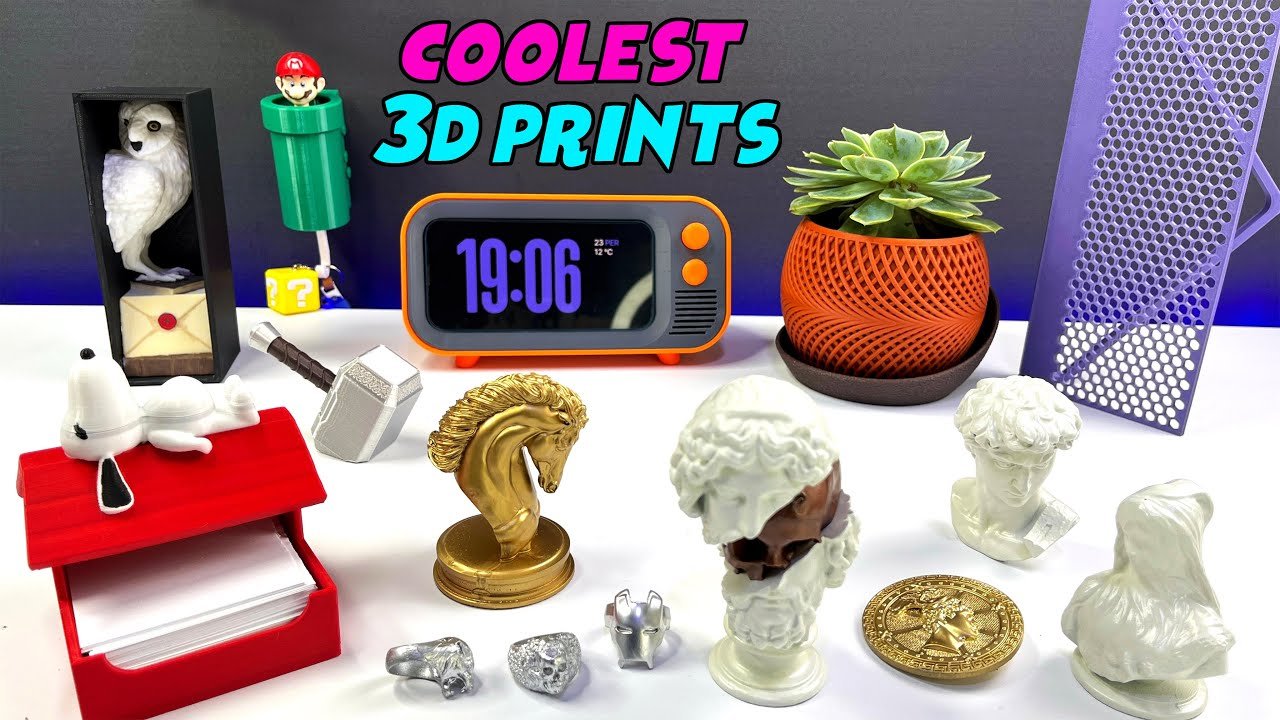
3D printing has transformed the way people create objects, turning digital designs into physical products with relatively little equipment and material. Whether you are a beginner, hobbyist, student, gamer, designer, or experienced maker, there are countless cool things to 3D print for entertainment, organization, decoration, and everyday use.
From clever desk accessories and personalized gifts to articulated toys, home décor, and practical organizers, 3D printing allows you to create objects that match your interests and needs. With the right design and filament, even a simple home 3D printer can produce impressive and useful results.
What Are Cool Things to 3D Print?
Cool things to 3D print are creative, interesting, useful, or entertaining objects that can be produced using a 3D printer. These projects can range from simple beginner-friendly models to complex mechanical designs that require advanced printing skills.
The best projects are often those that combine appearance with functionality. A well-designed phone stand, for example, can look attractive while also solving an everyday problem.
Cool Desk Accessories to 3D Print
Desk accessories are among the easiest and most useful 3D printing projects. They can help organize your workspace while giving your desk a personalized appearance.
Cable organizers, pen holders, headphone stands, monitor accessories, phone stands, and small storage containers are excellent examples. Many of these designs can be printed relatively quickly and customized according to the size of your workspace.
You can also print decorative desk objects such as geometric sculptures, miniature models, inspirational signs, and personalized nameplates. These projects are especially popular for home offices, study areas, and gaming setups.
Fun Things to 3D Print for Gaming
Gaming enthusiasts can use 3D printing to create accessories inspired by their favorite games and gaming equipment. Controller stands, headset holders, game-themed decorations, joystick accessories, and cable-management pieces can make a gaming setup more organized.
Decorative models based on fictional characters, creatures, weapons, vehicles, and game symbols can also make interesting display pieces. When printing copyrighted or fan-created designs, however, it is important to understand the designer’s licensing terms, particularly if you plan to sell the finished object.
Useful Things to 3D Print at Home
3D printing can be especially valuable when it solves small problems around the house. Drawer dividers, hooks, storage boxes, clips, cable holders, remote-control organizers, and replacement knobs are examples of practical projects.
A custom-designed object can be more useful than a standard store-bought product because it can be created for a specific size or purpose. For example, you can design a small organizer that fits precisely inside a particular drawer.
Creative Home Décor Ideas
3D printing also provides plenty of opportunities for creative interior decoration. Geometric vases, decorative planters, wall art, lampshades, sculptures, figurines, and modern ornaments can give a room a distinctive appearance.
Different filament colors and textures can further change the look of a printed object. Combining simple shapes with creative patterns can produce decorative pieces that look much more complicated than they actually are.
Personalized 3D Prints
One of the biggest advantages of 3D printing is personalization. Instead of purchasing a generic item, you can create something featuring a name, initials, date, logo, favorite symbol, or custom shape.
Personalized keychains, desk signs, bookmarks, phone accessories, ornaments, nameplates, and small gifts are popular examples. These projects can also be useful for birthdays, celebrations, school projects, and handmade gifts.
Cool 3D Printed Toys and Fidget Objects
Toys and fidget objects are another popular category of 3D printing projects. Articulated animals, flexible creatures, spinning objects, puzzles, gears, and mechanical toys can be both entertaining and visually impressive.
Some articulated models are designed with connected parts that can move directly after printing, reducing the need for complicated assembly. These projects are particularly interesting because they demonstrate how 3D printing can create objects with movement and mechanical functionality.
Articulated 3D Prints
Articulated 3D prints contain multiple connected or movable sections that allow the finished model to bend, rotate, or flex. Popular examples include articulated dragons, snakes, insects, animals, and fantasy creatures.
These designs are often considered “cool” because the finished object can move in ways that would be difficult to achieve with a simple solid print. Print orientation and printer calibration are important because poorly tuned settings can cause moving sections to fuse together.
Educational Things to 3D Print
3D printing can make learning more interactive by turning abstract concepts into physical objects. Students and teachers can print geometric shapes, molecular models, anatomical structures, mechanical components, maps, historical objects, and engineering models.
These projects can be particularly useful in science, mathematics, engineering, architecture, and design education. Instead of viewing a concept only on a screen or page, students can examine and manipulate a physical representation.
Organization and Storage Projects
If you want a project that is both cool and practical, organization products are an excellent choice. Modular storage boxes, tool holders, cable-management systems, SD-card holders, battery organizers, and compartment trays can help reduce clutter.
Because 3D printers can produce customized dimensions, you can create storage solutions for objects that do not fit standard organizers. Modular designs are especially useful because additional sections can be printed whenever more storage is required.
Cool Things to 3D Print for Cars
Some 3D printing projects can be useful inside vehicles, such as cable clips, phone mounts, storage organizers, cup-holder inserts, and small interior accessories.
However, automotive projects require extra care because temperatures inside vehicles can become high. Materials and designs should be selected carefully, and 3D-printed parts should not be used for safety-critical components such as brake, steering, restraint, or structural systems unless they are professionally engineered and appropriately tested.
Easy 3D Prints for Beginners
Beginners can start with simple objects that require minimal supports and straightforward geometry. Phone stands, keychains, simple containers, cable clips, plant markers, coasters, and basic toys are good starting points.
These projects help new users learn important skills such as bed leveling, nozzle height, temperature selection, first-layer control, infill, and print orientation. Once these fundamentals become familiar, more complex designs can be attempted.
Advanced 3D Printing Ideas
Experienced makers can explore projects involving multiple moving components, intricate geometries, functional mechanisms, and complex assemblies. Mechanical clocks, articulated models, robotics components, modular systems, and multi-part sculptures can provide greater challenges.
Advanced projects may require careful modeling, tighter tolerances, support structures, specialized materials, or multiple print settings. They can also involve post-processing such as sanding, painting, gluing, or assembly.
Choosing the Right Filament
The material you choose can significantly affect the appearance, strength, flexibility, and durability of a 3D print. PLA is a popular starting material because it is relatively easy to print and works well for decorative objects, models, and many household projects.
PETG can provide greater durability and is useful for many functional objects, while ABS is often selected for applications that require greater temperature resistance but can be more challenging to print successfully. Other materials, including TPU, can be useful when flexibility is required.
How to Find Good 3D Printing Designs
There are many online communities and repositories where makers share printable 3D models. When selecting a design, pay attention to the model’s print settings, required supports, recommended material, estimated printing time, and user feedback.
It is also important to check the license attached to a design. Some models are intended only for personal use, while others may permit modification or commercial use under specific conditions.
Tips for Better 3D Prints
A successful print begins with a properly prepared printer. Make sure the build plate is clean and correctly leveled, use suitable temperatures for the selected material, and check that the first layer adheres properly.
For larger or more complicated projects, consider printing a smaller test version first. This can help identify problems with dimensions, tolerances, supports, or material settings before spending several hours printing the complete model.
Are Cool 3D Prints Worth Making?
Absolutely. 3D printing provides a combination of creativity, customization, and practical problem-solving that makes it useful for far more than simple decorative models.
The best project depends on your interests and experience level. Beginners may prefer simple organizers and toys, while experienced makers can explore mechanical objects, personalized designs, robotics, and complex artistic creations.
Final Thoughts
There are virtually endless cool things to 3D print, from fun articulated toys and gaming accessories to useful household organizers and personalized décor. The technology makes it possible to transform a digital concept into a physical object tailored to your needs.
Whether you are looking for an easy first project or a challenging design to improve your skills, 3D printing offers plenty of opportunities to experiment. Starting with practical and manageable projects can help you build confidence before moving on to more advanced creations.
