


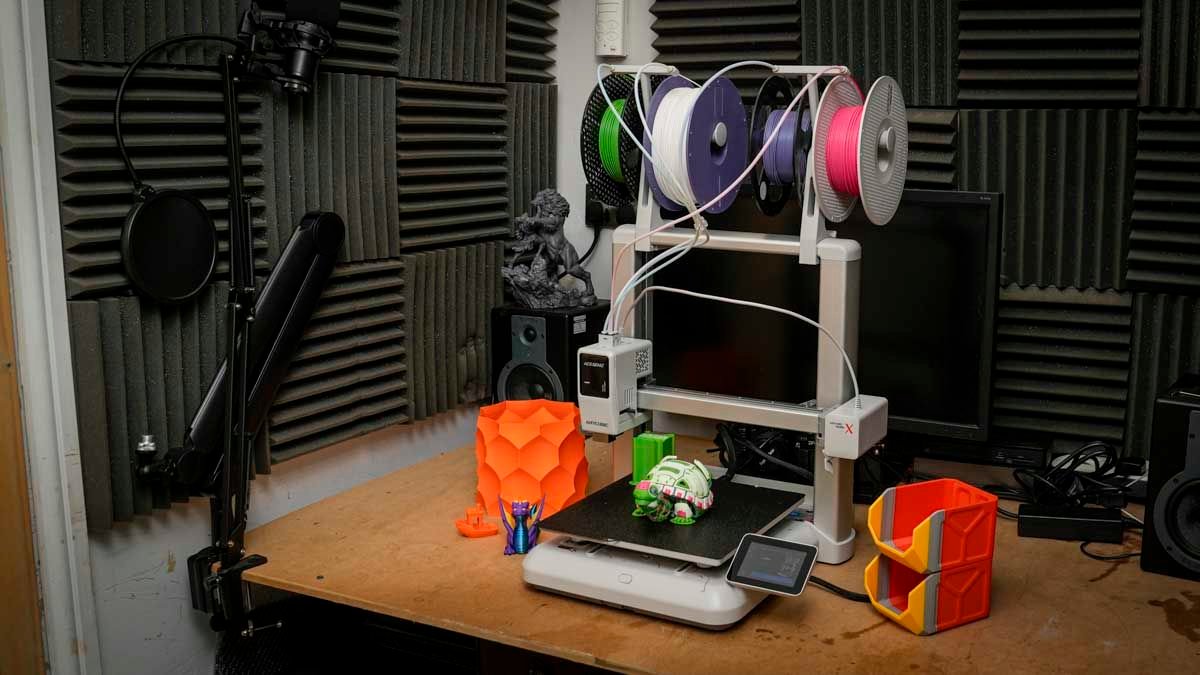
A multicolor 3D printer is a 3D printing machine designed to produce objects using two or more colors within the same print. Instead of creating an entire model in a single filament color, these printers can combine or switch between different materials or colors to produce more detailed and visually appealing results.
Multicolor 3D printing is useful for hobby projects, prototypes, educational models, decorations, artwork, miniatures, and customized products. Depending on the printer design, color changes may happen through multiple filament feeds, multiple extruders, multiple nozzles, or specialized material-mixing systems.
What Is a Multicolor 3D Printer?
A multicolor 3D printer is a 3D printer capable of producing a single object with multiple colors. It works similarly to a conventional FDM printer, but it has additional hardware or material-handling capabilities that allow different colors to be used during the printing process.
The printer follows instructions generated by slicing software, which determines when and where each color should be deposited. This makes it possible to create models with colorful patterns, labels, logos, decorative details, and different sections in contrasting colors.
How Does a Multicolor 3D Printer Work?
The basic printing process starts with a digital 3D model. The model is prepared in slicing software, where different colors or materials can be assigned to specific parts of the design.
During printing, the machine changes between filaments or combines colors depending on its technology. The selected material is heated and deposited layer by layer until the complete multicolor object is produced.
Some systems automatically change filaments, while others use multiple print heads or nozzles. The exact process depends on the printer’s design and the color-management system it uses.
Types of Multicolor 3D Printers
Multicolor 3D printers are available in several configurations. Each type uses a different approach to manage multiple colors.
Multi-Filament 3D Printers
Multi-filament systems use multiple spools of filament and automatically switch between them during printing. A single print head can therefore work with several colors without requiring the user to manually change the filament each time.
These systems can be convenient for colorful models because the color changes can be controlled automatically through the printer and slicing software.
Multi-Nozzle 3D Printers
Multi-nozzle printers use separate nozzles for different filaments. Each nozzle can contain a different color or material, allowing the printer to switch between them during a print.
This approach can reduce the need to repeatedly unload and reload filament. It can also be useful when printing with different materials that require different temperatures or printing conditions.
Dual-Extruder 3D Printers
Dual-extruder printers contain two extrusion systems that can use different filaments. They can be configured to produce models using two colors or, in some cases, two different materials.
This setup is useful for relatively simple two-color designs and for applications where one material is used for the model while another is used for support structures.
Color-Mixing 3D Printers
Color-mixing systems combine different filament colors before the material reaches the nozzle. By adjusting the proportions of the input materials, the printer can potentially create a broader range of colors.
This approach is different from simply switching between separate filaments because the system can blend colors to produce transitions or intermediate shades.
Tool-Changing 3D Printers
Some advanced printers use multiple interchangeable tool heads. Each tool can be configured with a different filament or printing function.
When the printer needs another color or material, it changes to the appropriate tool. This design can provide considerable flexibility, although the additional hardware and complexity may increase the cost and setup requirements.
Benefits of a Multicolor 3D Printer
One of the biggest advantages of multicolor 3D printing is the ability to create visually detailed objects without painting every section after printing.
Different colors can be assigned directly to specific areas of a digital model. This can save finishing time and make designs easier to recognize.
Improved Visual Detail
Multiple colors can make small details easier to see. Logos, lettering, facial features, symbols, patterns, and decorative elements can stand out more clearly when contrasting colors are used.
This is particularly valuable for models and objects where appearance is an important part of the final result.
Greater Design Freedom
Multicolor printing gives designers more creative possibilities than single-color printing. A single object can contain several colors, patterns, and visual sections without requiring separate prints.
This can be especially useful for artistic projects, educational models, customized products, and decorative objects.
Reduced Manual Painting
Traditional 3D prints often require sanding, priming, and painting to achieve a multicolor appearance. A multicolor printer can produce some of these color differences directly during printing.
Although post-processing may still be necessary, reducing manual painting can save time for certain projects.
Better Prototypes
Multicolor prototypes can communicate design concepts more effectively. Different components, functional areas, buttons, labels, or visual sections can be represented using contrasting colors.
This can make it easier for designers, clients, students, and engineers to understand a prototype before moving to final production.
Uses of Multicolor 3D Printers
Multicolor 3D printers are used across creative, educational, professional, and industrial environments. Their applications continue to expand as printing systems and materials improve.
Prototyping
Designers can create colorful prototypes that more closely represent the intended appearance of a finished product. Different colors can identify separate components or highlight particular features.
This can be useful during product development, presentations, and design evaluation.
Education
Multicolor printing can make educational models easier to understand. Teachers and students can create anatomical models, maps, geometric structures, scientific diagrams, and mechanical models with different colors representing different elements.
Color coding can make complex information more visually accessible.
Architecture and Design
Architects and designers can use multicolor prints to create presentation models and concept pieces. Different colors can distinguish buildings, rooms, landscape features, structural components, or other design elements.
This can make physical models more informative and visually engaging.
Gaming and Miniatures
Gaming enthusiasts can use multicolor printers to create character models, terrain, decorative pieces, game accessories, and collectible objects.
Color can be especially useful for miniatures because it can help distinguish clothing, equipment, characters, and other small details.
Art and Creative Projects
Artists can use multicolor 3D printing to create sculptures, decorative objects, abstract designs, and colorful installations. The ability to combine colors directly during printing opens up creative possibilities that are difficult to achieve with conventional manufacturing.
Designers can experiment with gradients, patterns, contrasting sections, and geometric color combinations.
Customized Products
Multicolor printers can produce personalized signs, nameplates, logos, ornaments, keychains, and other customized products. Different colors can be used to make names and symbols more visible.
This makes multicolor 3D printing useful for personal projects as well as certain small-scale manufacturing applications.
Multicolor vs. Single-Color 3D Printing
The main difference between the two technologies is the number of colors that can be incorporated into a print without manual intervention.
A single-color printer is generally simpler and can be more straightforward to operate. Multicolor printing provides greater visual flexibility but can introduce additional complexity, material usage, and printing time.
For simple functional parts, a single-color printer may be sufficient. For models, decorations, prototypes, and visually detailed objects, a multicolor printer can offer significant advantages.
Limitations of Multicolor 3D Printing
Despite its benefits, multicolor 3D printing has some limitations. Color changes can increase printing time because the printer may need to switch materials, purge previous filament, or perform additional movements.
Material waste can also be higher in some systems, particularly when filament needs to be purged during color changes. The amount of waste depends heavily on the printer technology and the complexity of the model.
Multicolor systems can also be more expensive or complicated than basic single-filament printers. Users may need to spend additional time learning how to configure colors, slicing profiles, and material settings.
Choosing a Multicolor 3D Printer
When choosing a multicolor 3D printer, consider the number of colors it supports, the way it changes materials, build volume, print speed, compatible filament types, and software capabilities.
Ease of use is also important. Automatic filament management can be convenient for beginners, while advanced users may prefer systems that provide greater control over materials and printing parameters.
It is also worth considering material waste, maintenance requirements, replacement parts, and the availability of technical support before making a decision.
Tips for Better Multicolor Prints
Good multicolor results depend on proper printer calibration and carefully prepared digital models. Make sure the build surface is clean and properly leveled, and use appropriate temperature settings for each material.
Color changes should also be configured correctly in the slicing software. For detailed models, testing a small section before starting a long print can help identify problems with color transitions, adhesion, or material compatibility.
Are Multicolor 3D Printers Worth It?
A multicolor 3D printer can be worthwhile for users who frequently create colorful models, prototypes, decorations, miniatures, educational objects, or personalized products.
However, someone who primarily prints simple mechanical parts may not need multicolor functionality. In that situation, a reliable single-color printer can provide a simpler and potentially more efficient solution.
Final Thoughts
A multicolor 3D printer expands the possibilities of additive manufacturing by allowing multiple colors to be incorporated into a single object. Multi-filament, multi-nozzle, dual-extruder, color-mixing, and tool-changing systems provide different approaches to achieving colorful prints.
From education and prototyping to gaming, art, architecture, and customized products, these printers can make 3D-printed objects more detailed and visually expressive. Choosing the right system ultimately depends on the desired colors, materials, print size, budget, and level of control required.
