


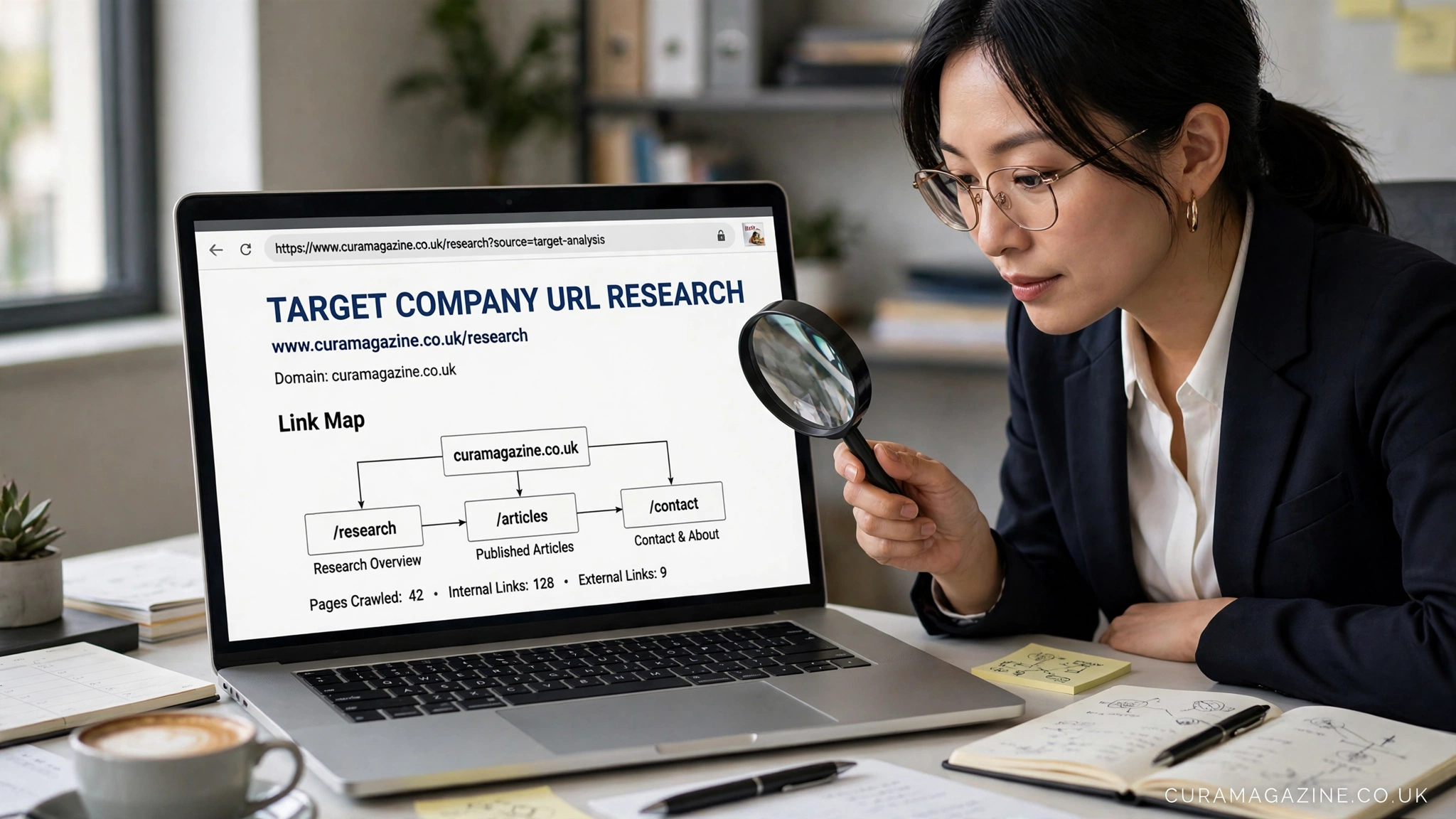
Finding the official website of a target company is one of the most important steps in business research, lead generation, competitor analysis, and corporate intelligence. In a digital-first business environment, a company’s website can provide valuable information about its products, services, leadership, locations, business operations, contact details, and market positioning. However, identifying the correct website is not always straightforward, particularly when multiple businesses share similar names or when search results include directories, social media profiles, and third-party listings.
Target company URL research is the process of identifying, verifying, and documenting the official website URL and domain associated with a specific business. The objective is not simply to find a website that mentions the company, but to establish which online destination genuinely represents the intended organization.
In 2026, this process is especially relevant for sales professionals, marketing teams, researchers, recruiters, investors, and procurement specialists who rely on accurate company information. A verified company URL helps researchers collect reliable data, reduce duplicate records, improve outreach accuracy, and build a stronger foundation for business decisions.
What Is Target Company URL Research?
Target company URL research refers to the systematic process of finding the correct website address for a selected business and checking whether that address belongs to, or is officially associated with, the intended company. It typically involves searching for the business name, reviewing official sources, examining domain details, and comparing information across multiple records.
A URL, or Uniform Resource Locator, is the complete address used to access a specific resource on the internet. For example, https://www.example.com/about is a URL, while example.com is the domain name and /about identifies a particular page within that website.
The distinction between a URL and a domain is important in company research. A business may use several URLs for different pages, regional websites, product lines, or customer portals, but researchers generally need to identify its primary official website first. Additional domains should be documented separately when they serve a clear business purpose.
Target company URL research therefore combines search techniques with verification methods. A strong result should be supported by evidence connecting the website to the correct legal entity, commercial brand, or operating business rather than relying on a matching name alone.
Why Is Finding the Official Company Website Important in 2026?
A company’s official website acts as a primary digital hub, providing valuable insights into its business activities, service offerings, latest updates, and available channels for customer interaction. For researchers, it can provide a starting point for building a company profile, identifying relevant contacts, reviewing product offerings, and understanding the organization’s commercial activities.
Accurate website identification is particularly important in B2B lead generation. If a sales team associates the wrong domain with a prospect, it may research the wrong business, create an inaccurate customer record, or direct its outreach to an unrelated organization. These errors can waste time, reduce data quality, and damage professional credibility.
Official website verification also supports competitor intelligence and market research. Researchers can use confirmed websites to review published product information, service categories, geographic coverage, company announcements, and publicly identified partnerships. This creates a more consistent foundation for comparing businesses across the same industry.
In addition, a verified domain can help researchers locate official email formats, careers pages, investor relations information, and customer support channels. However, a domain match alone does not prove that a particular email address is active or that an individual is authorized to represent the company; those details require separate verification.
Understanding Company URLs and Domain Names
Before beginning company URL research, it is useful to understand the basic components of a web address. This makes it easier to distinguish an organization’s primary domain from a subdomain, a specific webpage, or an unrelated third-party listing.
What Is a Domain Name?
A domain name is the recognizable web address associated with an internet resource. It allows users to access websites through readable names instead of having to remember numerical IP addresses.
For instance, in the URL https://www.example.com/contact, example.com represents the main domain, www serves as a subdomain, and /contact specifies the path to a particular page on the website. The protocol, https://, indicates how the browser connects to the website.
Domain names can also include different endings, known as top-level domains. Common examples include .com, .org, .net, and country-code endings such as .uk or .pk. A company’s domain ending may provide context, but it does not independently prove the company’s location, ownership, or legitimacy.
What Is an Official Company URL?
An official company URL is a web address that the business itself uses or formally identifies as an authorized online destination. It may lead to a corporate homepage, a regional website, a dedicated brand website, or a legitimate business unit within a larger organization.
Certain businesses function as subsidiaries of larger corporations, conduct their activities under alternative brand names, or manage separate websites dedicated to specific products, services, or business divisions. In these cases, the correct URL depends on the research objective and the relationship between the business name and the website.
Researchers should record the company’s main verified website independently, distinguishing it from affiliated web pages, social media profiles, third-party marketplaces, and external business listing directories. This distinction makes company records easier to verify and helps prevent unrelated websites from being incorrectly recorded as official sources.
How Does a Website Differ from a Domain Name?
A domain is the name used to locate an internet resource, while a website is the collection of pages and content accessible through that domain or related web addresses. A single company may operate several websites using different domains, and a single domain may host many different pages.
For instance, a business might maintain a corporate website, a separate online store, a regional portal, and a careers website. These destinations may all be legitimate, but they do not necessarily serve the same purpose.
When building a target company database, researchers should record the primary corporate domain first and add secondary URLs only when they are relevant. If the research focuses on a particular brand, product, or regional subsidiary, the most relevant official URL may differ from the parent company’s main website.
How to Find the Official Website of a Target Company
Finding a company’s website becomes more reliable when researchers follow a structured process. Instead of selecting the first search result, they should gather potential matches, compare identifying details, and confirm the relationship between the website and the target business.
Step 1: Search the Exact Company Name
Begin by searching for the company’s full name using a reputable search engine. Use quotation marks around distinctive names when appropriate to help narrow results to pages containing the exact phrase.
For example, a search for "Northstar Industrial Solutions" may reveal the company’s official website, business directories, professional profiles, press coverage, and registry records. These results provide possible leads, but they should not all be treated as equally authoritative.
If the company name is common, add relevant identifiers such as the city, country, industry, product category, or known parent organization. This helps distinguish the intended business from other organizations with similar names.
The goal of this first step is to create a shortlist of possible websites rather than immediately declaring a result correct. The most promising candidates should then be checked against additional sources.
Step 2: Use Search Operators to Narrow the Results
Search operators can make company URL research more efficient by restricting results to specific phrases, domains, or types of pages. These techniques are particularly helpful when the target company has a common name or appears in many unrelated search results.
Searching for the company name alongside terms such as official website, contact, about us, or company profile can help locate pages that provide direct business information. Adding a city or industry keyword may further narrow the results.
Researchers can also use the site: operator to search within a known domain. For example, site:example.com contact searches for relevant pages indexed from that domain, while site:example.com "company name" can help investigate whether the domain contains information about the intended business.
These search techniques improve discovery, but they do not independently verify ownership. A page can be indexed under a misleading, outdated, or unrelated domain, so important findings should still be checked against official and independent evidence.
Step 3: Check the Company’s Official Social Media Profiles
Many businesses link to their websites from their verified or established profiles on professional and social platforms. These links can provide useful evidence when a company’s official domain is difficult to locate through search engines alone.
Look for the company name, branding, business description, location, and links to external websites. Compare these details with the candidate domain and check whether the profile appears to represent the same organization.
A social media profile should be treated as supporting evidence rather than automatic proof of ownership. Profiles can be impersonated, abandoned, or maintained by third parties, and verification labels may have different meanings across platforms.
Whenever possible, compare the website link with additional sources, such as official business records, published company documents, or established industry associations. Consistency across multiple credible sources increases confidence in the result.
Step 4: Review Business Directories and Corporate Listings
Business directories and corporate databases can help researchers discover company websites, especially when working with large lists of businesses. These resources may include company names, addresses, phone numbers, industry classifications, and links to websites.
Examples of useful sources include established industry directories, local chambers of commerce, professional associations, company information services, and government business registries. The most appropriate source depends on the country, industry, and type of organization being researched.
Directory listings should not automatically be considered definitive. Some records are user-submitted, generated from aggregated data, or maintained infrequently, which means the listed website may be outdated or incorrectly associated with the business.
Use directories to discover candidate URLs and compare them with the company’s own communications or other reliable records. If a directory listing conflicts with an official source, investigate the discrepancy before finalizing the company record.
Step 5: Verify the Website’s Company Information
Once a potential website has been identified, examine its internal pages for evidence that it belongs to the target business. The About, Contact, Company, Leadership, Legal, and Investor Relations sections are often useful starting points.
Compare the company’s name, business activities, headquarters, telephone number, products, and other relevant identifiers with information from independent records. If the website identifies a legal entity or parent organization, check whether that relationship matches the business being researched.
The absence of a physical address or detailed company profile does not automatically mean that a website is unofficial, since disclosure practices vary across industries and countries. However, unexplained inconsistencies, copied branding, contradictory contact details, or claims that cannot be supported by other evidence should prompt further investigation.
The strongest verification comes from a combination of direct website evidence and independent confirmation. A matching logo or company name alone is not sufficient to establish that the domain is genuinely associated with the intended business.
How to Verify Whether a Domain Is Official
Finding a likely website is only part of the process. Researchers must also assess whether the domain is legitimately connected to the company and whether the available evidence supports recording it as the official website.
Check Domain Registration Information
Domain registration records can provide technical and administrative details about a registered domain, including its registrar, registration dates, and certain registrant information where that information is publicly available.
For generic top-level domains, researchers can use the ICANN Lookup service to inspect available registration data. ICANN explains that registration information may include details about the domain holder, but some records are privacy-protected or otherwise limited. <Cite refs={[“turn670627search0″,”turn670627search8”]}/>
Registration information should be interpreted carefully. A domain may be registered through a web agency, hosting provider, parent company, or privacy service rather than directly under the operating company’s name.
Consequently, a registration record can support an investigation but may not independently prove that a website is official. Researchers should combine it with company-published links, corporate records, and other evidence connecting the domain to the target business.
Confirm the Relationship Between the Brand and Domain
A company’s legal name and public-facing brand do not always match its domain name. Some organizations use shortened names, abbreviations, acquired brand names, or distinctive commercial identities that differ from their registered corporate names.
For example, a company legally registered as Northstar Industrial Holdings Limited might operate a public website under a shorter brand name. The domain could still be official if reliable evidence establishes the relationship between the legal entity and the brand.
Look for explanations in company disclosures, legal notices, annual reports, trademark information, or official parent-company pages. These sources can help clarify whether the domain belongs to the target company, a subsidiary, a related brand, or an unrelated business.
When the relationship remains uncertain, record the domain as a candidate rather than treating it as confirmed. This is particularly important for due diligence, financial research, and large-scale company databases where incorrect associations can affect many downstream decisions.
Inspect HTTPS and Website Security
A website using HTTPS encrypts information exchanged between the browser and the website, helping protect data in transit. Researchers can check whether the browser establishes a secure connection and whether there are warnings about invalid certificates or suspicious redirects.
However, HTTPS does not prove that a website belongs to the company it claims to represent. Fraudulent and impersonation websites can also use HTTPS, so technical security must be considered alongside identity verification.
Pay attention to misspellings, unusual domain extensions, unexpected hyphens, misleading subdomains, and addresses that imitate familiar company names. A domain such as company.example.com belongs to the example.com domain hierarchy, not automatically to a separate organization named Company.
If the website requests credentials, payment information, or confidential documents, verify its identity through an independently confirmed communication channel before proceeding.
Check for Consistency Across Multiple Sources
Cross-verification is one of the most effective ways to improve the accuracy of target company URL research. Instead of relying on a single source, compare the candidate domain with several independent references.
For example, the company’s official social profile may link to the domain, a regulatory filing may identify the same corporate entity, and the website’s legal notice may list the corresponding company name. Together, these sources provide stronger support than a single search result.
Not every business will have extensive public documentation, especially small private companies or newly established organizations. In such cases, researchers should document the evidence available, note the limitations, and avoid assigning a higher level of certainty than the facts justify.
Best Tools for Target Company URL Research in 2026
Several types of tools can support company website discovery and verification. The most effective research process combines search engines, primary company sources, public records, and domain lookup services rather than relying on one tool for every task.
Search engines are useful for discovering candidate URLs, locating company announcements, and finding pages indexed under a business name. Search operators can narrow results, while targeted queries can help distinguish similarly named organizations.
Corporate registries and regulatory databases can help verify legal names, registration jurisdictions, and documented corporate relationships. Their coverage and available fields vary by country, so researchers should select the appropriate registry for the target company’s location and legal structure.
Domain registration lookup services provide technical registration details. For generic top-level domains, ICANN’s lookup service is a useful starting point for publicly available registration information. As ICANN explains in its current guidance, RDAP became the definitive source for generic top-level domain registration data on January 28, 2025, replacing the previously sunsetted WHOIS services for that purpose. <Cite refs={[“turn670627search8″,”turn670627search5”]}/>
Company websites, professional profiles, industry associations, and reputable business directories provide additional context. When using commercial lead databases or automated research platforms, researchers should verify important fields independently because aggregated business records can contain outdated or mismatched URLs.
Common Challenges in Finding Official Company Domains
One of the most common challenges is name duplication. Two businesses may operate under the same or similar names in different countries, industries, or legal jurisdictions, creating multiple plausible search results.
Another challenge is the difference between a brand name and its legal entity. Companies may change their names after mergers, acquisitions, rebranding, or restructuring, while older domains and directory listings remain online. Researchers need to establish which entity the research concerns and whether a newer website has replaced an older one.
Some companies operate multiple legitimate domains. A parent company may use one domain for corporate information and other domains for regional operations, ecommerce, product support, or specialized brands. In these cases, identifying the official corporate website does not necessarily mean that all other domains are unofficial.
Finally, some businesses have little online presence or use third-party platforms instead of maintaining a dedicated website. A lack of a clear official domain should be recorded as an unresolved research result rather than filled with an unrelated website or an invented URL.
Common Mistakes to Avoid During URL Research
A frequent mistake is selecting the first search result without checking its source or relevance. Search rankings can reflect advertising, search optimization, popularity, or other factors and should not be treated as proof that a result is the official company website.
Another mistake is confusing business directories with official websites. A directory may accurately describe a company and provide useful contact information, but its domain belongs to the directory operator rather than automatically to the business being researched.
Researchers should also avoid assuming that a domain is official simply because it contains the company’s name. Similar domains can belong to competitors, resellers, unrelated organizations, or impersonators, making independent verification essential.
Ignoring dates can create problems as well. A company may have moved to a new domain, merged with another business, or changed its brand identity, while old pages continue to appear in search results. Recording when the URL was checked helps future researchers understand how current the information is.
How to Document a Verified Company URL in a Research Database
Once the official website has been identified, the result should be recorded in a consistent format. A structured database makes it easier to review the evidence, update records, and distinguish confirmed URLs from unresolved candidates.
Useful fields include the target company name, legal entity name where available, official website URL, root domain, country, source used for verification, verification date, confidence level, and notes explaining any uncertainty. Additional domains can be recorded separately when they are relevant to the research objective.
For example, a hypothetical record might identify Northstar Industrial Solutions as the target company, https://www.example.com as a placeholder URL, example.com as the domain, and the official company profile plus a corporate registry entry as supporting evidence. In a real research database, the placeholder would be replaced only after the actual domain had been verified.
Confidence levels should reflect the strength of the evidence. A domain linked from a company’s established official profile and supported by consistent legal information may justify high confidence, while a domain found only in an unverified directory may require further checks.
Researchers should also maintain a review process for important records. Periodic checks can identify domain changes, broken websites, rebranding, acquisitions, and other developments that make an earlier URL inaccurate.
Example of Target Company URL Research
Consider a hypothetical business named Greenfield Packaging Solutions. A researcher needs to identify its official website before adding the company to a B2B prospecting database.
The initial search returns three possible results: a website with a matching company name, a business directory listing, and a professional social media profile. Rather than selecting the first result, the researcher compares the company descriptions, locations, product categories, and available contact information across all three sources.
The professional profile links to the candidate website, and the website’s About page identifies the same business activities and location. A corporate registry record also confirms a legal entity with a compatible name, although the researcher checks whether the website’s legal notice establishes the relationship between that entity and the public-facing brand.
After reviewing the available evidence, the researcher records the candidate domain, the official URL, the sources used, and the date of verification. If the legal relationship cannot be established conclusively, the database records the domain as probable rather than confirmed and flags the record for further investigation.
This example illustrates how a repeatable verification process can reduce errors and create more reliable company research records.
Frequently Asked Questions About Target Company URL Research
What is target company URL research?
Target company URL research is the process of finding and verifying the official website address of a business. It typically involves searching the company name, reviewing its official pages, checking supporting records, and documenting the evidence used to establish the correct domain.
How can I find a company’s official website quickly?
Start by searching the exact company name alongside terms such as “official website,” “contact,” or the company’s location and industry. Then compare the most relevant results with company profiles, legal records, and other reliable sources before recording the URL as official.
How do I know whether a company domain is genuine?
Check whether the domain is linked from established company-controlled profiles or documents, whether its content identifies the correct business, and whether the available legal and contact information is consistent. Domain registration records can provide supporting information, but they may not independently prove company ownership.
What is the difference between a URL and a domain?
A URL is the complete address of a specific web resource, while a domain is the recognizable name used to locate a website. For example, https://www.example.com/about is a URL, and example.com is the domain.
Can I use domain lookup tools to verify company ownership?
Domain lookup tools can reveal available registration information, including the registrar and certain registration details. However, registrant information may be privacy-protected or associated with a third party, so the results should be combined with company records and other evidence.
What should I do if a company has no official website?
Check whether the business uses an established professional profile, a parent company’s website, an official marketplace page, or another verified online presence. If no official website can be established, record the URL as unavailable or unverified rather than assigning an unrelated domain.
Why is official URL research important for B2B lead generation?
Accurate company URLs help sales and marketing teams identify the correct business, review its services, find relevant contacts, and reduce duplicate or mismatched records. Better data quality can improve prospect research and make outreach more relevant.
How often should company URLs be verified?
Verification frequency depends on the purpose of the database and the importance of each record. Companies involved in active sales campaigns, due diligence, or ongoing monitoring may require more frequent checks, while lower-priority records can be reviewed periodically or when a significant business change is detected.
Conclusion
Target company URL research is a foundational part of reliable business intelligence in 2026. Finding a website that mentions a business is relatively easy, but confirming that the domain genuinely represents the intended company requires a more disciplined approach.
By combining targeted search techniques, official company information, corporate records, domain registration lookup services, and cross-source verification, researchers can identify accurate URLs and document the evidence supporting each result. This process helps reduce data errors, improve lead generation, and strengthen the quality of company profiles and research dossiers.
The most important principle is to prioritize verification over assumption. A carefully documented domain with clear supporting evidence is far more valuable than an unverified URL collected simply to complete a database field. When performed consistently, target company URL research becomes a practical foundation for accurate, transparent, and efficient business research.
