


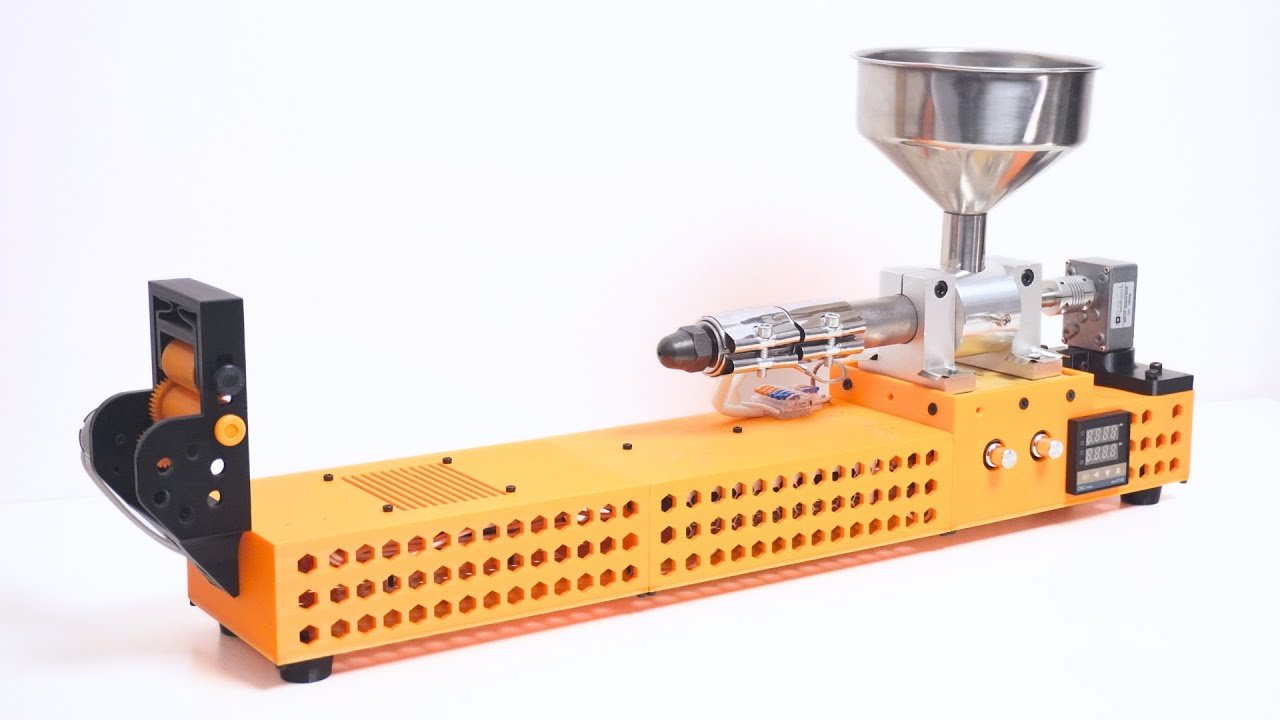
A filament recycler is a machine or system designed to process waste plastic, such as discarded 3D printing filament, failed prints, support structures, and plastic scraps, and convert it into reusable material. In many setups, the recycled plastic is processed into new filament that can potentially be used for future 3D printing.
As 3D printing becomes more popular, the amount of plastic waste produced by failed prints and unused material can also increase. A filament recycler provides a way to recover some of this material instead of sending it directly to waste.
The recycling process typically involves collecting plastic, sorting it by material, shredding it into smaller pieces, melting and extruding it, and producing a consistent filament. The quality of the recycled filament depends heavily on the cleanliness and composition of the input material as well as the accuracy of the recycling process.
What Is a Filament Recycler?
A filament recycler is equipment used to transform plastic waste into a form that can be reused, most commonly 3D printing filament. It is particularly relevant to filament-based additive manufacturing, where thermoplastic materials can be heated and reshaped.
A typical recycling setup may include a plastic shredder, heating and extrusion system, cooling mechanism, and filament-winding system. Some compact machines combine several of these functions into one unit.
The purpose is not simply to melt plastic. Producing usable filament requires controlling factors such as temperature, extrusion rate, diameter, cooling, and material consistency.
How Does a Filament Recycler Work?
The filament recycling process begins by collecting suitable plastic waste. This may include failed 3D prints, support material, test pieces, leftover filament, and other compatible thermoplastic scraps.
The collected material is then sorted according to its plastic type and, where appropriate, color. Mixing incompatible plastics can produce inconsistent or unusable material, so proper separation is an important part of the process.
Step 1: Collecting Plastic Waste
The first stage is gathering plastic waste from 3D printing or other suitable sources. Failed prints and support structures are common sources of recyclable material.
It is generally important to keep different materials separate. For example, PLA should not automatically be mixed with PETG or ABS simply because they look similar.
Step 2: Sorting the Material
After collection, the plastic is sorted according to material type, color, and condition. Contaminated or unsuitable pieces may need to be removed.
Sorting helps maintain more consistent properties in the recycled filament. Keeping colors separate can also make it easier to produce predictable-looking filament.
Step 3: Shredding
The sorted plastic is fed into a shredder or granulator that breaks it into smaller pieces. These pieces are often called plastic flakes or pellets after processing.
Smaller pieces are easier to feed into an extrusion system because they can be heated and melted more consistently.
Step 4: Drying
Some thermoplastics can absorb moisture from the surrounding environment. Excess moisture can negatively affect the extrusion process and the quality of the resulting filament.
For this reason, appropriate drying and storage can be important before the material enters the extruder. The required drying conditions depend on the particular plastic being processed.
Step 5: Melting and Extrusion
The shredded plastic is fed into an extruder, where controlled heat softens or melts the material. A screw mechanism then pushes the molten plastic through a specially sized opening.
The material exits the extrusion die as a continuous strand. Maintaining consistent temperature and extrusion conditions is essential for producing filament with a stable diameter.
Step 6: Cooling
The newly extruded filament needs to cool and solidify. Cooling may be achieved through controlled air or water-based systems, depending on the equipment and material.
The cooling process needs to be controlled carefully because uneven cooling can affect filament dimensions and shape.
Step 7: Measuring and Winding
After cooling, the filament is typically measured to check its diameter. A winding system then collects the finished filament onto a spool.
Consistent winding helps prevent tangles and makes the recycled filament easier to use in a 3D printer.
Types of Filament Recyclers
Filament recycling systems vary considerably in size, complexity, and automation. The appropriate type depends on the amount of waste being processed and the quality requirements of the recycled material.
Manual Filament Recycling System
A manual system usually requires the operator to perform several stages separately. Plastic may be manually sorted and shredded before being fed into an extrusion machine.
This approach can be suitable for hobbyists, makers, and small-scale experimentation. It may also provide greater control over individual processing stages, although it requires more hands-on work.
Desktop Filament Recycler
A desktop filament recycler is a compact system designed for smaller-scale use. It may combine shredding, extrusion, cooling, and winding functions in a relatively small setup.
This type can be useful for home workshops, educational environments, and makerspaces where plastic waste is generated in moderate quantities.
Automated Filament Recycling System
An automated recycling system reduces the amount of manual intervention required during processing. Depending on the equipment, automation may control extrusion temperature, filament diameter, cooling, and winding.
These systems can be useful for larger operations where consistency and production efficiency are important.
Industrial Plastic Recycling System
Industrial systems are designed to process much larger quantities of plastic waste. They can include high-capacity shredders, industrial extruders, advanced filtration systems, cooling equipment, and automated spool handling.
Such systems are generally intended for professional recycling operations rather than occasional home use.
Benefits of a Filament Recycler
One of the main advantages of filament recycling is that it can give certain plastic waste a second use. Failed prints and other suitable scraps can potentially be processed into material for future projects.
However, recycling does not guarantee that every piece of waste can be converted into high-quality filament. Material compatibility, contamination, repeated heating, and extrusion quality can all influence the final result.
Reduces Plastic Waste
A filament recycler can help divert suitable 3D printing waste from disposal. Failed prints, support structures, and other scraps can be collected and processed instead of immediately becoming waste.
This can be particularly useful for users and organizations that produce significant quantities of plastic through repeated prototyping and testing.
Makes Use of Failed Prints
Failed prints are an unavoidable part of many 3D printing workflows. Instead of simply discarding them, suitable failed parts can become feedstock for another recycling cycle.
This creates a more circular approach to handling certain thermoplastic materials.
Can Reduce Material Costs
If recycled filament is produced successfully, it may reduce the amount of new filament required for some projects. This can be especially valuable for users who generate substantial amounts of compatible plastic waste.
The actual cost savings depend on electricity use, equipment costs, labor, material loss, and the quality of the resulting filament.
Encourages Sustainable Manufacturing
Filament recycling can support efforts to use materials more efficiently. Rather than treating every failed print as unusable waste, users can explore ways to recover compatible plastic.
This approach can be part of a broader strategy that includes reducing print failures, optimizing designs, reusing materials, and responsibly managing waste.
Provides Greater Material Control
For makers and researchers, recycling can provide an opportunity to experiment with their own material-processing workflow. Users can study how different extrusion temperatures, cooling rates, and processing conditions affect the resulting filament.
This can be particularly valuable in educational and experimental environments.
Common Uses of a Filament Recycler
Filament recyclers can be used in several environments where thermoplastic 3D printing waste is generated.
Home 3D Printing
Hobbyists can use recycling systems to process suitable failed prints and scraps generated during personal projects. A compact setup may be enough for users who produce relatively small quantities of waste.
The recycled material can then potentially be used for future non-critical prints, depending on its quality and consistency.
Makerspaces
Makerspaces often operate several 3D printers and can generate significant quantities of failed prints and support material. A recycling system can provide a dedicated way to manage compatible plastic waste.
It can also serve as an educational tool for demonstrating material recycling and additive manufacturing.
Schools and Universities
Educational institutions can use filament recycling systems to teach students about plastics, manufacturing, engineering, sustainability, and 3D printing.
Students can observe how a discarded plastic object moves through several processing stages before becoming usable material again.
Prototyping Workshops
Design and engineering workshops can generate large quantities of test prints during product development. Recycling suitable thermoplastic waste can help reduce the amount of material sent to disposal.
However, recycled filament should be evaluated carefully before being used for prototypes where dimensional accuracy or mechanical performance is critical.
Materials Commonly Used for Filament Recycling
The suitability of a plastic for recycling depends on its chemical composition and the equipment being used. Common 3D printing materials such as PLA, PETG, and ABS can potentially be processed through appropriate recycling systems.
PLA is widely used in desktop 3D printing and is commonly encountered in recycling experiments. PETG and ABS can also be recyclable through suitable equipment, but they require processing conditions appropriate to their material characteristics.
Different plastics should generally be kept separate unless the recycling system and material formulation are specifically designed to handle mixtures. Mixing incompatible materials can result in poor extrusion and unpredictable properties.
Challenges of Making Recycled Filament
Producing good-quality recycled filament is more complicated than simply melting plastic and pulling it into a strand. The material must be processed under controlled conditions to achieve a reasonably consistent diameter and quality.
Repeated heating can also affect some plastics. Depending on the material and processing history, repeated thermal cycles may change its properties.
Contamination is another major challenge. Dust, labels, other plastics, additives, moisture, and foreign objects can interfere with extrusion and reduce the quality of recycled filament.
Filament Diameter Consistency
One of the most important quality factors is filament diameter. A 3D printer’s extrusion system expects filament to remain within an appropriate diameter range.
If the recycled filament varies significantly in thickness, the printer may extrude too much or too little material. This can result in inconsistent layers, under-extrusion, over-extrusion, or other print-quality problems.
For this reason, successful filament recycling often requires careful measurement and control during extrusion.
How to Choose a Filament Recycler
When selecting a filament recycler, consider the materials you plan to process and the quantity of plastic waste you generate. A small hobby setup may not require the same capacity or automation as a professional workshop.
Temperature control is particularly important because different plastics require different processing conditions. The machine should be capable of reaching and maintaining the temperatures required by the materials you intend to recycle.
The extrusion system, shredder capacity, filament diameter control, cooling method, winding mechanism, and overall maintenance requirements should also be evaluated.
Tips for Better Filament Recycling
Good material preparation can significantly improve the recycling process. Keep different plastics separated and remove contaminated or unsuitable material before shredding.
Dry materials appropriately when required, and store both raw and recycled filament in conditions that minimize moisture exposure.
It is also useful to monitor the diameter of the extruded filament throughout the process. Consistent measurement can help identify extrusion problems before an entire spool is produced.
Is Recycled Filament as Good as New Filament?
Recycled filament is not automatically equivalent to newly manufactured filament. Its performance depends on the original material, number of processing cycles, contamination, moisture, extrusion quality, and other factors.
For decorative objects, prototypes, educational projects, and other applications where exact material performance is not critical, recycled filament may be useful. For demanding engineering applications, the material should be tested carefully before use.
Manufacturers and professional users may also blend recycled material with virgin material to achieve specific performance or consistency requirements, provided the materials and process are compatible.
Is a Filament Recycler Worth It?
A filament recycler can be worthwhile for users who generate a large amount of compatible plastic waste and want to experiment with material recovery. It can be especially attractive for makerspaces, educational institutions, prototyping workshops, and sustainability-focused projects.
For occasional home printing, however, the cost and complexity of recycling equipment may outweigh the benefits. In such cases, reducing failed prints and following appropriate local plastic-recycling practices may be more practical.
Final Thoughts
A filament recycler provides a way to process suitable plastic waste from 3D printing and potentially turn it into reusable filament. The typical workflow involves sorting, shredding, drying, melting, extrusion, cooling, diameter control, and winding.
While recycling can reduce waste and provide opportunities to reuse materials, producing reliable filament requires careful material separation and process control. With the right equipment and workflow, filament recycling can become a useful part of a more efficient and sustainable 3D printing process.
