


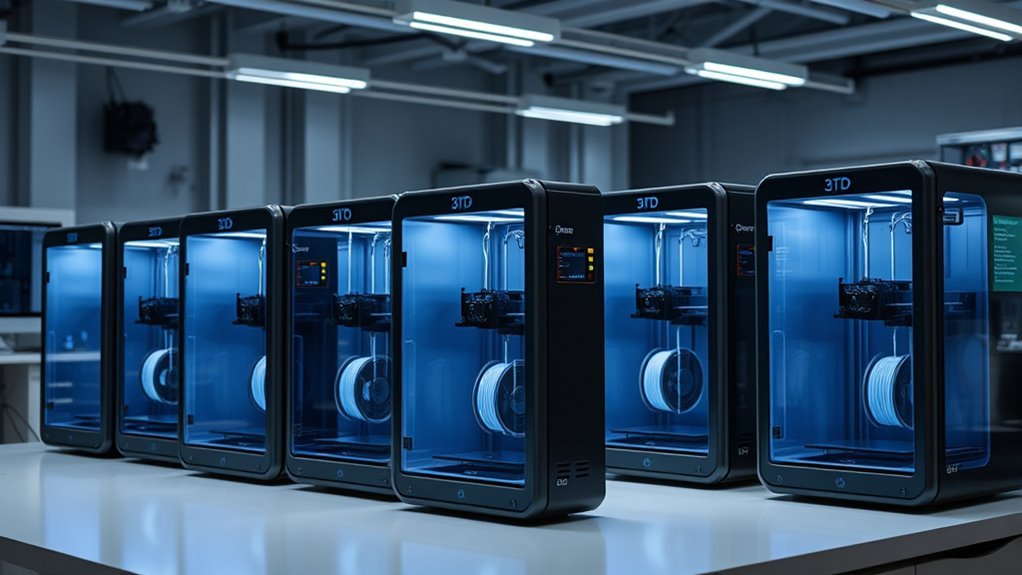
An enclosed 3D printer is a 3D printing machine that places the printing area inside a protective enclosure. Unlike open-frame printers, it surrounds the build space with panels or a cabinet, helping control the printing environment while reducing exposure to dust, drafts, noise, and moving components.
Enclosed 3D printers are available in different designs, sizes, and technologies, making them suitable for beginners, hobbyists, schools, workshops, offices, and professional manufacturing environments. Their controlled printing spaces can also be particularly useful when working with materials that benefit from stable temperatures.
What Is an Enclosed 3D Printer?
An enclosed 3D printer is a printer designed with a covered or fully surrounded build chamber. The enclosure may be made from acrylic, polycarbonate, glass, metal, or a combination of materials, depending on the printer model and its intended use.
The enclosure separates the printing area from the surrounding environment. This can help maintain more consistent conditions around the print and provide an additional layer of protection while the printer is operating.
Some enclosed printers are completely sealed, while others have partially enclosed frames or doors that allow access to the build platform. More advanced models may include temperature management, ventilation, filtration, lighting, cameras, and other monitoring features.
How Does an Enclosed 3D Printer Work?
The basic printing process is similar to that of other 3D printers. A digital model is prepared using slicing software, which converts the model into instructions that control the printer’s movements, temperatures, and material deposition.
During printing, the enclosure surrounds the build area while the printer creates the object layer by layer. Depending on the design, the chamber may help reduce temperature fluctuations and protect the print from external airflow.
This controlled environment can be especially helpful for materials that are more sensitive to temperature changes or drafts. However, the effectiveness of an enclosure depends on its construction, ventilation system, printer design, and the material being printed.
Types of Enclosed 3D Printers
Enclosed 3D printers can be categorized according to their construction, printing technology, and intended use. Understanding these types makes it easier to choose a suitable machine.
Fully Enclosed 3D Printer
A fully enclosed 3D printer has walls, a door, and a top or cabinet surrounding the primary printing area. This design provides strong protection from dust and accidental contact with moving components.
Fully enclosed models are often suitable for home offices, classrooms, workshops, and professional environments where a cleaner and more controlled workspace is desirable.
Partially Enclosed 3D Printer
A partially enclosed printer covers some sides of the machine while leaving other areas open. It offers some of the advantages of an enclosure without completely isolating the printing chamber.
This type can provide better airflow and easier access while still offering protection against drafts and accidental contact.
Temperature-Controlled Enclosed 3D Printer
Some advanced enclosed printers are designed to regulate the temperature inside the build chamber. Maintaining a more stable chamber environment can improve printing performance with certain engineering materials.
These printers are generally more expensive and are often intended for advanced hobbyists, engineering applications, prototyping, and professional production.
Desktop Enclosed 3D Printer
Desktop enclosed printers are compact machines designed to fit on workbenches, desks, or small workshop spaces. They are commonly used for educational projects, household objects, prototypes, models, and hobby printing.
Their relatively small footprint makes them practical when workspace is limited.
Industrial Enclosed 3D Printer
Industrial enclosed printers are larger systems designed for demanding production and engineering applications. They may include advanced chamber heating, automated calibration, filtration, monitoring, and material-management systems.
These machines are typically used by manufacturers, engineering companies, research facilities, and professional prototyping teams.
Benefits of an Enclosed 3D Printer
One of the main advantages of an enclosed 3D printer is the ability to create a more controlled printing environment. The enclosure can reduce the effect of external airflow and sudden environmental changes around the print.
This can be valuable when printing materials that are more susceptible to warping or other temperature-related issues.
Better Temperature Stability
An enclosure can help retain heat around the build area and reduce rapid temperature changes. Stable conditions can contribute to more consistent results when printing suitable materials.
The actual temperature control provided varies considerably between printer models, so an enclosure alone should not automatically be considered a heated chamber.
Protection From Dust and Drafts
Open printers are exposed to the surrounding environment, including dust and airflow from fans, windows, air conditioners, and movement around the workspace.
An enclosure creates a physical barrier that can reduce these external influences and help keep the printing area cleaner.
Improved Safety
The enclosure can reduce direct access to moving components, hot surfaces, and the active printing area. This can be particularly useful in homes, classrooms, offices, and shared workshops.
It is still important to follow the manufacturer’s safety instructions, because an enclosure does not eliminate the risks associated with high temperatures, moving parts, electricity, or printing materials.
Reduced Noise
The panels surrounding an enclosed printer can help reduce the amount of operating noise that reaches the surrounding room. The degree of noise reduction depends on the enclosure’s materials and construction.
For home offices or shared workspaces, even moderate noise reduction can make the printer more comfortable to operate.
Better Workspace Organization
An enclosed design can give a 3D printer a more organized and finished appearance. It can also help keep cables, moving parts, and printing components visually contained.
This makes enclosed printers attractive for professional offices, laboratories, classrooms, and dedicated maker spaces.
Uses of Enclosed 3D Printers
Enclosed 3D printers are used across many environments because they can combine controlled printing conditions with additional physical protection.
Prototyping
Engineers and designers can use enclosed printers to produce prototypes, test components, housings, brackets, mechanical parts, and product concepts.
A stable printing environment can be useful when producing prototypes from materials that require more controlled conditions.
Education
Schools, colleges, and training centers can use enclosed printers for STEM education, engineering projects, design classes, and practical demonstrations.
The enclosure can also provide an additional physical barrier between students and hot or moving components, although supervised operation remains important.
Home 3D Printing
Home users can use enclosed printers to create models, replacement parts, decorations, organizers, toys, tools, and customized objects.
The enclosed design can be especially convenient when the printer is located in a shared room or home office.
Engineering and Manufacturing
Professional teams can use enclosed 3D printers for rapid prototyping, functional testing, tooling, jigs, fixtures, and small-batch production.
More advanced machines may support engineering-grade materials and specialized temperature-control systems.
Architecture and Design
Architects and designers can create physical models of buildings, products, components, and other concepts. Enclosed printers can provide a practical solution for offices that need reliable desktop-scale model production.
Hobby and Maker Projects
Makers can use enclosed printers for mechanical projects, cosplay components, miniatures, electronics enclosures, replacement parts, and custom designs.
The printer’s capabilities will depend on its build volume, nozzle temperature, heated bed, chamber design, and supported materials.
Enclosed vs Open 3D Printer
The biggest difference between an enclosed and open 3D printer is the structure surrounding the build area.
An open-frame printer provides easy access, good visibility, and generally simpler construction. However, it leaves the print exposed to surrounding airflow, dust, and changes in room conditions.
An enclosed printer provides greater physical separation and can create a more stable environment. It may also be quieter and more suitable for shared spaces, although it can cost more and occupy more space.
Neither design is automatically better for every user. The best choice depends on the materials, print requirements, workspace, budget, and desired level of environmental control.
What Materials Can You Print in an Enclosed 3D Printer?
The materials supported by an enclosed 3D printer depend on its hotend temperature, heated bed, chamber design, and manufacturer specifications.
Common materials may include PLA, PETG, ABS, ASA, TPU, nylon, polycarbonate, and other engineering filaments. Not every enclosed printer can safely or effectively print all of these materials.
PLA generally does not require a controlled chamber, while materials such as ABS, ASA, nylon, and some other engineering plastics can benefit from reduced drafts and more stable temperatures.
When printing materials that may produce fumes or particles, appropriate ventilation, filtration, and manufacturer-recommended safety practices should be followed.
Features to Look for in an Enclosed 3D Printer
When choosing an enclosed 3D printer, consider the printer’s overall capabilities rather than focusing only on the enclosure.
Build volume is important because it determines the maximum size of objects that can be produced. A larger build area provides greater flexibility but usually requires more workspace.
Temperature capability is another major consideration. Check the maximum nozzle and heated-bed temperatures and determine whether the printer has an actively heated chamber if your intended materials require one.
Other useful features can include automatic bed leveling, filament sensors, flexible build plates, direct-drive extrusion, touchscreen controls, Wi-Fi connectivity, cameras, air filtration, and power-loss recovery.
Is an Enclosed 3D Printer Better for Beginners?
An enclosed 3D printer can be a good option for beginners, particularly when the printer has automatic calibration, simple software, reliable temperature control, and a user-friendly interface.
The enclosure can also make the machine feel more contained and organized in a home or educational environment.
However, beginners should not choose a printer solely because it is enclosed. Ease of use, print reliability, replacement parts, software support, maintenance requirements, and community support are equally important.
Limitations of Enclosed 3D Printers
Despite their advantages, enclosed 3D printers have some limitations. They can be larger and heavier than comparable open-frame models because of the additional panels, doors, and structural components.
They may also cost more, particularly when the enclosure includes active heating, filtration, cameras, or other advanced systems.
Heat management can also become important. Some materials benefit from warmer chambers, while others can be affected by excessive heat around components that were designed to operate at lower temperatures.
How to Choose the Right Enclosed 3D Printer
Start by identifying what you plan to print. If you mainly create decorative models and simple household objects, a basic enclosed desktop printer may provide everything you need.
If you intend to work with ABS, ASA, nylon, polycarbonate, or other demanding materials, pay closer attention to the printer’s chamber temperature, hotend capabilities, heated bed, build surface, and ventilation system.
You should also consider build volume, printing speed, automatic calibration, material compatibility, software, maintenance, replacement parts, and overall operating cost.
Tips for Using an Enclosed 3D Printer
Place the printer on a stable, level surface with enough space around it for maintenance and ventilation. Avoid positioning it where excessive heat, moisture, or direct sunlight can interfere with operation.
Use the recommended printing temperatures and material settings for each filament. Even with an enclosure, correct bed preparation, first-layer calibration, cooling, and slicing settings remain essential.
Keep the enclosure and build chamber clean, inspect moving components regularly, and follow the manufacturer’s maintenance schedule. If the printer includes a filtration or ventilation system, make sure it is maintained according to the manufacturer’s instructions.
Are Enclosed 3D Printers Worth It?
An enclosed 3D printer can be worth the investment for users who want a cleaner, more controlled, and protected printing environment. It is particularly useful for certain materials, shared spaces, professional workshops, educational environments, and advanced prototyping.
For users who primarily print PLA on a basic desktop machine, an enclosure may not provide enough additional value to justify a higher purchase price.
The right choice ultimately depends on the type of objects you print, materials you use, available workspace, safety requirements, and the level of environmental control you need.
Final Thoughts
An enclosed 3D printer provides a protected printing space that can help reduce drafts, dust, noise, and accidental contact with the active printing area. More advanced models can also provide greater temperature control and support demanding materials.
From home projects and education to engineering prototypes and professional manufacturing, enclosed printers can serve a wide range of applications. Choosing the right model requires looking beyond the enclosure itself and considering build volume, temperature capabilities, materials, reliability, safety features, software, and overall usability.
