


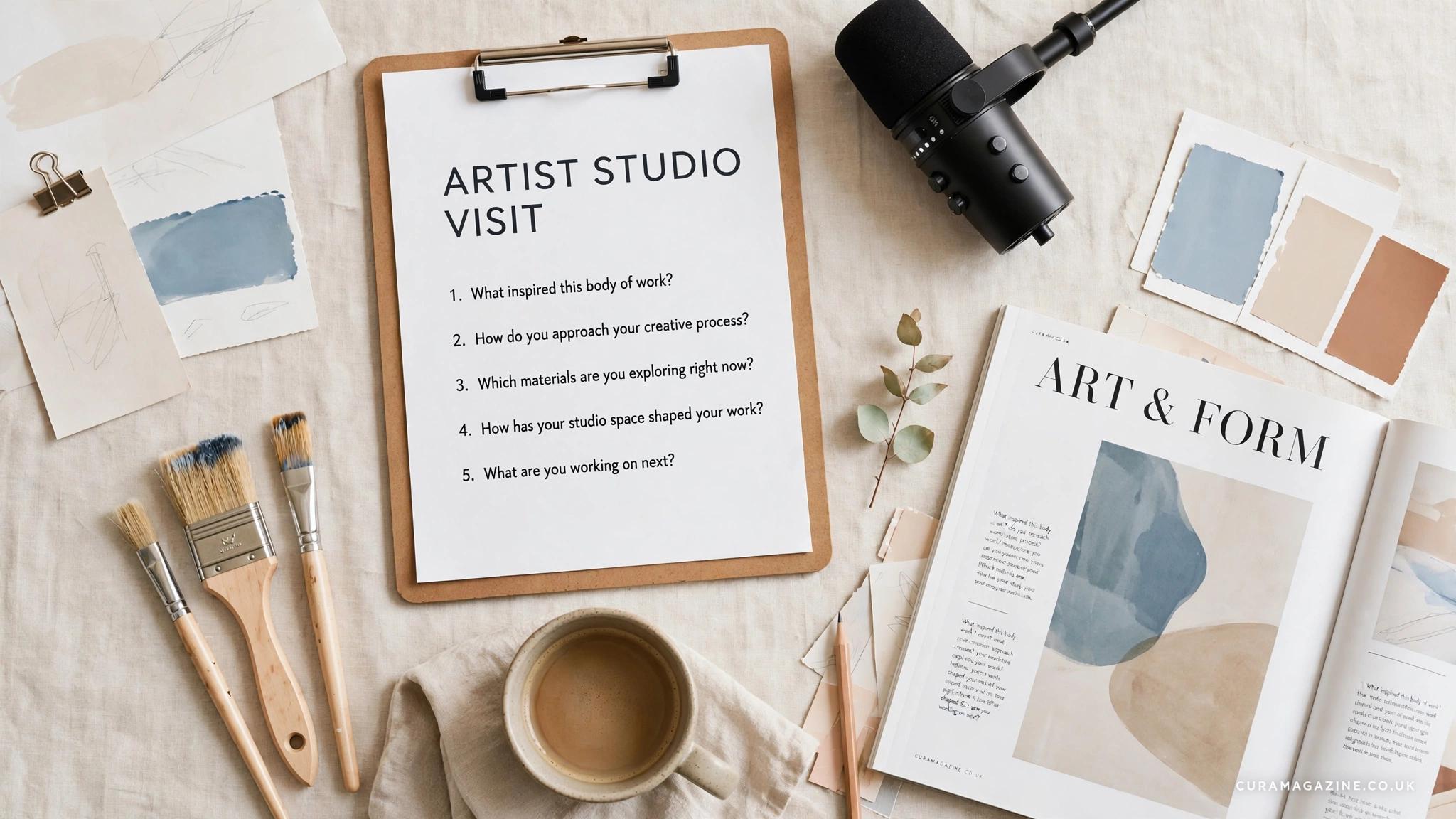
An artist studio visit offers a unique opportunity to understand contemporary art beyond the finished artwork. By entering the artist’s working environment, curators, art writers, collectors, and magazine editors can explore the ideas, materials, processes, and personal experiences that shape an artistic practice. Unlike a conventional gallery interview, a studio visit provides a closer look at how artworks develop, how creative decisions are made, and how an artist’s surroundings influence their work.
For contemporary art publications, an artist studio visit interview is an effective editorial format for presenting artists in a more personal and engaging way. It combines conversation, visual documentation, and critical reflection to create a feature that introduces readers to both the artist and the thinking behind their work. The most successful studio visit articles move beyond biography, revealing the questions, experiments, and experiences that give an artist’s practice its distinctive character.
This guide explores how to plan, conduct, photograph, and write an artist studio visit interview. It includes a professional interview structure, essential questions, practical advice for art writers, and a sample editorial format suitable for contemporary art magazines, independent publications, gallery websites, and artist-focused features.
What Is an Artist Studio Visit Interview?
An artist studio visit interview is a journalistic or editorial feature developed through a conversation with an artist in their working environment. The studio may be a dedicated workspace, a shared artist residency, a converted industrial building, a home studio, or another location where the artist develops and produces work. The setting provides visual and contextual information that can enrich the interview and help readers understand the relationship between the artist’s environment and creative process.
The format typically combines open-ended questions with observations about the studio, works in progress, materials, tools, sketches, reference images, and finished artworks. Rather than following a rigid question-and-answer structure throughout, the interviewer can use the surroundings to guide the conversation and encourage the artist to explain specific decisions. A half-finished painting, a collection of found objects, or an experimental material can often lead to a more revealing discussion than a general question about artistic inspiration.
For magazines such as CURA. Magazine and other contemporary art publications, studio visits can also provide an opportunity to connect individual practices with wider artistic and cultural conversations. A well-developed feature presents the artist’s own perspective while giving readers enough context to understand the work critically, without reducing the article to promotional copy.
Why Studio Visits Matter in Contemporary Art
Studio visits reveal aspects of artistic practice that may remain invisible in an exhibition. A gallery usually presents selected works in a carefully arranged environment, whereas the studio can reveal experimentation, revision, unfinished projects, discarded ideas, and the practical challenges involved in making art. These details help audiences recognise that artistic production is rarely a straightforward process from initial idea to completed object.
For curators and gallery professionals, a studio visit can also be an important part of researching an artist’s work. Seeing artworks in progress allows visitors to discuss materials, scale, installation requirements, and possible future directions. For writers and editors, the visit offers an opportunity to gather specific observations and quotations that make an article more informative and visually engaging.
Studio visits are equally valuable for readers who want to develop a deeper understanding of contemporary art. By learning how artists research subjects, experiment with techniques, and respond to uncertainty, audiences gain insight into the decisions that shape individual artworks. The resulting feature can make an unfamiliar practice more accessible while preserving the complexity and ambiguity that often make contemporary art compelling.
The Standard Format of an Artist Studio Visit Interview
A professional studio visit feature usually follows a clear editorial structure. The format should feel conversational and natural while ensuring that the article provides a coherent introduction to the artist, their working environment, and their artistic ideas.
1. Headline and Editorial Introduction
The headline should identify the artist and communicate the central theme of the interview. A strong title can refer to a particular material, recurring subject, working method, or conceptual concern that emerges during the visit.
Examples include Inside the Studio of [Artist Name]: Material, Memory and Transformation or Studio Visit: [Artist Name] on Painting, Process and Place. These formats work well for magazine features because they combine a clear subject with an editorial angle.
The introduction should briefly introduce the artist, explain why their practice is relevant, and establish the context of the visit. It may mention a recent exhibition, an ongoing project, a distinctive medium, or a central question explored through the artist’s work. Rather than summarising the entire interview, the opening should create enough interest for readers to continue.
2. The Studio Environment
The next section describes the artist’s workspace and its relationship to their practice. Useful details may include the arrangement of materials, the presence of unfinished works, the use of natural or artificial light, the scale of the room, or the way the artist organises tools and references.
Descriptions should be based on direct observation rather than assumptions about the artist’s personality. A crowded worktable does not automatically indicate a particular temperament, and a minimalist studio does not necessarily imply a minimalist artistic philosophy. The aim is to illustrate how the artist’s surroundings offer insight into their creative process, daily routines, and approach to making art.
This part can also serve as a natural starting point for the discussion. Asking the artist to explain a particular object, work in progress, or arrangement of materials often creates a more engaging opening than beginning with a broad question about their entire career.
3. Artistic Background and Influences
This section examines the personal experiences, creative influences, and significant encounters with art that have shaped the artist’s evolving approach and creative vision. Questions may address education, formative experiences, influential exhibitions, literature, music, film, cultural traditions, personal histories, or encounters with other artists.
The aim is not to reproduce a complete biography. Instead, the interviewer should identify the influences that have a clear relationship with the work being discussed. Specific examples are more useful than general statements about inspiration because they help readers understand how an influence becomes part of an artistic process.
4. Materials, Techniques and Creative Process
The creative process should be a central part of the studio visit. This section investigates how the artist develops ideas, selects materials, tests techniques, revises compositions, and decides when a work is complete. It may also explore the practical conditions of production, including access to equipment, the scale of the studio, collaboration with technicians, or the limitations of particular materials.
The strongest questions invite artists to describe actual decisions rather than simply state their preferred methods. Asking why a particular surface was chosen, what changed during the making of a work, or which experiment failed can produce more revealing answers than asking whether the artist enjoys their medium.
5. Current Projects and New Directions
A studio visit should provide insight into what the artist is working on now. This may include an upcoming exhibition, a new body of work, an experimental series, a research project, or a change in direction that has not yet become visible to the public.
The interviewer should clarify whether the artist is discussing confirmed projects, early ideas, or possibilities that remain uncertain. This distinction is particularly important when writing about future exhibitions or unpublished work, as creative plans can change between the studio visit and publication.
6. Closing Reflections
The final section can look towards the artist’s future interests, unresolved questions, and broader reflections on contemporary art. A thoughtful closing question should invite a considered answer rather than require a definitive statement about the artist’s career.
The article can conclude with a quotation that captures a central idea from the conversation, a description of an artwork in progress, or an observation that returns to the studio environment introduced at the beginning. This creates an editorial sense of closure without suggesting that the artist’s practice has reached a fixed conclusion.
Essential Artist Studio Visit Interview Questions
The following questions are designed for contemporary art interviews and can be adapted to painting, sculpture, photography, installation, digital art, performance, textiles, and interdisciplinary practice. They are prompts rather than a rigid questionnaire; the interviewer should select questions according to the artist’s work and allow the conversation to develop naturally.
A. Questions About the Studio and Working Environment
- How long have you been working in this studio, and what first attracted you to the space?
- How does the environment influence the way you make your work?
- Are there particular objects, tools, books, or materials in the studio that are especially important to you?
- How do you organise your workspace when working on several projects at once?
- Does your studio reflect the way you think, or is it primarily organised around practical needs?
- How important are light, sound, architecture, and the surrounding environment to your working process?
- Has the studio changed significantly as your practice has developed?
- If you could change one thing about your working environment, what would it be?
B. Questions About Artistic Background and Inspiration
- What first encouraged you to pursue art as a professional practice?
- Which early experiences continue to influence the work you make today?
- Were there particular artists, exhibitions, books, films, or musical experiences that changed how you understood art?
- How has your relationship with your chosen medium developed over time?
- Do personal experiences play a direct role in your work, or do they become transformed through the artistic process?
- How do cultural background, memory, place, or identity influence your practice?
- Are there subjects or questions that repeatedly return in your work?
- Has your understanding of what it means to be an artist changed since you began?
C. Questions About Materials and Technique
- What materials are you currently working with, and why did you choose them?
- How does a new work usually begin: with an image, an idea, a material, a question, or an experiment?
- Do you plan each work in advance, or does the process develop through making?
- How do you know when a material is suitable for a particular idea?
- Can you describe a recent experiment that changed the direction of a work?
- What role do mistakes, accidents, and unexpected results play in your process?
- How do you decide that an artwork is finished?
- Are there technical limitations that have become important to your artistic language?
- Do you work alone, or do particular projects require collaboration with other practitioners?
- What have you learned recently that has changed the way you approach your work?
D. Questions About Ideas and Artistic Meaning
- What central questions are you exploring in your current body of work?
- How do you develop the relationship between an artwork’s visual form and its underlying ideas?
- Are there particular social, political, historical, or environmental subjects that inform your practice?
- How much do you want viewers to understand about the ideas behind your work?
- Do you think about the audience while making an artwork, or does that relationship develop later?
- How do you balance personal expression with broader cultural questions?
- Are there meanings in your work that have emerged unexpectedly after a piece was completed?
- What would you like viewers to notice when they spend time with your work?
E. Questions About Current Projects and Future Directions
- What are you working on in the studio at the moment?
- How does your current project differ from your previous work?
- Is there a new material, technique, or subject you are interested in exploring?
- How do you decide which ideas deserve a longer period of investigation?
- Are there projects you have wanted to develop but have not yet had the opportunity to realise?
- What challenges are you encountering in your current work?
- How do you see your practice evolving over the next few years?
- Is there a question you are interested in exploring but have not yet found a way to address?
F. Questions About the Contemporary Art World
- How do you understand your work in relation to the wider contemporary art scene?
- Has the way your work is exhibited influenced the way you make it?
- What role do galleries, curators, collectors, and art publications play in the development of your practice?
- How important are artist-run spaces and independent exhibitions to emerging artists?
- Has digital culture changed how you make, document, or share your work?
- What challenges do artists face when trying to sustain a long-term practice today?
- Are there artists or creative communities whose work you think deserves greater attention?
- What would you like to see change in the contemporary art ecosystem?
How to Conduct a Successful Studio Visit
Research the Artist Before Arriving
Preparation allows the interviewer to move beyond questions that can be answered through a short biography or website. Review the artist’s portfolio, previous interviews, exhibition history, artist statements, and recent projects. Identify recurring themes and note any changes in materials, subjects, or methods that could form the basis of a more specific conversation.
Prepare a flexible list of questions rather than a script that must be followed in order. This creates room for spontaneous discoveries while ensuring that important subjects are addressed. If the artist has recently produced a significant body of work, familiarise yourself with it before the visit so you can discuss particular pieces with confidence.
Observe Before You Ask
When you arrive, take a moment to look around the studio before beginning the formal interview. Notice the works in progress, the placement of materials, the use of space, and any details that appear particularly relevant to the artist’s practice. Ask permission before handling objects, opening sketchbooks, or photographing sensitive materials.
Observation should lead to questions rather than assumptions. If several versions of a painting are leaning against a wall, ask how the artist decides which direction to pursue. If a collection of found objects occupies a worktable, ask whether these materials are references, future components, or independent objects of interest.
Encourage Specific Examples
Broad questions can produce broad answers. Asking an artist about their inspiration may lead to a general description of influences, whereas asking what prompted a particular decision in a recent work can reveal a more detailed account of the creative process.
Follow-up questions are therefore essential. If an artist mentions a failed experiment, ask what happened and how it changed the work. If they refer to a book, historical event, or other artist, ask how that reference became relevant to the project. These details create a more informative interview and help distinguish the resulting article from a standard artist profile.
Allow Space for Uncertainty
Artists do not always have a definitive explanation for every decision they make. Some ideas emerge through experimentation, and their significance becomes clearer only after the work has developed. A productive interview makes room for uncertainty, contradiction, and changing interpretations rather than pressuring the artist to provide a fixed meaning for every artwork.
This approach is particularly important in contemporary art, where ambiguity and open-ended interpretation may be central to the practice. The interviewer’s role is to clarify the artist’s thinking without imposing a conclusion that the artist has not expressed.
Photography and Visual Documentation for a Studio Visit
Visual documentation is a major component of a magazine-style studio visit. A strong image selection should communicate the character of the studio, show the artist at work, and provide detailed views of the artworks discussed in the interview. Images should contribute information rather than simply decorate the page.
<text color=”secondary” size=”sm”>Suggested image sequence</text>
<box gap={3}> <row align=start gap={3}> <AsyncImage query=”contemporary artist working in their studio wide environmental portrait natural light” aspectRatio=”3:4″ width=”124px”/> <box flex=”1″ gap={1}> **1. The environmental portrait**
  A photograph of the artist within the studio establishes the setting and introduces the person behind the work. The image should feel natural and reveal something about the relationship between the artist and their working environment.
</box>
</row> <divider color=”subtle”/> <row align=start gap={3}> <AsyncImage query=”contemporary painter studio work in progress canvas easel paint materials documentary photography” aspectRatio=”3:4″ width=”124px”/> <box flex=”1″ gap={1}> **2. The artist at work**
  A photograph of the artist making, assembling, drawing, or examining an artwork provides insight into the physical process. Capture genuine activity where possible rather than relying entirely on staged gestures.
</box>
</row> <divider color=”subtle”/> <row align=start gap={3}> <AsyncImage query=”contemporary art studio close up paint texture sculpture material detail” aspectRatio=”3:4″ width=”124px”/> <box flex=”1″ gap={1}> **3. Material and process details**
  Close-up images of tools, surfaces, textures, sketches, and experimental materials help communicate aspects of the practice that may be difficult to describe in words.
</box>
</row> <divider color=”subtle”/> <row align=start gap={3}> <AsyncImage query=”contemporary artist studio several finished paintings leaning against wall exhibition documentation” aspectRatio=”3:4″ width=”124px”/> <box flex=”1″ gap={1}> **4. Finished works and works in progress*
  Photograph the artworks clearly, including enough context to communicate their scale and relationship to the studio. Record titles, dates, dimensions, and materials accurately.
</box>
</row> </box>
Before publication, confirm image credits, artwork captions, and reproduction permissions. If the studio contains unpublished works or confidential project materials, agree with the artist on which images may be used and whether any details should remain private.
How to Turn a Studio Visit Into a Magazine Feature
Writing the article begins with identifying the strongest idea to emerge from the visit. Rather than reproducing the conversation in chronological order, look for a central theme that connects the artist’s methods, ideas, and current projects. This might be an unusual material, a recurring interest in memory, a relationship with a particular location, or a tension between traditional technique and new technology.
The opening paragraph should establish the atmosphere of the studio while introducing the artist’s central concern. Specific details can make the setting vivid, but they should be accurate and relevant. A description of unfinished paintings, carefully arranged tools, or an experimental sculpture can create an immediate sense of place while leading naturally into the broader discussion.
The main body of the article should alternate between observation, explanation, and direct quotations. Quotations are most effective when they reveal the artist’s own language or offer an insight that would lose its character through paraphrasing. Use the surrounding prose to explain context, connect ideas, and guide readers between different aspects of the practice.
A strong ending returns to the central question of the interview or looks towards the artist’s next stage of development. It should leave readers with a deeper understanding of the work without attempting to summarise every point raised during the conversation.
Sample Artist Studio Visit Interview Format
The following structure can be adapted for a contemporary art magazine, gallery publication, independent art journal, or artist-focused digital feature.
Headline: Inside the Studio of [Artist Name]: Exploring [Central Theme]
Standfirst: A short introduction of approximately 30–50 words explaining who the artist is, what their practice explores, and why the studio visit is timely.
Opening scene: A short narrative passage introducing the studio and one or two significant visual details.
Artist introduction: A concise overview of the artist’s practice, background, medium, and relevant recent projects.
The studio and creative process: A discussion of the working environment, materials, methods, and decisions involved in making art.
Ideas and influences: An exploration of the concepts, references, experiences, and questions informing the work.
Current projects: A closer look at ongoing research, works in progress, upcoming exhibitions, or new directions.
Closing reflection: A final quotation or observation that captures the artist’s approach and leaves readers with a meaningful insight.
Image captions and credits: Accurate artwork titles, dates, media, dimensions where available, photographer credits, and reproduction permissions.
For a digital magazine, the interview may be presented as a question-and-answer feature with short editorial introductions between sections. For a print magazine, a more narrative approach can combine descriptive passages with selected quotations and full-page studio photography.
Common Mistakes to Avoid During an Artist Studio Visit
One common mistake is treating the visit as a promotional exercise rather than an opportunity for informed discussion. Although artists may want to share upcoming projects, the interview should provide more than exhibition dates, career milestones, and general statements about inspiration. Questions about decisions, materials, uncertainty, and research tend to produce a more distinctive editorial feature.
Another mistake is relying too heavily on abstract language. Contemporary art often involves complex ideas, but an article becomes difficult to follow when it uses theoretical terminology without explanation or specific examples. Writers should preserve the complexity of the artist’s thinking while using clear language that allows readers to understand the relationship between ideas and artworks.
Writers should also avoid interpreting the artist’s personality through superficial details in the studio. The presence of certain books, objects, or materials does not automatically establish their meaning. Ask the artist about details that seem relevant, verify factual information, and distinguish direct observation from interpretation.
Finally, do not overlook practical and ethical responsibilities. Obtain permission before photographing people or private materials, confirm quotation accuracy, respect agreed publication restrictions, and ensure that artwork credits are complete. These steps protect both the artist and the credibility of the publication.
Conclusion: Creating Meaningful Artist Studio Visit Interviews
An artist studio visit interview is one of the most effective ways to explore contemporary art through the combination of conversation, observation, and visual storytelling. By examining the artist’s environment, materials, influences, and working methods, the interviewer can reveal the processes and questions that shape the finished work. The format also offers an opportunity to introduce emerging and established artists to readers in a way that feels personal without sacrificing critical depth.
For art magazines, curators, writers, and independent publishers, the key to a successful studio visit lies in preparation, attentive observation, and thoughtful follow-up questions. The strongest interviews focus on specific examples, allow room for uncertainty, and connect the artist’s individual practice with wider conversations in contemporary culture.
Ultimately, a well-crafted studio visit does more than document where art is made. It helps readers understand how ideas become artworks, how creative practices evolve, and why the artist’s work matters within the broader contemporary art landscape.
Frequently Asked Questions
How long should an artist studio visit interview be?
A studio visit may last between 45 minutes and two hours, depending on the artist’s availability and the complexity of the practice. A published magazine feature can range from approximately 800 to 2,000 words, with longer formats suited to in-depth profiles and substantial visual documentation.
What are the most important questions to ask an artist?
Start with questions about the work currently in progress, the materials being used, and the ideas behind specific artistic decisions. Follow up with questions about influences, experiments, challenges, and future directions rather than relying only on general questions about inspiration.
Should a studio visit interview use a question-and-answer format?
Both question-and-answer and narrative formats work well. A Q&A preserves the conversational exchange, while a narrative feature allows the writer to combine quotations, studio observations, and contextual analysis. The best format depends on the publication’s editorial style and the nature of the interview.
What should a photographer capture during a studio visit?
Prioritise an environmental portrait, the artist working, material details, finished artworks, works in progress, and wider views of the studio. Confirm permissions and collect accurate captions and credits before publication.
How can an artist prepare for a studio visit?
Artists can prepare by identifying works they would like to discuss, making relevant materials accessible, considering current projects, and deciding whether any unfinished or private work should remain undocumented. There is no need to make the studio look artificially perfect; an authentic view of the working process is often more revealing.
What makes a studio visit interview suitable for an art magazine?
A strong magazine feature combines accurate reporting, thoughtful questions, specific observations, compelling quotations, and clear visual documentation. It introduces the artist’s practice while giving readers a meaningful understanding of the ideas and processes behind the work.
