


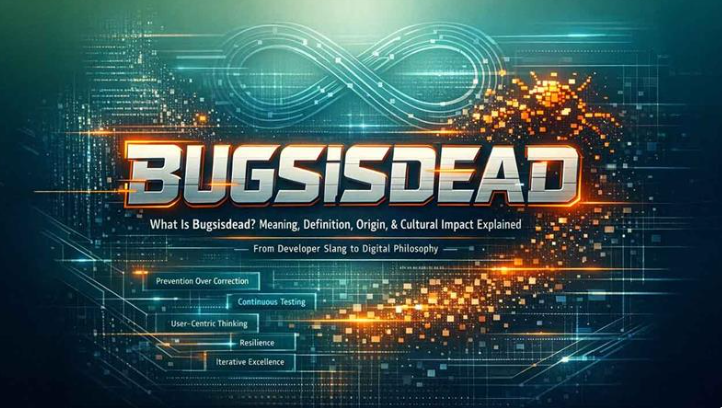
The term “Bugsisdead” is an internet-style phrase that appears to combine the word “bugs” with the statement “is dead.”
It is not a formally defined word in dictionaries or academic sources, but rather an expression that can take meaning from context, online usage, or creative interpretation.
In many digital spaces, such terms emerge as usernames, hashtags, meme phrases, or symbolic expressions.
Because of this, “Bugsisdead” can carry different meanings depending on where and how it is used.
Understanding it requires looking at both its literal structure and its possible cultural or symbolic interpretations.
Literal Breakdown of the Term
When analyzed literally, “Bugsisdead” can be separated into three parts: “bugs,” “is,” and “dead.”
This structure forms a simple declarative phrase suggesting that bugs are no longer alive or have been eliminated.
On the surface, it could refer to insects or pests being removed or destroyed.
However, literal interpretations are rarely the primary meaning in internet-born phrases like this.
Instead, the phrase is more often used symbolically or stylistically, especially in online communities where language is flexible and expressive.
Possible Digital and Gaming Context
In gaming and software communities, the word “bugs” often refers to glitches or errors in code.
From this perspective, “Bugsisdead” could symbolically mean that all bugs have been fixed or that a system is now stable.
Developers sometimes use playful or exaggerated phrases to indicate progress, such as saying a project is “bug-free” or “ready for release.”
In that sense, “Bugsisdead” may represent completion, debugging success, or the end of technical issues.
However, in real-world development, bugs are rarely ever completely eliminated, so the phrase is usually more humorous than literal.
Meme Culture and Internet Usage
Online communities frequently create phrases that are intentionally ambiguous, dramatic, or humorous.
“Bugsisdead” fits into this pattern, where meaning is shaped more by tone than by strict definition.
In meme culture, these kinds of expressions are often used in an ironic or aesthetic way, without requiring a clear or fixed meaning.
They may appear in captions, usernames, or comments where the goal is to evoke curiosity or a certain vibe.
Because of this, the phrase can carry different emotional tones—ranging from humor and sarcasm to seriousness or abstraction—depending on the context.
Symbolic Interpretation of “Bugsisdead”
Beyond literal and technical meanings, “Bugsisdead” can also be interpreted symbolically.
It may represent the idea of overcoming problems, eliminating obstacles, or achieving control over chaos.
“Bugs” can be understood metaphorically as issues, flaws, or unwanted disruptions in life or systems.
In this context, “dead” implies resolution, finality, or the successful elimination of those issues.
This symbolic interpretation is common in digital language, where users often turn simple phrases into expressions of achievement or mindset.
Usage as a Username or Online Identity
Many internet users adopt unique combinations of words like “Bugsisdead” as usernames or online identities.
Such names are often chosen for their originality, mystery, or aesthetic appeal rather than literal meaning.
In this context, the phrase may not be intended to communicate a specific message at all.
Instead, it functions as a digital identity marker that stands out across platforms like gaming networks, forums, or social media.
The lack of a fixed meaning actually makes it more versatile as a username, since it can be interpreted differently by different audiences.
Why Terms Like “Bugsisdead” Spread Online
Internet language evolves quickly because users constantly remix words, ideas, and cultural references.
Phrases like “Bugsisdead” spread because they are simple, memorable, and open to interpretation.
Such terms often gain traction through repetition in niche communities, gaming circles, or meme-sharing platforms.
Over time, they may develop multiple meanings depending on how widely they are used and in what context.
This flexibility is a key reason why modern internet vocabulary continues to expand in unpredictable ways.
Conclusion
“Bugsisdead” is not a formally defined term but rather an adaptable internet phrase that can carry different meanings depending on context.
It may refer literally to eliminated bugs, symbolically to problem-solving, or stylistically as a username or meme expression.
Its ambiguity is what makes it interesting, allowing users to interpret it in creative and personal ways.
Like many internet-born phrases, its meaning is shaped less by definition and more by usage, culture, and context.
