


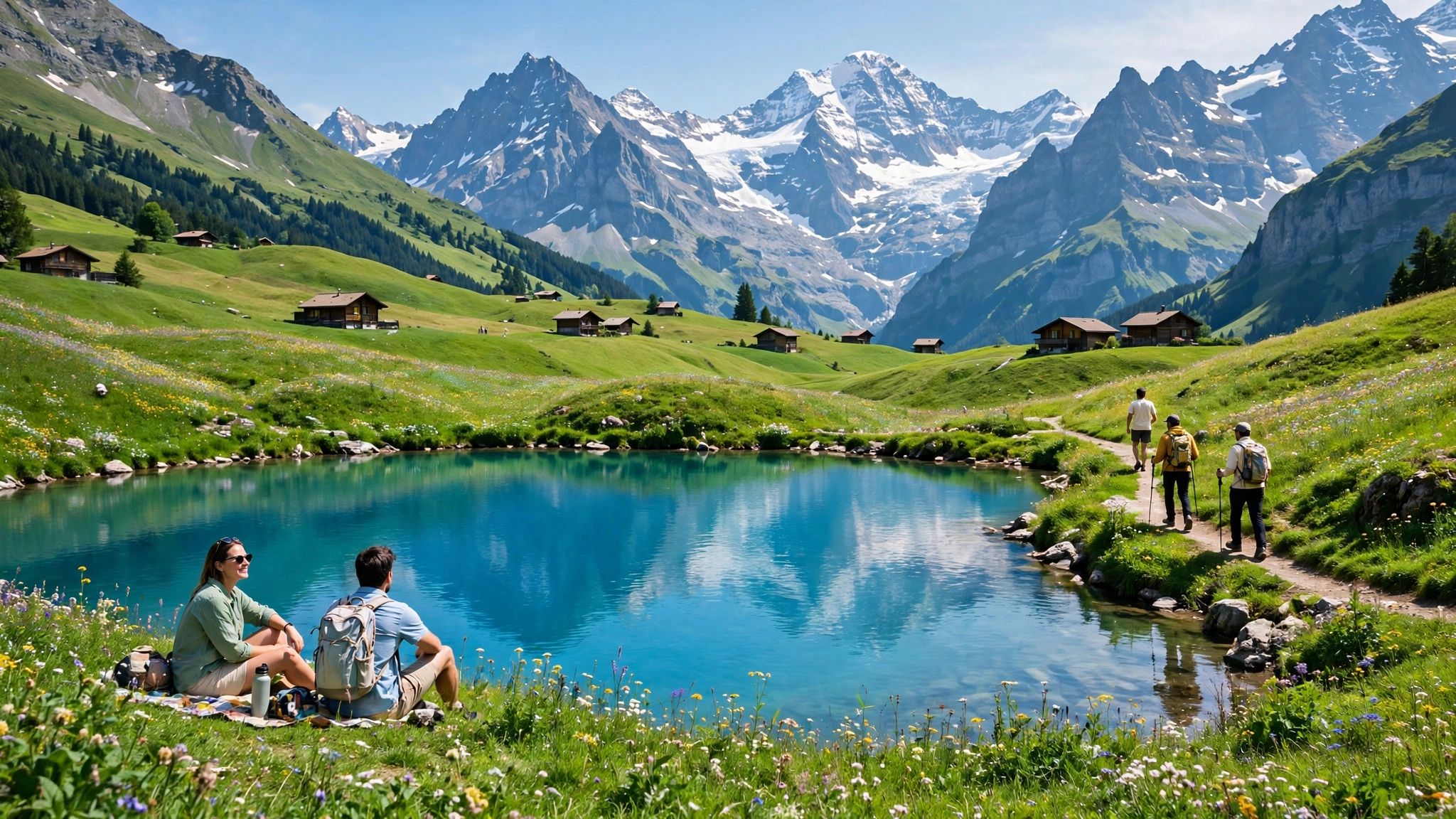
The traditional idea of a European summer holiday often involves beaches, hot weather and busy Mediterranean resorts. In 2026, however, an alternative is gaining attention: the Alpine summer holiday, with UK travellers increasingly looking towards the mountains for cooler temperatures, outdoor activities and a different kind of European escape.
The trend is particularly visible in online search behaviour. Google Trends data reported by Euronews shows that UK search interest for the term “alpine summer” increased by 82% year on year in 2026, as travellers looked for cooler European destinations during periods of intense summer heat.
What Is an Alpine Summer Holiday?
An Alpine summer holiday means spending the warmer months in mountain destinations rather than choosing a conventional beach resort. Switzerland, France, Austria and northern Italy are among the countries offering the classic Alpine combination of mountain scenery, lakes, hiking trails, cable cars and outdoor activities.
The concept has become closely connected with the wider “coolcation” trend, in which travellers deliberately choose destinations with more comfortable summer temperatures. Euronews describes “alpine summer” as a newer offshoot of this movement, reflecting growing interest in spending hot European summers at higher elevations.
For British travellers, the appeal is not necessarily about escaping summer altogether. Instead, the attraction is being able to enjoy sunshine and long days without spending an entire holiday in extreme heat.
Why Are UK Travellers Choosing the Alps in 2026?
One of the clearest reasons is the changing European summer climate. The 2026 summer brought significant heat across parts of Europe, encouraging travellers to reconsider traditional hot-weather destinations.
Switzerland experienced an exceptionally hot and dry first half of 2026, while its glaciers suffered substantial losses. Research reported in October found that Swiss glaciers lost 5.5% of their volume during 2026, highlighting just how intense conditions in the Alpine region have become.
That does not mean the Alps are uniformly cool, but altitude can provide a meaningful contrast to lower-elevation European destinations. Mountain resorts can offer cooler mornings, shaded hiking routes, alpine lakes and access to higher terrain where temperatures are generally lower.
The Rise of the “Coolcation”
The Alpine trend forms part of a broader change in how British consumers think about summer travel. Rather than automatically searching for the hottest possible destination, some travellers are prioritising comfortable weather and outdoor experiences.
Google Trends data cited by Euronews puts the growth in UK searches for “alpine summer” at 82% year on year, providing a useful indication of how quickly the terminology has entered the travel conversation.
The idea has also been promoted by mountain holiday specialists, which are expanding their summer programmes beyond traditional skiing. Heidi, for example, doubled its selection of walking destinations to 46 resorts across countries including France, Austria, Switzerland, Italy, Slovenia, Poland and Andorra.
Hiking Is Replacing the Beach Day
One of the biggest attractions of an Alpine holiday is the sheer variety of outdoor activities. Hiking is an obvious starting point, with routes ranging from relatively easy lakeside walks to demanding high-altitude trails.
Unlike a beach holiday where much of the day can revolve around the hotel, pool or coastline, a mountain trip can be structured around exploration. Travellers can spend the morning walking through alpine meadows, stop at a mountain restaurant for lunch and then take a cable car back towards a resort.
The result is a holiday that combines exercise, sightseeing and relaxation without requiring travellers to choose between an active break and a scenic one.
Alpine Lakes Are Another Major Attraction
The Alps are not simply about mountains. Their lakes have become an important part of the region’s summer appeal, particularly for travellers who want opportunities for swimming and waterside relaxation.
Switzerland is especially well positioned for this type of holiday, with numerous lakes and rivers accessible from towns and mountain resorts. National Geographic previously highlighted the growing international interest in Swiss summer travel and noted the popularity of wild swimming among visitors.
This creates an appealing alternative to a traditional Mediterranean beach. Instead of spending the day beside the sea, travellers can swim in a mountain lake surrounded by dramatic peaks.
Switzerland, Austria, France or Italy?
Spanning multiple European nations, the Alps offer British travellers a wide range of destinations to choose from. Switzerland is particularly attractive for travellers interested in panoramic rail journeys, mountain towns and highly developed public transport.
Austria offers a combination of traditional alpine villages, hiking, lakes and resort infrastructure, while the French Alps provide extensive mountain landscapes and established tourism infrastructure. Northern Italy adds a different cultural and culinary dimension, combining dramatic mountain scenery with Italian food and architecture.
Recent ski-travel data also suggests that British travellers’ Alpine preferences are becoming more diverse. WeSki’s 2026 research found that Italy gained share across every British skier segment it analysed, while France remained particularly important for groups and Austria gained ground among several traveller types.
The Alps Are Easier to Explore Without a Car
Convenient travel options also make Alpine destinations particularly attractive to holidaymakers from Britain. Switzerland in particular has an extensive public transport network connecting cities, lakes and mountain destinations.
Panoramic trains, cog railways, cable cars and funiculars can turn the journey itself into part of the holiday. National Geographic has highlighted Switzerland’s public transport network and the growing appeal of travelling through the Alps by train rather than relying entirely on a car.
For UK travellers concerned about the environmental impact or inconvenience of flying and driving, this can make a mountain holiday feel more accessible. It also allows visitors to combine several destinations without spending long periods behind the wheel.
Cost Is Still a Major Consideration
The Alpine trend does not mean British holidaymakers have stopped worrying about prices. Cost remains one of the most important factors shaping UK travel decisions in 2026.
A June YouGov survey found that 42% of UK adults said the cost of living was influencing their summer travel plans, while accommodation costs were cited by 32% and airfare prices by 29%. Some travellers responded by choosing domestic holidays, cheaper destinations or shorter trips.
That makes the Alps an interesting proposition rather than an automatically cheap one. Switzerland, in particular, can be expensive, while some Alpine destinations in Austria, France, Italy and Slovenia can offer different price points.
Travellers therefore need to compare accommodation, transport, lift or cable-car costs, food and activities rather than judging a destination solely by the price of the flight.
Short-Haul Travel Is Becoming More Important
The 2026 travel environment has also encouraged UK holidaymakers to look closer to home. ABTA reported in July that 84% of UK adults planning an overseas holiday were opting for short-haul travel for the coming months.
The Alps fit neatly into this preference. They are within relatively easy reach of the UK compared with long-haul destinations, while offering a very different experience from a conventional British summer break.
For travellers who want an international holiday but do not want a lengthy journey, Alpine destinations can therefore provide a practical compromise.
Mountain Holidays Offer More Than Hiking
Although hiking is central to the Alpine summer experience, the region offers considerably more. Visitors can cycle through mountain valleys, swim in lakes, take scenic trains, ride cable cars, visit historic villages or simply relax at a hotel overlooking the peaks.
Families can also find activities suited to different ages, while couples may prefer scenic rail journeys, spa hotels and lakeside restaurants. More adventurous visitors can add climbing, paragliding, canyoning or mountain biking to their itinerary.
This flexibility is important because it allows the same destination to serve different types of travellers. An Alpine holiday does not have to mean spending every day walking several miles uphill.
British Travellers Are Also Exploring Rural Alternatives
The interest in mountain destinations is part of a broader appetite for nature-focused holidays. Airbnb reported that searches among UK guests for domestic destinations increased by more than 11% year on year for summer 2026, with rural and countryside locations receiving particular attention.
That suggests the underlying trend is larger than simply “people want to go to the Alps.” British travellers appear increasingly interested in quieter environments, outdoor experiences and destinations where they can escape busy urban areas.
The Alps offer an international version of that experience, combining rural scenery with well-developed tourist infrastructure.
Is an Alpine Summer Better Than a Beach Holiday?
The answer depends on what a traveller wants from a holiday. A beach break remains attractive for people who prioritise warm sea temperatures, nightlife and effortless relaxation.
An Alpine holiday is better suited to travellers who want scenery, fresh-air activities, walking, cycling, swimming in lakes and a more varied daily itinerary. It can also appeal to people who find prolonged extreme heat uncomfortable.
The important change in 2026 is that travellers increasingly have both options in mind. The choice is no longer simply between one European beach destination and another; mountains are becoming part of the mainstream summer conversation.
What Is Driving the Search Interest?
Several trends appear to be working together. Hot European summers are encouraging people to search for cooler destinations, while the wider coolcation movement is giving travellers a new vocabulary for describing what they want.
At the same time, social media has made mountain scenery highly visible. Images of alpine lakes, cable cars, hiking trails and panoramic hotels can create demand for destinations that many travellers might previously have associated primarily with winter skiing.
The result is a shift in perception: the Alps are increasingly being marketed and discovered as summer destinations in their own right, rather than simply places to visit when there is snow on the ground.
What Should UK Travellers Consider Before Booking?
Anyone planning an Alpine summer holiday should consider altitude, weather, transport and activity levels before booking. Mountain weather can change rapidly, and a destination that looks warm and sunny in photographs can still require appropriate clothing and footwear.
It is also worth checking whether lifts, mountain railways and attractions operate during the dates of travel. Some facilities have seasonal opening periods, while hiking routes at higher elevations can be affected by snow or weather conditions.
Travellers should also consider the type of resort they want. Some Alpine destinations are lively year-round, while others become much quieter after the winter ski season.
The Environmental Reality of the Alps
There is an important contradiction at the heart of the Alpine summer boom. The same climate changes encouraging travellers to seek cooler mountain destinations are also putting severe pressure on Alpine ecosystems.
Swiss glaciers lost nearly a fifth of their ice volume over the five years to 2026, according to research reported in October. The 2026 loss alone reached 5.5%, making it one of the most severe years on record.
That means travellers visiting the Alps in 2026 are experiencing landscapes that are changing rapidly. Responsible tourism, public transport, respect for trails and careful management of natural areas are likely to become increasingly important as visitor numbers rise.
Final Takeaway
Alpine summer holidays are becoming one of the most noticeable European travel trends for UK travellers in 2026. Google Trends data cited by Euronews shows UK searches for “alpine summer” up 82% year on year, while travel-industry research points to continued interest in short-haul, rural and experience-focused holidays.
The attraction is easy to understand: mountains offer cooler environments, spectacular scenery, hiking, cycling, swimming, scenic rail journeys and a break from the crowded beach-resort model.
But the trend is about more than avoiding hot weather. It reflects a broader change in how UK travellers are approaching summer holidays in 2026, with comfort, nature, flexibility and outdoor experiences becoming increasingly important alongside price and convenience.
For travellers considering a European break this summer, the Alps therefore offer a compelling alternative to the traditional beach holiday — and the growing search interest suggests that more British holidaymakers are beginning to discover exactly that.
