


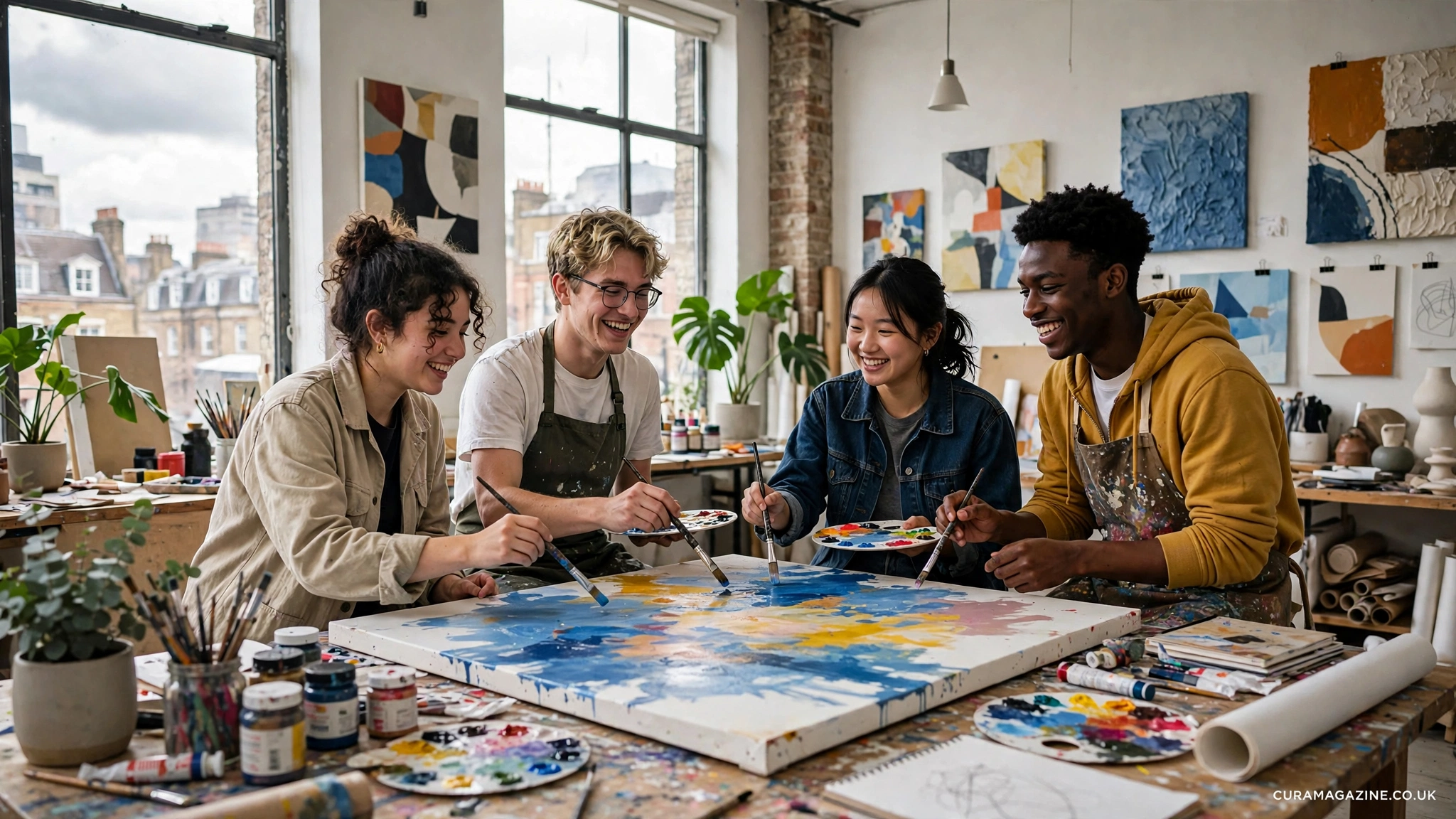
The UK contemporary art scene in 2026 is defined by experimentation, cultural diversity, and a growing willingness to challenge traditional ideas about what art can be. From painting and sculpture to moving images, immersive installations, photography, and interdisciplinary practice, emerging artists are developing distinctive visual languages that reflect the complexities of modern life. Their work explores identity, memory, technology, social change, environmental responsibility, and the relationship between personal experience and collective history.
Emerging UK Artists 2026 – Magazine Feature celebrates the creative voices contributing to this evolving landscape. Across London and regional art centres throughout England, Scotland, Wales, and Northern Ireland, artists are building new audiences, experimenting with unconventional materials, and exploring alternative ways to exhibit their work. Their growing visibility reflects the importance of independent galleries, artist-led initiatives, contemporary art publications, and exhibitions that give new talent opportunities to reach wider audiences.
The Changing Landscape of Contemporary Art in the UK
The British art scene has long been shaped by its ability to bring together different cultures, disciplines, and artistic traditions. In 2026, that diversity continues to influence the development of contemporary practice, with artists working across painting, sculpture, film, sound, textiles, performance, and digital media. Rather than following a single dominant style, emerging practitioners are creating individual approaches that combine personal narratives with broader cultural and political questions.
Major exhibitions and artist development programmes are helping audiences discover this diversity. The 2026 edition of New Contemporaries, for example, selected 26 emerging and early-career artists from across the UK for exhibitions at South London Gallery and MIMA in Middlesbrough. The programme includes a broad range of artistic approaches, demonstrating how contemporary practice extends across different media, communities, and geographical locations. <Cite refs={[“turn266037search1″,”turn266037search0”]}/>
Artists to Watch in 2026
Okiki Akinfe: Painting, Identity, and Contemporary Culture
Okiki Akinfe is among the artists attracting attention within the contemporary British art scene. Her painting practice brings together art-historical references, personal experience, and reflections on the cultural pressures surrounding identity and representation. Through carefully constructed compositions, she explores the relationship between individual experience and the wider visual culture that shapes how people understand themselves and others.
In 2026, Akinfe’s work has received visibility through exhibitions and presentations connected with London’s contemporary art scene, including Frieze Focus. Her practice illustrates how emerging artists can combine traditional painting techniques with contemporary concerns, creating works that engage with the history of the medium while offering a perspective grounded in present-day experience. <Cite refs={[“turn266037search3″,”turn266037search2”]}/>
Laurie Smith: Art, Memory, and Queer Histories
Laurie Smith is another artist to follow in 2026, particularly for work that examines the relationship between place, identity, memory, and the histories of queer communities. Her paintings draw on cultural and historical references to consider how spaces of social gathering can become vulnerable to surveillance, redevelopment, and changing urban environments. By connecting intimate experiences with wider social questions, her work encourages viewers to reconsider the histories embedded within familiar places.
Smith’s presentation at Frieze Focus 2026 brought attention to these concerns within an international art-fair setting. Her practice demonstrates the ability of painting to function as both a visual medium and a form of cultural investigation, revealing how overlooked histories can be revisited through contemporary artistic interpretation. <Cite refs={[“turn266037search2″,”turn266037search3”]}/>
Ella Fleck: Installation and the Politics of Digital Culture
Ella Fleck represents an experimental approach to contemporary installation, using sound, sculpture, and spatial experience to investigate the production and circulation of cultural narratives. Her work explores how technology, digital platforms, and commercial systems can shape perceptions of intimacy, identity, and human relationships. Rather than presenting these subjects through a single image or statement, her installations invite audiences to encounter the ideas through their physical and sensory surroundings.
Fleck’s participation in Frieze London 2026 highlights the continuing interest in ambitious, conceptually driven work by emerging artists. Her practice also illustrates how installation can expand the possibilities of exhibition-making, encouraging galleries and art fairs to consider experiences that move beyond conventional paintings and objects displayed on walls or plinths. <Cite refs={[“turn266037search2″,”turn266037search3”]}/>
Kat Anderson: Experimentation Across Creative Disciplines
Kat Anderson brings together visual art, music, and filmmaking within a multidisciplinary practice. Working across different forms of expression allows artists such as Anderson to explore the connections between image, sound, movement, and narrative, creating work that does not fit neatly into a single artistic category. This approach reflects a broader tendency among contemporary practitioners to treat disciplines as interconnected possibilities rather than fixed boundaries.
Anderson was included in the Contemporary Art Society’s Spring 2026 On Our Radar selection, which highlights emerging and mid-career artists developing distinctive practices. Such recognition can help audiences discover artists whose work moves between established categories and whose creative development benefits from opportunities to experiment across multiple media. <Cite refs={[“turn266037search4”]}/>
Maya Hewitt: Painting, Sculpture, and Imagined Worlds
Maya Hewitt’s practice explores the expressive possibilities of painting alongside ceramic sculpture, creating visual environments that bring together personal experience, memory, fantasy, and the rhythms of domestic life. Her approach reflects a wider interest in how artists can use multiple materials to create interconnected bodies of work, allowing objects and images to contribute to a shared atmosphere or narrative.
Her presentation within Frieze London’s Focus section in 2026 placed this combination of painting and sculpture within a platform dedicated to emerging international galleries and artists. Hewitt’s work illustrates how contemporary practice can move between intimate, familiar subjects and imaginative interpretations, encouraging viewers to reconsider the emotional and symbolic significance of everyday environments. <Cite refs={[“turn266037search2”]}/>
The Themes Defining Emerging UK Art in 2026
Identity, Representation, and Cultural Belonging
Questions of identity and representation remain central to contemporary British art. Artists are examining how cultural heritage, family histories, migration, gender, race, language, and community influence the ways individuals understand their place in society. These subjects often emerge through portraiture, painting, photography, textiles, installation, and archival research, with artists drawing on both personal experience and collective histories to develop their ideas.
The significance of this work extends beyond the representation of individual identities. By questioning familiar images and dominant narratives, emerging artists can open new discussions about visibility, belonging, and whose experiences are included in cultural institutions. Their practices encourage audiences to engage with British identity as a changing and multifaceted concept rather than a single, fixed cultural story.
Technology, Artificial Intelligence, and Digital Expression
Digital technology continues to influence how artists create and distribute their work. Interactive installations, digital photography, video, virtual environments, and AI-assisted processes offer new possibilities for experimentation, while raising questions about originality, ownership, authenticity, and the relationship between human creativity and automated systems. Emerging artists are increasingly able to move between physical and digital formats, responding to a world in which images and information circulate rapidly across multiple platforms.
The most compelling technology-driven work uses these tools to investigate meaningful questions rather than relying solely on novelty. Artists may examine online identity, algorithmic influence, surveillance, digital labour, or the changing boundaries between public and private life. In this context, technology becomes both a creative medium and a subject of critical inquiry, offering new ways to understand the conditions shaping contemporary culture.
Sustainability and Environmental Awareness
Environmental concerns are influencing the materials, methods, and subjects explored by artists across the UK. Some practitioners incorporate reclaimed materials, recycled textiles, or objects with previous histories into their work, while others investigate landscape, climate change, biodiversity, and the environmental consequences of industrial production. These approaches demonstrate how contemporary art can make ecological questions visible through material experimentation and visual storytelling.
Sustainability also involves examining the systems through which art is produced, transported, exhibited, and collected. Emerging artists may consider the environmental impact of materials, the reuse of exhibition structures, or the relationship between local communities and the natural environment. Such questions encourage a more reflective approach to artistic production, connecting the formal qualities of an artwork with the wider conditions in which it is made.
Politics, Community, and Social Change
Many emerging UK artists are exploring the social structures that influence everyday life, including economic inequality, housing, migration, labour, surveillance, and access to public space. Their work can combine documentary research with imaginative interpretation, using visual art to investigate subjects that are frequently simplified in public debate. Through exhibitions, participatory projects, and community-based practices, artists can create spaces in which different experiences are considered and discussed.
These practices also challenge the assumption that contemporary art must exist separately from everyday social realities. An artwork may function as a visual experiment, a historical investigation, a public conversation, or a means of preserving memories that might otherwise be overlooked. By connecting individual stories with broader structural questions, emerging artists contribute to a more expansive understanding of the role of art in contemporary society.
Beyond London: Regional Art Scenes and Creative Communities
Although London remains an influential centre for galleries, art fairs, and international cultural exchange, emerging artistic talent is not confined to the capital. Cities and towns across the UK support studios, independent galleries, artist-led spaces, university programmes, and regional exhibitions that provide opportunities for experimentation. These networks can allow artists to develop their practices within communities that have their own histories, creative resources, and cultural priorities.
The presentation of New Contemporaries at MIMA in Middlesbrough in 2026 is a significant example of this broader geographical reach. Bringing the exhibition to the North East created an opportunity to connect emerging artists with new audiences outside London, while recognising the importance of regional cultural institutions. A more geographically diverse art scene benefits both artists and audiences by encouraging dialogue between different places, experiences, and creative communities. <Cite refs={[“turn266037search0″,”turn266037search1”]}/>
The Role of Independent Galleries and Artist-Led Spaces
Independent galleries and artist-led organisations play an important role in supporting emerging artists, particularly when practitioners are developing experimental work that may not immediately fit the expectations of larger commercial institutions. These spaces can offer opportunities for first exhibitions, collaborative projects, informal exchange, and sustained relationships between artists and local audiences. They also contribute to the discovery of new practices by creating room for artistic risk and alternative approaches to presentation.
Contemporary art fairs can extend this visibility by connecting emerging artists and newer galleries with collectors, curators, critics, and international audiences. Frieze Focus 2026, for instance, brought together 35 presentations from younger galleries, providing a platform for artists working in a range of media and conceptual approaches. Such opportunities can introduce new audiences to emerging practices, although long-term artistic development continues to depend on sustained support, resources, and opportunities beyond a single exhibition. <Cite refs={[“turn266037search2″,”turn266037search3”]}/>
What the Future Holds for Emerging UK Artists
The future of emerging British art will be shaped by the relationship between creative ambition and the practical conditions in which artists work. Access to affordable studio space, exhibition opportunities, funding, mentorship, and professional networks can significantly influence whether artists are able to sustain their practices over time. As the cultural sector changes, independent organisations, public institutions, collectors, and publishers all have a role to play in supporting a wider range of voices and approaches.
At the same time, the diversity of artistic practice suggests that there is no single direction in which contemporary British art is moving. Painting continues to develop alongside installation, digital media, sculpture, performance, and interdisciplinary research, while artists draw on local histories and international influences to create distinctive work. The most important developments may therefore emerge not from a single movement, but from the ongoing exchange between different generations, disciplines, communities, and ideas.
Conclusion: The Emerging UK Artists Defining 2026
Emerging UK Artists 2026 represents a dynamic field of creative practice in which new perspectives are challenging familiar assumptions about art, identity, technology, and society. Artists such as Okiki Akinfe, Laurie Smith, Ella Fleck, Kat Anderson, and Maya Hewitt illustrate the range of approaches attracting attention across contemporary exhibitions and artist-development platforms. Their practices demonstrate how painting, installation, multidisciplinary work, and conceptual experimentation can offer fresh ways of understanding the cultural realities of the present.
For art enthusiasts, collectors, curators, students, and cultural readers, following emerging UK artists provides an opportunity to discover new ideas while understanding the networks that help creative practices develop. As exhibitions, independent galleries, and contemporary art publications continue to introduce new voices, the British art scene remains a space of experimentation and debate. In 2026, its significance lies not only in identifying artists to watch, but also in recognising the diverse creative communities shaping what contemporary art can become.
Frequently Asked Questions
Who are the emerging UK artists to watch in 2026?
Artists receiving attention through recent exhibitions and contemporary art programmes include Okiki Akinfe, Laurie Smith, Ella Fleck, Kat Anderson, and Maya Hewitt. This selection reflects a range of practices and is not a definitive ranking of the UK’s emerging artists.
What are the main trends in UK contemporary art in 2026?
Important themes include identity, cultural representation, digital technology, environmental awareness, social change, experimental installation, and multidisciplinary creative practice. Artists are exploring these topics through a broad range of materials and approaches.
Where can audiences discover emerging British artists?
Audiences can explore exhibitions at public galleries, independent art spaces, graduate shows, contemporary art fairs, and artist-led organisations. Programmes such as New Contemporaries and Frieze Focus provide useful starting points for discovering early-career talent.
Why are emerging artists important to the UK art scene?
Emerging artists introduce new perspectives, experiment with different materials and methods, and challenge established ideas about art and culture. Supporting their development helps maintain a diverse and evolving creative sector.
How can collectors and art enthusiasts follow new talent?
Following gallery programmes, contemporary art magazines, exhibition announcements, artist portfolios, and curated emerging-artist selections can help audiences discover new practitioners. Visiting exhibitions and reading interviews can provide valuable context for understanding the ideas behind their work.
