


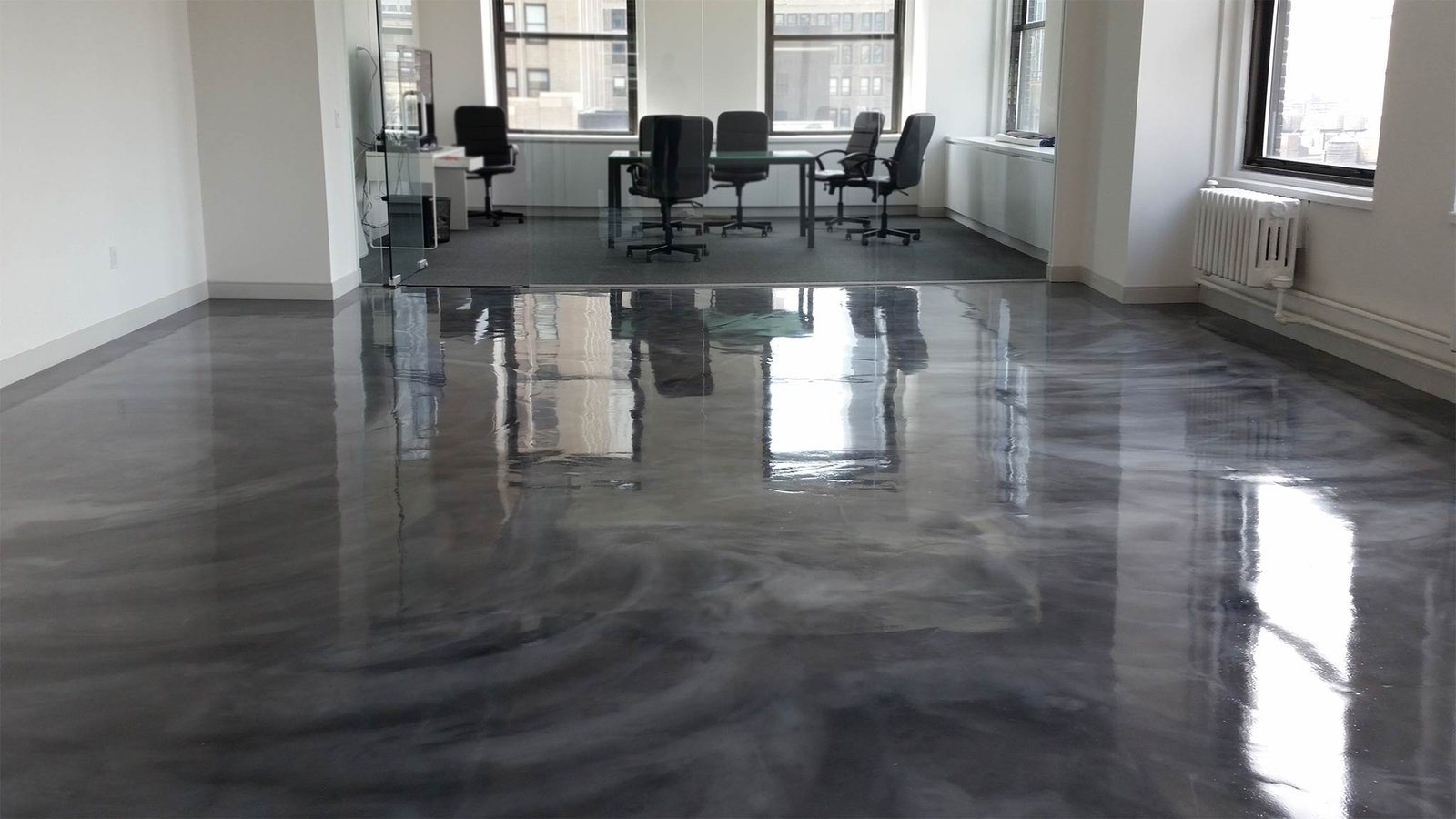
Epoxy flooring is a durable floor coating made by combining epoxy resin with a hardener to create a strong, bonded surface. It is widely used in garages, warehouses, workshops, commercial buildings, industrial facilities, kitchens, showrooms, and other areas where floors need to withstand heavy use.
Beyond durability, epoxy flooring is popular because it can create a smooth, attractive, and easy-to-clean surface. It is available in different colors, textures, finishes, and decorative styles, making it suitable for both practical and aesthetic applications.
This complete guide explains how epoxy flooring works, its major benefits, different types, typical costs, installation process, maintenance requirements, advantages and disadvantages, and factors to consider before choosing an epoxy floor.
What Is Epoxy Flooring?
Epoxy flooring is a resin-based floor coating system that chemically cures after two main components are mixed together. The resin and hardener react to form a rigid material that bonds to a properly prepared concrete surface.
Unlike ordinary paint, epoxy creates a thicker and more durable coating. Depending on the system selected, it can provide resistance against abrasion, chemicals, stains, moisture, and heavy foot or vehicle traffic.
The finished surface can range from a simple solid-color coating to a highly decorative floor containing metallic effects, colored flakes, quartz aggregate, or other design elements.
How Does Epoxy Flooring Work?
The performance of an epoxy floor depends heavily on the chemical reaction between the resin and hardener.
When the two components are mixed according to the manufacturer’s specifications, they begin curing and form a cross-linked polymer. Once fully cured, the material becomes a hard, bonded surface.
The concrete underneath is equally important. Dust, oil, grease, moisture, cracks, weak concrete, and other contaminants can interfere with adhesion.
For this reason, professional installers generally spend considerable time preparing the existing floor before applying the epoxy system.
Benefits of Epoxy Flooring
Exceptional Durability
One of the biggest advantages of epoxy flooring is its durability.
A properly installed system can withstand substantial foot traffic, equipment, vehicle movement, and everyday wear, making it suitable for garages, workshops, warehouses, and commercial environments.
The actual service life depends on the epoxy formulation, substrate preparation, installation quality, traffic level, and maintenance routine.
Easy to Clean
Epoxy creates a relatively seamless surface with fewer joints and gaps where dirt can accumulate.
This makes routine cleaning easier than many conventional flooring materials. Dust, spills, and debris can generally be removed with sweeping, mopping, or suitable cleaning products.
The smooth surface is particularly useful in environments where maintaining cleanliness is important.
Chemical Resistance
Certain epoxy systems provide strong resistance to oils, fuels, solvents, cleaning chemicals, and other substances.
This makes epoxy useful in garages, workshops, manufacturing facilities, laboratories, and commercial spaces.
However, chemical resistance varies between products, so the specific manufacturer’s technical data should be checked before selecting an epoxy system for chemical exposure.
Attractive Appearance
Epoxy flooring can go far beyond its traditional industrial appearance, offering stylish finishes that complement modern residential and commercial spaces.
It can be customized with different colors, decorative flakes, quartz aggregates, metallic effects, borders, logos, and gloss levels.
This flexibility allows the same general flooring technology to be used in a practical garage or a visually polished commercial showroom.
Moisture Resistance
A cured epoxy coating can provide an effective barrier against many forms of surface moisture.
This can be particularly beneficial for concrete floors exposed to occasional spills or humid environments.
However, moisture vapor coming through the concrete can cause adhesion problems or blistering. Testing and appropriate moisture management are therefore important before installation.
Improved Safety
Epoxy floors can be formulated with additives or textured aggregates that improve traction.
Anti-slip finishes are particularly useful in areas where water, oil, or other liquids may make smooth floors hazardous.
The right texture should be selected according to the environment because an extremely aggressive texture can make cleaning more difficult.
Types of Epoxy Flooring
Solid-Color Epoxy
Solid-color epoxy is one of the simplest options.
It creates a consistent colored surface and is commonly used in garages, workshops, storage areas, and commercial spaces.
It is a practical choice when durability and a clean appearance are more important than elaborate decorative effects.
Flake Epoxy Flooring
Flake flooring systems add decorative vinyl flakes to the coating, creating a textured and visually appealing finish.
The flakes create a textured appearance that can hide minor dirt and imperfections while adding visual depth.
These systems are particularly popular in residential garages and commercial spaces.
Quartz-Filled Epoxy
Quartz epoxy incorporates colored quartz aggregate into the flooring system.
This can increase texture, durability, and slip resistance while producing a decorative appearance.
Quartz systems are often used in demanding commercial and institutional environments.
Metallic Epoxy
Metallic epoxy uses specialized pigments to create flowing, three-dimensional visual effects.
Each installation can have a distinctive appearance because the pigments move and blend during application.
Metallic systems are commonly selected for showrooms, offices, retail spaces, restaurants, and residential interiors where appearance is a major priority.
Self-Leveling Epoxy
Self-leveling epoxy is formulated to flow across a prepared surface and produce a relatively smooth finish.
It can be useful for floors requiring a uniform appearance, although proper substrate preparation remains essential.
Epoxy Mortar Flooring
Epoxy mortar systems are among the heavier-duty epoxy flooring options.
They combine epoxy resin with graded aggregates to produce a thick and highly durable floor.
These systems can be appropriate for industrial environments that experience severe mechanical or chemical demands.
Epoxy Flooring Cost
The cost of epoxy flooring depends on several factors, so there is no single price that applies to every project.
Important variables include the floor’s size, existing concrete condition, preparation requirements, epoxy product, number of coats, decorative finish, labor costs, geographic location, and project complexity.
A basic coating over a clean and well-prepared concrete floor will generally cost less than a multi-layer system requiring extensive repairs and decorative finishes.
Before comparing quotes, make sure each contractor specifies what is included. A very low quote may exclude important preparation work, primer coats, crack repairs, topcoats, or moisture testing.
Factors That Affect Installation Cost
Floor Size
Larger floors can sometimes have lower costs per square foot because contractors can spread setup and labor expenses across a larger area.
Smaller projects may have a higher effective cost per square foot because minimum labor and mobilization charges still apply.
Concrete Condition
A clean, smooth concrete slab requires less preparation than damaged or contaminated concrete.
Cracks, holes, oil contamination, old coatings, uneven areas, and moisture problems can significantly increase preparation costs.
Epoxy System
Different epoxy products have different performance characteristics and price points.
Industrial-grade systems designed for heavy traffic and chemical exposure generally require a larger investment than basic decorative coatings.
Decorative Features
Solid colors are usually simpler than systems containing flakes, quartz, metallic pigments, multiple colors, borders, or custom designs.
The more complicated the appearance, the more labor and materials may be required.
Epoxy Flooring Installation Process
Step 1: Inspect the Concrete
The installation begins with an assessment of the existing floor.
The installer should look for cracks, damage, contamination, previous coatings, moisture problems, and areas of weak concrete.
This inspection helps determine which preparation and coating system will be appropriate.
Step 2: Prepare the Surface
Surface preparation is one of the most important stages of epoxy installation.
The concrete may be mechanically ground, shot blasted, or otherwise prepared to remove contaminants and create an appropriate profile for bonding.
Oil, grease, dust, loose material, and old coatings must be addressed before coating begins.
Step 3: Repair Damage
Cracks, holes, joints, and damaged sections may need to be repaired before applying epoxy.
The exact repair material depends on the size and nature of the defect.
Ignoring significant substrate problems can lead to visible imperfections or coating failure later.
Step 4: Apply Primer
Some epoxy systems use a primer to improve adhesion and help seal the concrete.
The primer must be applied according to the product’s specifications and allowed to cure appropriately.
Not every system uses the same sequence, so installation instructions should always take priority.
Step 5: Apply Epoxy
The resin and hardener are mixed in the correct proportions before being applied to the prepared floor.
Depending on the system, installers may use rollers, squeegees, or other specialized tools.
Multiple coats may be applied to achieve the desired thickness and performance.
Step 6: Add Decorative Elements
For decorative systems, flakes, quartz, metallic pigments, or other materials are incorporated at the appropriate stage.
The installation method varies depending on the desired appearance.
Step 7: Apply Topcoat
A protective topcoat may be added to improve abrasion resistance, chemical resistance, UV performance, or overall appearance.
The type of topcoat should be selected according to the conditions the floor will experience.
Step 8: Allow Proper Curing
The floor must remain undisturbed while the coating cures.
Drying and curing times vary according to the product, temperature, humidity, ventilation, and other environmental conditions.
Walking or driving on the floor too early can damage the new surface.
How Long Does Epoxy Flooring Last?
The lifespan of epoxy flooring varies considerably.
A professionally installed, high-quality system with appropriate substrate preparation can remain functional for many years, particularly in areas with moderate traffic.
Heavy industrial use, UV exposure, harsh chemicals, poor maintenance, moisture problems, and inadequate installation can shorten its service life.
Regular cleaning and prompt attention to damage can help maintain the floor’s appearance and performance.
Epoxy Flooring for Garages
Garages are among the most common residential applications for epoxy flooring.
The coating can create a clean surface that is easier to sweep and mop while providing resistance to many common automotive fluids.
Decorative flakes can also give a garage a polished appearance while helping disguise minor dirt.
Before coating a garage floor, however, check whether moisture is coming through the slab. A coating installed over a moisture-prone substrate may experience adhesion problems.
Epoxy Flooring for Commercial Spaces
Commercial facilities often use epoxy because of its durability and customizable appearance.
Retail stores, workshops, offices, restaurants, warehouses, and service facilities can choose different systems based on traffic and maintenance requirements.
For commercial applications, factors such as slip resistance, chemical exposure, cleaning requirements, fire regulations, and expected traffic should be considered during product selection.
Epoxy Flooring for Industrial Applications
Industrial floors often face much harsher conditions than residential floors.
Forklifts, heavy machinery, chemicals, impact, temperature changes, and continuous traffic can place substantial stress on the surface.
Industrial epoxy systems can be formulated for these demanding environments, but the correct system should be selected based on the actual operating conditions rather than simply choosing the thickest available coating.
Advantages and Disadvantages
Advantages
Epoxy flooring offers several important benefits, including durability, easy cleaning, customization, chemical resistance, and a seamless appearance.
It can also transform an ordinary concrete floor into a more polished and functional surface.
Disadvantages
Despite its advantages, epoxy is not suitable for every situation.
Installation can require extensive preparation, and poor surface preparation can cause peeling, bubbling, or premature failure.
Some epoxy systems can also become slippery when wet unless an appropriate anti-slip texture is incorporated.
Certain formulations may yellow or experience color changes when exposed to prolonged sunlight, although UV-resistant topcoats and alternative resin systems can help address this issue.
Epoxy vs. Traditional Floor Paint
Epoxy and ordinary concrete floor paint are not the same.
Traditional floor paint generally provides a thinner decorative layer, while epoxy systems chemically cure into a more substantial coating.
Epoxy is usually selected when greater durability, chemical resistance, and long-term performance are priorities.
Paint may be appropriate for lighter-duty applications where the primary goal is inexpensive cosmetic improvement.
How to Maintain Epoxy Flooring
Maintaining epoxy flooring is relatively straightforward.
Sweep or dust-mop regularly to remove abrasive dirt and debris.
Clean spills promptly and use cleaning products recommended for the specific coating.
Avoid dragging extremely heavy objects across the surface whenever possible, and inspect areas exposed to heavy traffic for signs of wear or damage.
If a section becomes damaged, repairing it early can help prevent the problem from becoming larger.
Common Epoxy Flooring Problems
Peeling
Peeling can occur when the coating does not bond properly with the concrete.
Contamination, inadequate surface preparation, moisture, or incorrect installation can contribute to adhesion failure.
Bubbling
Bubbles or blisters can develop when moisture or trapped air affects the coating during or after installation.
Proper substrate assessment and application procedures can reduce this risk.
Cracking
Epoxy itself is rigid, while concrete can move or develop cracks.
If significant cracks in the substrate are not properly addressed, they may eventually become visible through the finished coating.
Slippery Surface
A smooth, glossy epoxy floor can become slippery when wet.
Adding an appropriate anti-slip aggregate can improve traction and make the floor safer.
Is Epoxy Flooring Worth It?
For many applications, epoxy flooring can be a worthwhile investment.
Its combination of durability, easy maintenance, chemical resistance, and visual customization makes it particularly useful for garages, workshops, commercial spaces, and industrial environments.
However, the quality of the installation matters enormously. Spending more on proper surface preparation and an appropriate coating system can be more valuable than simply choosing the cheapest product or contractor.
Frequently Asked Questions
Can epoxy be applied over old concrete?
Yes, epoxy can be installed over existing concrete when the substrate is structurally sound and properly prepared. Existing coatings, contamination, cracks, and moisture must be evaluated first.
How long does epoxy flooring take to install?
The installation timeline depends on floor size, preparation, number of coats, environmental conditions, and curing requirements. A simple project may take a few days, while complex floors can require considerably longer.
Is epoxy flooring waterproof?
A properly cured epoxy coating provides strong resistance to surface water and moisture, but it should not automatically be considered a solution for ongoing moisture vapor problems within a concrete slab.
Can epoxy flooring be used outdoors?
Some epoxy products can be used in exterior applications, but standard epoxy may experience color changes or degradation under prolonged UV exposure. Exterior projects require a product specifically designed for those conditions.
Can epoxy flooring be repaired?
Yes. Localized damage can often be repaired, although the repair process depends on the type and extent of the damage and may produce a visible difference in appearance.
Final Thoughts
Epoxy flooring is a versatile flooring solution that combines durability, easy maintenance, chemical resistance, and attractive design options. From residential garages to demanding industrial facilities, different epoxy systems can be selected according to traffic, environmental conditions, appearance, and performance requirements.
The most important factor is not simply choosing an epoxy product. Proper concrete preparation, moisture assessment, correct application, and adequate curing are essential for achieving a long-lasting result.
Before starting a project, compare flooring systems and contractor quotes carefully, consider the conditions your floor will experience, and make sure the proposed installation includes appropriate preparation and protective topcoats. With the right system and professional installation, epoxy can turn an ordinary concrete surface into a durable and attractive floor.
