


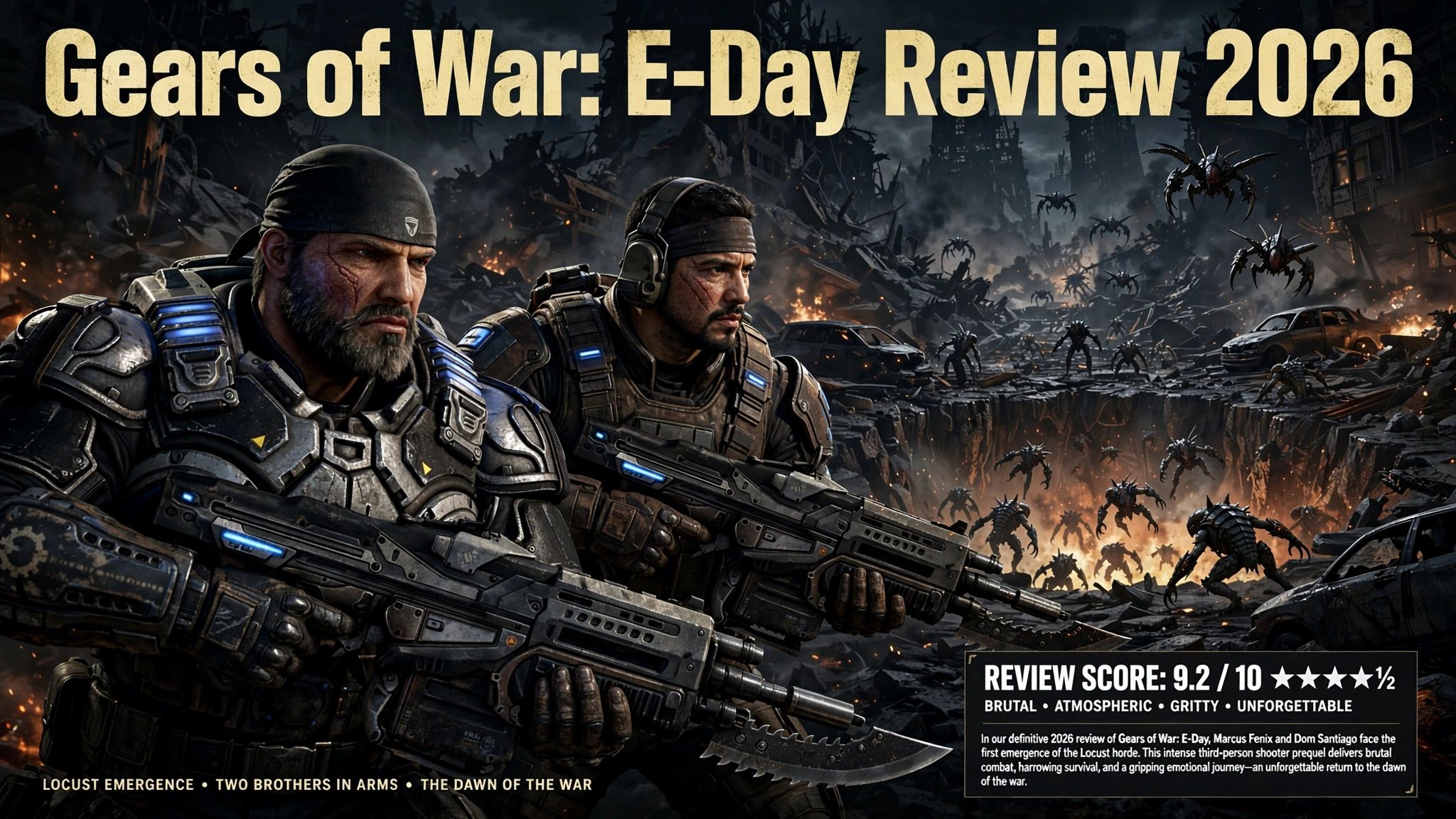
Gears of War: E-Day Review: The legendary third-person shooter series returns to its roots with a prequel that explores the terrifying beginning of the Locust invasion. Developed by The Coalition and published by Xbox Game Studios, Gears of War: E-Day takes players back to the moment that transformed the peaceful world of Sera into a battlefield filled with destruction, fear, and desperate human resistance.
Released on October 6, 2026, the game brings back iconic characters Marcus Fenix and Dominic Santiago while introducing modernized combat mechanics, expanded environments, and a darker atmosphere inspired by the original trilogy. Powered by Unreal Engine 5, E-Day seeks to reinvent the classic cover-shooter experience through cutting-edge visuals, intense combat encounters, and a deeper sense of immersion.
The result is a major new entry that emphasizes the franchise’s defining strengths while attempting to make its established formula feel fresh. Combining intense firefights, cinematic storytelling, cooperative action, and a deeper dive into the franchise’s origins, E-Day is shaping up to be a notable release for Xbox and PC players, with the campaign’s pacing and narrative execution likely to influence its overall reception. the campaign’s storytelling and overall pacing will play a key role in shaping the experience. execution have received mixed reactions from critics.
Gears of War: E-Day Review – Game Overview
Gears of War: E-Day is a third-person action shooter that combines tactical cover-based combat, science-fiction warfare, survival horror, and cinematic storytelling. Instead of continuing directly from the events of earlier installments, the game revisits one of the most significant moments in the franchise’s history: Emergence Day, when the Locust Horde suddenly emerges from beneath the planet’s surface.
This prequel approach allows The Coalition to revisit familiar characters before the events that define their later lives. It also provides an opportunity to explore the early stages of humanity’s struggle against an enemy that threatens the survival of the entire civilization.
The game is available on Xbox Series X|S, Windows PC, and Steam, with access through eligible Game Pass subscriptions. It supports a single-player campaign, cooperative play, the Horde Siege PvE mode, and competitive Versus multiplayer, offering several ways to experience its combat systems.
Story and Setting – The Beginning of Emergence Day
A Darker Look at the Gears of War Universe
The story of Gears of War: E-Day unfolds fourteen years before the events of the original Gears of War. The planet Sera is already recovering from years of human conflict, but the emergence of the Locust Horde introduces a new and far more terrifying threat.
Rather than presenting the Locust as an established military enemy from the beginning, the prequel focuses on the shock and confusion of their initial invasion. Civilians face an unfamiliar danger, military forces struggle to understand the scale of the attack, and entire communities are thrown into chaos as the underground threat spreads across the surface.
This setting gives the narrative a different emotional foundation from later entries in the franchise. The struggle goes far beyond defeating an enemy or carrying out orders, focusing instead on the desperate fight to endure as familiar life crumbles and humanity faces an uncertain future.
Marcus Fenix and Dominic Santiago Return
Marcus Fenix and Dominic Santiago once again occupy central roles in the story, giving longtime fans an opportunity to experience an earlier chapter of their relationship. Their bond has long been at the heart of the franchise, bringing together combat-hardened instincts, unwavering devotion, witty banter, and moments of genuine emotional depth that make their relationship so memorable.
In E-Day, their presence provides continuity with the original trilogy while allowing the game to examine the circumstances surrounding the Locust invasion. Their experiences during the initial catastrophe help establish the foundation for the soldiers and survivors they become in later games.
The supporting cast also contributes to the campaign’s perspective on the unfolding crisis. New squad members, including Mags Carter and Lucas Reyes, help broaden the narrative beyond the two established protagonists and provide additional viewpoints on the challenges facing humanity.
Horror, Suspense, and Emotional Storytelling
One of the most interesting aspects of E-Day is its renewed emphasis on horror. The original Gears of War combined military action with unsettling underground environments, grotesque enemies, and moments of vulnerability that contrasted with its heavily armed protagonists.
The prequel revisits this balance by presenting the Locust as an overwhelming and frightening presence rather than merely another group of targets. The sudden appearance of hostile creatures, devastated streets, and desperate encounters helps create an atmosphere in which the characters are confronting something they do not fully understand.
The emotional impact depends on how effectively the campaign connects large-scale destruction with personal experiences. Although some critics have praised its dramatic presentation and character moments, others have argued that the story does not always develop its central ideas as thoroughly as its historical significance deserves.
Gameplay Analysis – Classic Cover-Based Action Enhanced With Modern Mechanics
Refined Movement and Cover Mechanics
Cover-based combat remains the foundation of Gears of War: E-Day. Players move between walls, barricades, vehicles, and other environmental objects to avoid incoming fire while looking for opportunities to attack exposed enemies.
The system encourages players to think carefully about positioning instead of treating every encounter as a straightforward shooting gallery. Advancing too quickly can leave Marcus vulnerable, while remaining behind the same piece of cover for too long can allow enemies to flank his position or force him into the open.
The Coalition has rebuilt the cover system and introduced more flexible movement options, including additional traversal actions and greater verticality. These changes help make encounters feel more fluid while preserving the deliberate, weighty movement that distinguishes Gears from faster first-person shooters.
Weapons and the Signature Chainsaw Lancer
The diverse arsenal continues to stand out as one of the franchise’s biggest strengths, giving players plenty of options to approach combat in different ways. The familiar Lancer assault rifle, Gnasher shotgun, Longshot sniper rifle, and explosive equipment give players different ways to approach combat, whether they prefer controlled ranged attacks or aggressive close-quarters engagements.
Few weapons capture the series’ identity quite like the Lancer, whose integrated chainsaw transforms conventional firefights into savage close-range encounters while highlighting the franchise’s bold sci-fi aesthetic. E-Day also explores the origins of familiar military equipment, giving some of the series’ most recognizable weapons additional context within the prequel’s setting.
Each weapon serves a different tactical purpose. Shotguns reward players who can close the distance safely, sniper rifles offer powerful precision attacks, and automatic weapons provide sustained fire against enemies advancing across open ground.
The best encounters require players to switch between these tools according to the situation. Ammunition availability, enemy placement, available cover, and the risk of being surrounded all influence which weapon is most effective at a given moment.
Enemy Variety and Combat Difficulty
The Locust Horde remains central to the combat experience, combining standard infantry with faster creatures, heavily armored opponents, and larger monsters capable of changing the rhythm of an encounter. These different enemy types encourage players to adapt rather than rely on a single weapon or defensive position.
Some enemies pressure players from a distance, while others rush directly toward cover or force soldiers to relocate. Larger creatures introduce a more cinematic scale to combat, making certain encounters feel closer to survival horror than conventional military shooting.
However, enemy variety does not automatically guarantee consistent pacing. Some reviews have criticized the campaign for repeating similar combat scenarios and relying on enemies that can absorb excessive amounts of damage, particularly during difficult encounters.
This creates a noticeable contrast between the satisfying feel of individual gunfights and the potential fatigue of playing through too many similar battles in succession.
Weapon Modifications and Tactical Customization
E-Day introduces weapon modifications that allow players to adjust selected aspects of their equipment. Depending on the available upgrade, modifications can improve handling, reduce recoil, enhance aiming, or change the effectiveness of certain combat tools.
These options add another layer of decision-making to the shooting mechanics. Players can experiment with different configurations to suit their preferred style or prepare for encounters involving specific enemy types.
Exploration also provides opportunities to discover equipment and upgrades away from the main combat route. Although these additions give players more reasons to investigate their surroundings, their effectiveness depends on whether the rewards feel meaningful and the discovery process remains enjoyable rather than overly guided.
Campaign Design and Level Exploration
Linear Action With More Room to Move
The campaign combines directed action sequences with broader environments that offer additional room for movement and exploration. Rather than becoming a completely open-world game, E-Day retains a mission-based structure while providing selected areas with more opportunities to investigate, reposition, and approach combat from different angles.
This design fits the franchise’s identity because Gears has traditionally relied on carefully constructed encounters rather than unrestricted exploration. A well-designed battlefield can create tension through the placement of cover, enemy firing positions, environmental hazards, and limited escape routes.
Wider environments can also support more tactical choices. Players may be able to move toward elevated positions, flank enemies, search for supplies, or investigate optional locations before continuing with the main objective.
Side Activities and Optional Rewards
Optional exploration offers additional opportunities to find resources, weapon modifications, and environmental details that expand the world beyond the central mission. These activities can provide useful rewards while giving players a reason to look beyond the most obvious route.
However, the balance between guidance and discovery is important. Too little direction can make optional content frustrating, while excessive markers and notifications can reduce the satisfaction of finding something independently.
Reviews have differed on how successfully E-Day handles this balance. Some appreciate the additional customization and environmental detail, while others consider aspects of its exploration overly guided and less rewarding than the systems used in earlier entries.
Campaign Length and Pacing
One of the more divisive elements of E-Day is its campaign structure. PC Gamer described the single-player experience as a 20-plus-hour campaign whose repeated firefights eventually become exhausting, while other reviewers have been more enthusiastic about its extended battles and cinematic momentum.
A longer campaign can be an advantage when its missions introduce meaningful changes in tone, enemy behavior, objectives, and storytelling. It becomes a weakness when similar encounters dominate too much of the experience without providing sufficient variation.
For players who enjoy Gears primarily for its shooting mechanics, the extended combat may be welcome. Those who value a tightly paced narrative adventure may find that the campaign could have benefited from more variety between its major battles.
Graphics and Visual Presentation – Unreal Engine 5 in Action
Detailed Environments and Destruction
Unreal Engine 5 gives E-Day a modern technical foundation for presenting the destruction of Sera. Buildings, streets, military equipment, character armor, and environmental debris contribute to a world that feels more detailed than the series’ earlier installments.
The contrast between intact urban spaces and areas devastated by the Locust invasion is particularly important to the game’s atmosphere. The setting is not simply a collection of arenas; it represents a civilization undergoing a sudden and violent transformation.
Large combat sequences benefit from detailed environments and dramatic lighting, while smaller visual elements help reinforce the physicality of the action. Explosions, damaged structures, blood effects, and enemy animations contribute to the series’ familiar presentation of brutal military science fiction.
Lighting, Shadows, and Environmental Atmosphere
Modern lighting technology helps create more convincing contrasts between exposed streets, damaged interiors, underground spaces, and areas illuminated by fires or artificial sources. These differences are especially valuable when the game shifts toward suspenseful encounters and horror-inspired sequences.
The visual design also supports the distinction between moments of relative safety and situations in which the Locust can emerge unexpectedly. Darkness, limited visibility, and environmental clutter can make enemy movements harder to anticipate, adding tension to the experience.
On compatible PC hardware, the game’s advanced rendering features provide additional visual options. Coverage from Tom’s Hardware highlights the title’s use of Unreal Engine 5 technologies, including MegaLights, while PC-specific features extend the range of graphics settings available to players. Source: Tom’s Hardware.
Character Models, Animation, and Cinematic Presentation
Character models play an important role in making the story feel grounded. Facial expressions, body language, armor details, and animation help communicate the stress experienced by soldiers facing a sudden invasion.
Combat animation is equally important because Gears depends on the physical relationship between movement, cover, weapons, and enemy reactions. Smooth transitions between aiming, firing, climbing, and moving into defensive positions help the action feel responsive and coherent.
Cinematic sequences provide a different visual rhythm from the combat sections. When they are effective, they allow the story to slow down and focus on character relationships, the scale of the disaster, and the consequences of individual encounters.
Audio Design, Music, and Voice Acting
Sound design is a major part of the Gears experience, and E-Day uses weapon reports, explosions, enemy sounds, and environmental effects to reinforce the intensity of combat. The distinctive sound of automatic fire or a powerful shotgun blast can make an encounter feel immediate even when the player is focused on finding cover.
Audio cues also contribute to tactical awareness. The sounds of nearby enemies, incoming attacks, and environmental destruction help communicate what is happening beyond the player’s direct field of view.
The soundtrack supports the cinematic tone, shifting between intense action and more atmospheric moments. Voice acting adds personality to the squad and helps balance the military setting with the relationships that give the story its emotional weight.
Not every element is equally successful, however. Tom’s Guide praised the game’s overall presentation and voice performances while noting that repeated combat dialogue can become tiresome during longer sessions.
Multiplayer Review – Horde Siege and Versus Modes
Horde Siege: Cooperative Survival Expanded
Horde Siege expands the series’ established cooperative survival formula by placing squads in larger environments with objectives that extend beyond simply eliminating successive waves of enemies. Players must coordinate their attacks, manage threats, and decide when to pursue additional objectives for potential rewards.
The mode’s larger battlefields can make encounters feel less predictable than traditional wave-based survival. Players may need to travel between objectives, respond to unexpected enemy activity, and cooperate with teammates whose positions and priorities change throughout a match.
This structure gives cooperative play a more active rhythm. Instead of relying exclusively on a fixed defensive position, squads can be encouraged to move through the environment and make decisions about when to fight, regroup, or pursue optional challenges.
PC Gamer highlighted Horde Siege as one of the game’s strongest features, describing it as an effective evolution of the traditional Horde experience. For players who enjoy teamwork and replayable combat, it may provide more lasting appeal than the campaign alone.
Versus Multiplayer and Competitive Combat
The competitive Versus modes preserve the close-range tactical combat that has long defined Gears multiplayer. Players must use cover, manage weapon selection, read enemy movement, and coordinate attacks with teammates to gain an advantage.
The combination of shotguns, rifles, grenades, and environmental positioning rewards players who understand the relationship between aggressive movement and defensive awareness. A poorly timed advance can expose an entire team, while a well-executed flank can quickly turn a losing engagement into a victory.
E-Day includes refined competitive modes and updated movement mechanics, offering a modernized interpretation of the franchise’s established multiplayer formula. Its appeal will depend on factors such as map variety, matchmaking quality, balance updates, and the long-term strength of its player community.
For returning fans, Versus provides a familiar competitive environment with updated mechanics. For newcomers, it offers a demanding mode in which positioning, timing, and teamwork can matter as much as aiming accuracy.
Performance Review – Xbox Series X|S and PC
Xbox Series X and Series S Performance
On Xbox consoles, E-Day benefits from a development approach designed around modern hardware. The official game listing advertises support for 4K Ultra HD, HDR, and up to 60 frames per second on Xbox Series X|S, although actual image quality and rendering behavior can vary between the two consoles.
A stable frame rate is especially valuable in a cover-based shooter because combat depends on precise aiming, quick movement between defensive positions, and rapid responses to enemy attacks. Large battles featuring numerous enemies, destruction effects, and complex lighting can place additional demands on the rendering system.
Console players should consider the differences between hardware models when evaluating visual quality and performance. The Series X has more graphical resources available, while the Series S targets a different hardware and rendering budget.
The practical experience will also depend on display capabilities, installed updates, and the game’s current technical state. Consequently, advertised output specifications should not be interpreted as a guarantee that every scene will maintain identical image quality or performance.
PC Performance and Graphics Settings
The PC version offers a wider range of options for players who want to balance visual quality with responsiveness. Resolution, textures, shadows, geometry, effects, and other graphics settings can be adjusted according to the available hardware.
The game also supports modern upscaling technologies, including NVIDIA DLSS 4.5, AMD FSR 4, and Intel XeSS 3.0, according to PC performance coverage. Compatible NVIDIA hardware can additionally use RTX Mega Geometry, a feature associated with the game’s advanced geometric rendering.
These technologies can help players achieve a more suitable balance between image clarity and frame rate, but their benefits depend on GPU compatibility, resolution, graphics settings, and the particular upscaling or frame-generation mode being used.
Players with powerful graphics cards can pursue higher resolutions and more demanding visual settings, while mid-range systems may benefit from selective reductions in effects, shadows, and other costly options. The best configuration is not necessarily the one with every setting at its maximum; consistent responsiveness can be more valuable during intense firefights.
Recommended Approach to PC Optimization
For a practical starting point, players should begin with the game’s recommended graphics preset and assess performance during demanding combat scenes rather than relying exclusively on quiet areas. Explosions, large enemy groups, destruction, and complex lighting can reveal limitations that are less obvious during exploration.
If frame rates fluctuate, reducing the most demanding settings or enabling a compatible upscaling option may help. Players should also ensure that their graphics drivers are current and that the game is installed on a suitable drive with sufficient free storage.
Advanced features such as ray-traced geometry can offer visible improvements, but they should be evaluated against their performance cost on the specific hardware being used. A balanced configuration that maintains stable gameplay is generally preferable to a maximum-quality preset that produces inconsistent results.
Performance should therefore be judged across the complete experience, including demanding encounters and longer play sessions. Although early technical coverage has highlighted the game’s visual ambitions and broad PC settings, individual results can differ considerably between systems.
Accessibility, Replayability, and Overall Value
Accessibility and control options are important considerations for a modern action game, particularly one that requires frequent aiming, movement, and rapid interaction with cover. Players should review the available in-game settings to determine whether the control layout and presentation options suit their needs.
Replayability comes primarily from the game’s cooperative modes, competitive multiplayer, weapon customization, and opportunities to revisit combat encounters with different approaches. These features provide alternatives to simply completing the campaign once and moving on to another game.
The value proposition will depend on how much time players expect to spend in each mode. Someone primarily interested in Marcus and Dom’s origin story may judge the experience differently from a player who intends to spend dozens of hours in Horde Siege or Versus.
Game Pass availability also gives eligible subscribers an alternative to purchasing the game separately. Players who are uncertain about the campaign’s length or pacing may find subscription access a convenient way to decide whether E-Day fits their preferences.
Gears of War: E-Day – Pros and Cons
What Works Well
E-Day’s greatest strength is its combat. The cover system, recognizable weapon arsenal, and updated movement mechanics preserve the qualities that made Gears distinctive while providing a more flexible foundation for modern encounters.
The presentation is another major advantage. Detailed environments, dramatic lighting, destructive battles, and strong audio design help communicate the scale of the Locust invasion and the vulnerability of the people caught within it.
The multiplayer offering adds further value. Horde Siege introduces a more expansive cooperative structure, while Versus maintains the competitive identity that longtime fans expect from the series.
What Could Be Better
The campaign’s pacing is the most notable concern raised by some critics. Repeated firefights and similar objectives can reduce the impact of an otherwise compelling setting, especially when a long sequence of battles leaves limited room for narrative development.
Some enemy encounters have also been criticized for excessive durability, which can undermine the satisfying feedback normally associated with Gears’ powerful weapons. Repetitive dialogue and overly explicit exploration guidance may further reduce immersion during extended sessions.
These weaknesses do not erase the game’s strengths, but they make the overall experience more dependent on individual preferences. Players who enjoy sustained combat may be more forgiving of the campaign’s structure than those looking for a tightly paced story-driven adventure.
Is Gears of War: E-Day Worth Playing?
Gears of War: E-Day is worth considering for players who enjoy tactical third-person shooters, cooperative action, and cinematic science-fiction storytelling. Its updated combat mechanics and detailed presentation demonstrate how the franchise can retain its recognizable identity while taking advantage of newer hardware.
Longtime fans have a particularly strong reason to explore the prequel because it returns to Marcus Fenix, Dominic Santiago, and the defining catastrophe of the series’ early history. New players can also use E-Day as an introduction to the setting without needing to follow every event in the earlier games, although familiarity with the franchise can add context to its characters and references.
The main reservation concerns the campaign’s length and repetition. Players seeking constant variety in mission objectives and a consistently evolving narrative may find parts of the experience less engaging, even when the underlying shooting remains enjoyable.
For multiplayer-focused players, Horde Siege and Versus provide additional reasons to stay involved beyond the main story. The final value depends on whether those modes, the campaign, or a combination of both align with the player’s expectations.
Final Verdict – A Powerful Return With Some Pacing Problems
Gears of War: E-Day brings the franchise back to one of its most important historical moments and builds its experience around the elements that made the original games memorable. The brutal cover-based combat, recognizable arsenal, horror-inspired atmosphere, and cinematic presentation provide a strong foundation for this return to Sera’s darkest chapter.
Its most successful features are the refined shooting mechanics, modern visual presentation, and expanded cooperative multiplayer. These elements demonstrate that the traditional Gears formula can remain engaging without abandoning its focus on tactical positioning and intense firefights.
The campaign is less consistent. Its extended combat sequences and occasional repetition can weaken the narrative momentum, creating a noticeable gap between the quality of individual encounters and the pacing of the full adventure.
Nevertheless, E-Day remains a significant entry for fans of the franchise and a compelling option for players who enjoy action-heavy third-person shooters. It offers a modern interpretation of classic Gears combat, a return to the series’ horror roots, and a fresh opportunity to experience the beginning of the Locust invasion.
Overall conclusion: Gears of War: E-Day is a visually impressive and mechanically satisfying prequel whose strongest qualities are its gunplay, atmosphere, and multiplayer. Its uneven campaign pacing prevents it from being an unqualified success, but fans of tactical shooting and cooperative action will find plenty to appreciate.
Frequently Asked Questions
What is Gears of War: E-Day about?
Gears of War: E-Day is a prequel set fourteen years before the original game. It follows Marcus Fenix, Dominic Santiago, and other characters as the Locust Horde launches its devastating invasion of the planet Sera.
When was Gears of War: E-Day released?
The game launched worldwide on October 6, 2026, following an early-access period that began on October 1 for eligible players.
Which platforms support Gears of War: E-Day?
The game is available on Xbox Series X|S, Windows PC, and Steam. It is also available through eligible Game Pass subscriptions, with cloud gaming options offered through supported services.
Does Gears of War: E-Day have multiplayer?
Yes. The game includes cooperative campaign options, Horde Siege PvE, and competitive Versus multiplayer. These modes provide alternatives to the single-player campaign.
How good are the graphics in Gears of War: E-Day?
The game uses Unreal Engine 5 to deliver detailed environments, modern lighting, and cinematic destruction. Its PC version also includes advanced rendering and upscaling features, although the quality and performance players experience depend on their hardware and settings.
Is Gears of War: E-Day worth buying?
It is a strong option for fans of cover-based shooters and players who enjoy cooperative action. However, anyone primarily interested in a tightly paced single-player story should consider the mixed critical feedback concerning campaign repetition and length before purchasing.
Do you need to play the previous Gears of War games first?
No. Because E-Day is a prequel, it provides an entry point into the franchise’s earlier history. Playing the original trilogy can nevertheless provide additional context for Marcus and Dom’s relationship and the events that follow the invasion.
