


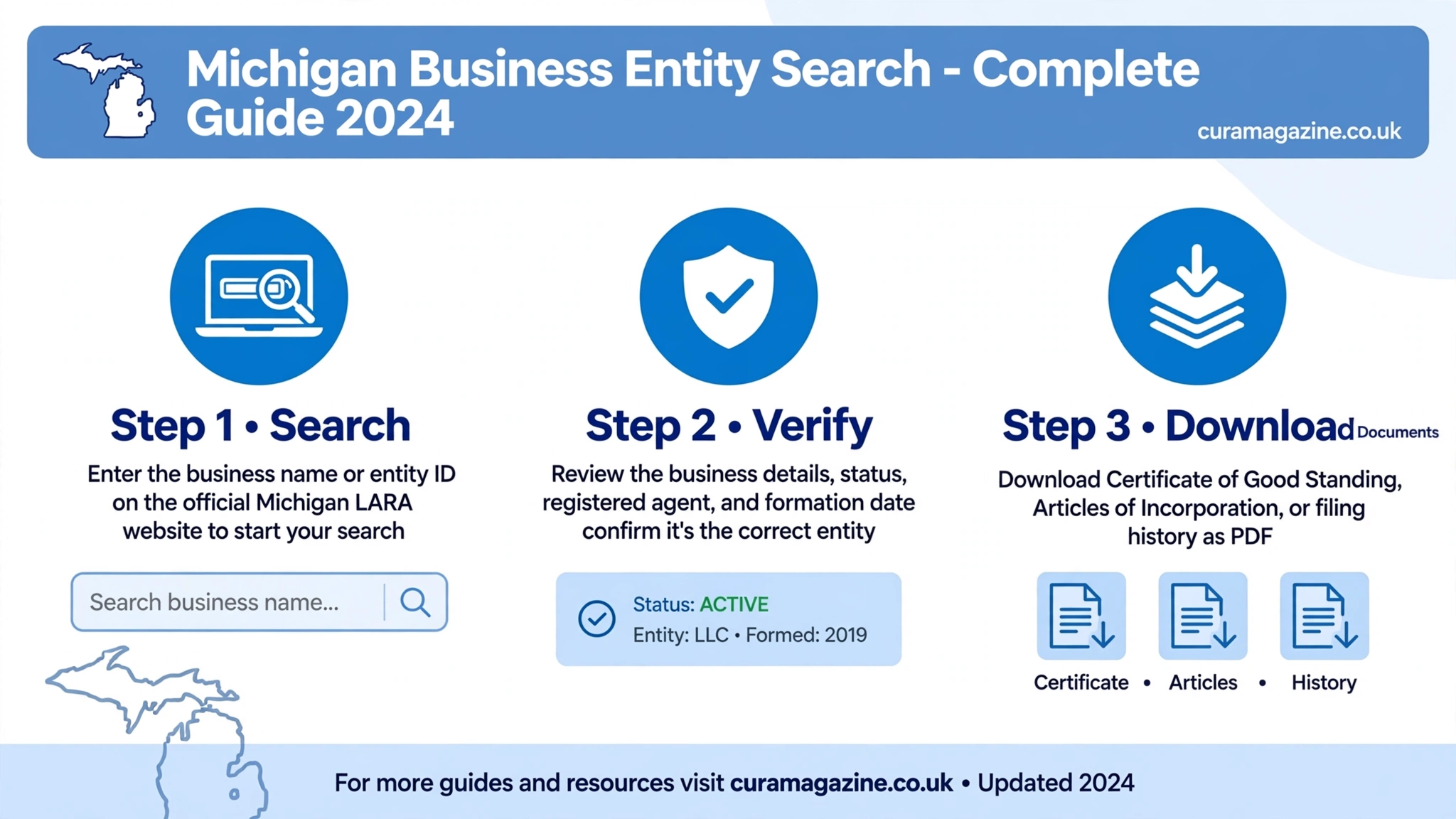
If you need to look up a Michigan LLC, corporation, partnership, or another registered business entity, the Michigan Business Entity Search is the state’s primary public-record tool for finding business registration information. The search is maintained through the Michigan Department of Licensing and Regulatory Affairs, or LARA, and can be used to locate an entity by business name, individual associated with the entity, identification number, or filing number.
Michigan moved its business-record services to the MiBusiness Registry Portal in June 2025. The newer system replaced the state’s former online filing platform and now provides access to business searches, filings, certificates, copies, and other entity-management services.
What Is the Michigan Business Entity Search?
The Michigan Business Entity Search is a public lookup system for finding records maintained by the Corporations Division of LARA. It covers a wide range of registered business structures, including limited liability companies, corporations, limited partnerships, and limited liability partnerships, as well as foreign entities authorized to conduct business in Michigan.
For someone researching a company, the search can answer basic questions such as whether a business appears in Michigan’s records, what name it is registered under, and what information has been filed with the state.
The database is particularly useful when you are checking a company before entering into a business relationship, researching an existing organization, confirming the spelling of a legal business name, or investigating whether a proposed business name is already being used.
How to Search for a Michigan LLC or Corporation
Start by opening Michigan’s Business Entity Search through the current LARA business-record system. Enter the information you have about the company and select the search method that best matches it.
A business-name search can generally be performed using several matching methods. A “Begins with” search looks for entities whose names start with the wording you enter, while an exact-match search looks for the corresponding business name. Keyword searching can help when you know only part of the name, and Soundex searching can identify names with similar pronunciations.
This flexibility is useful because a company’s legal name may not be identical to the name it uses publicly. For example, a business might advertise itself under a shortened brand name while its state registration includes additional words such as “LLC,” “Inc.,” “Corporation,” or another legal designation.
Searching by Business Name
Searching by business name is usually the most straightforward option when you already know the company’s legal or commonly used name. Enter the most distinctive portion of the name rather than adding unnecessary words that could make the search too narrow.
If an exact search produces no result, try a keyword or “Begins with” search. You can also experiment with variations in spelling and punctuation, particularly when the business name contains abbreviations, multiple words, or unusual terms.
A search result should be treated as a starting point for reviewing the company’s actual record. Seeing a similar name does not automatically mean that the entity you found is the same business you are researching, so compare additional information before drawing a conclusion.
Searching by Individual Name
Michigan’s system also allows searches based on the name of an individual associated with a business entity. Depending on the information available in the state’s records, this can include people listed as resident agents, officers, directors, shareholders, members, managers, or general partners.
This option can be helpful when you know the person connected with a business but do not know the company’s exact legal name.
There is an important limitation, however: the search information associated with individuals depends on records entered into the state’s current system. Michigan notes that certain individual-name results only include information received after the current electronic system was implemented, so an incomplete result should not automatically be interpreted as proof that a person has never been associated with a Michigan business.
Searching by Identification Number
If you have a Michigan entity identification number, searching by that number can be more precise than searching by name. Michigan business entities are assigned identification numbers, and the search system allows users to enter a valid nine-digit entity identification number.
This can be especially useful when several businesses have similar names. A unique identification number can help distinguish the particular company you are trying to locate from other entities in the state’s database.
When conducting due diligence, using the identification number from an official document or previously verified record can also reduce the risk of confusing two businesses with similar names.
Searching by Filing Number
Michigan also provides a filing-number search option. A filing number identifies a particular filing submitted to the Corporations Division and can be useful when you are trying to locate a specific document or filing associated with an entity.
This method is more specialized than a standard company-name search. It is most useful when you already have a filing number from a state record, filing confirmation, or other business document.
What Information Can You Find?
The amount and type of information available can vary according to the entity and the records filed with the state. Business records can provide important details about an entity’s registration and filings, including information connected with its legal existence and state-maintained record.
The record may help you identify the entity’s legal name, entity type, identification information, registered office, resident agent, and other filed information. Depending on the record, you may also be able to review filing history and access available documents or request official copies.
A resident agent is the person or qualifying organization designated to receive documents, notices, or legal demands on behalf of the business. The registered office is the physical location associated with that agent for purposes of the state’s business records.
How to Check Whether a Michigan Business Is Active
One common reason people use the Michigan entity search is to determine the current status of a business. When reviewing a company record, pay attention to the entity’s status and filing history rather than relying solely on the company’s website, advertising, or other third-party information.
Status information can matter when you are considering a contract, verifying a supplier, researching a potential business partner, or checking the records of a company that has stopped operating publicly.
Keep in mind that a state business registration record is not the same thing as a comprehensive business-license search. Michigan’s Corporations Division explains that it handles the formation and maintenance of business entities, while specific professional, occupational, or other regulatory licenses may be administered by different state agencies.
How to Check a Michigan Business’s Registered Agent
The registered or resident agent is an important part of a Michigan business entity’s public record. This person or organization is designated to receive documents, notices, or demands served on the business.
For corporations and LLCs, Michigan requires the appropriate agent and registered office information as part of the entity’s formation records. Because the agent and registered office can change, the information shown in the current state record is more useful for present-day verification than an old document that may no longer reflect the company’s registration.
A registered-agent address should not automatically be assumed to be the company’s principal place of business. The registered office serves a specific legal and administrative purpose and may be different from where the company conducts its everyday operations.
Can You Use the Search to See Who Owns an LLC?
The answer is not always straightforward. Michigan’s public business records can contain names associated with an LLC, such as members or managers, but the information available depends on the entity’s filings and the particular record being viewed.
An LLC’s members are its owners, while management may be handled by the members or by designated managers. Therefore, finding a manager, resident agent, or another individual connected with an LLC does not necessarily establish that the person is an owner.
If ownership is important for a transaction or legal matter, the state entity record should be interpreted carefully and, where necessary, supplemented with the company’s governing documents or other appropriate records.
Michigan LLC Search vs. Corporation Search
The same general Michigan business-entity search system can be used to locate both LLCs and corporations, but the underlying legal structures are different.
A Michigan LLC is a separate business entity whose owners are its members. Michigan describes an LLC as a business entity separate from its members, with liability generally limited to the members’ financial contributions, subject to applicable law.
A corporation is also a separate legal entity, but its ownership structure is based on shareholders, with corporate governance generally involving directors and officers. Corporations can include domestic profit corporations, nonprofit corporations, professional service corporations, and foreign corporations authorized to operate in Michigan.
For search purposes, the important point is that the entity type shown in the state record tells you what kind of legal organization you are dealing with. It should not be assumed that an LLC and corporation have identical ownership, management, filing, or compliance requirements.
How to Check a Business Name Before Forming an LLC
If you are planning to create a Michigan LLC or corporation, searching the existing business database is an important preliminary step. Look for existing entities with names that are identical or confusingly similar to the name you want to use.
Michigan cautions that a preliminary business-name search does not guarantee that the name will ultimately be available when formation documents are submitted. A search can therefore help identify potential conflicts, but it should not be treated as final approval of a proposed name.
If you need additional time before forming a corporation, Michigan provides a name-reservation process under its applicable rules. Business owners should also consider whether the proposed name creates trademark or branding concerns, because state entity-name availability and trademark rights are separate issues.
What Changed With Michigan’s New Business Portal?
Michigan launched the MiBusiness Registry Portal on June 23, 2025, replacing the state’s previous business filing platform. The new system consolidated several business-record functions into a newer online environment.
The portal allows users to search for and view business records, submit business filings, file annual reports and statements, and request certificates and copies. Michigan also discontinued paper submissions for annual reports and annual statements beginning with the portal transition.
This change is important if you find older articles or guides describing Michigan’s previous Corporations Online Filing System. Instructions that refer to the former system may no longer match the current interface, so users should rely on the state’s current business-record system when performing a search.
Does a Business Entity Search Prove a Company Has a Business License?
No. A business entity registration and a business license are different things.
Registering an LLC or corporation establishes the entity’s legal existence under Michigan’s business-entity laws, but it does not necessarily authorize the company to perform every type of activity. Certain professions, occupations, industries, and regulated activities can require separate licenses, registrations, permits, or approvals.
For that reason, someone researching a contractor, professional practice, healthcare business, regulated service provider, or another specialized company may need to check both the entity record and the relevant licensing authority.
Why a Michigan Business Search Can Be Useful
For consumers and businesses, the state entity database can provide a useful layer of verification before entering a relationship with a company. It can help confirm that a business exists in the state records, distinguish a legal entity from a trade or brand name, identify publicly recorded business contacts, and provide access to filing information.
It can also be useful when sending legal or formal correspondence, checking information provided by a vendor, researching a potential partner, or trying to understand the history of a Michigan business entity.
The most reliable approach is to compare the information in the state record with the information supplied by the business itself. If the names, addresses, entity types, or other important details do not match, that discrepancy is worth investigating rather than assuming that the records refer to the same organization.
Common Problems When Searching Michigan Businesses
One of the most common problems is searching for the brand name instead of the company’s legal entity name. A company may operate under a trade name that is different from the name registered with the state.
Another problem is using an overly restrictive search. If an exact-name search returns nothing, try a broader keyword search or a different spelling. Businesses can also have similar names, so finding a matching or nearly matching result is not enough by itself to establish that you have located the correct company.
Older information can create another source of confusion. A registered agent, address, officer, or other business detail may have changed since an older document was issued. When current status matters, review the latest available state record rather than relying solely on an old filing.
What to Do After Finding the Business
Once you locate the entity, review the record carefully instead of stopping at the search-result page. Confirm the legal name, entity type, identification information, current status, and other details relevant to why you performed the search.
If you are checking a business for a transaction, you may also want to review available filing history and obtain official copies or certificates when a formal record is required. A basic online search can provide useful information, but a certified document may be more appropriate when the information will be submitted to a bank, government agency, court, lender, or another organization that requires official documentation.
For legal, ownership, tax, licensing, or contractual questions, the state entity database should be treated as one source of information rather than a substitute for professional advice or a complete investigation.
Frequently Asked Questions About Michigan Business Entity Search
Is Michigan’s business entity search free?
The public search function is intended to let people look up Michigan business-entity records. However, some services associated with records, such as certain certificates or copies, can involve separate fees.
Can I search for an LLC by its owner’s name?
You may be able to locate entities associated with an individual’s name when that person’s information appears in the state’s searchable records. The available results depend on the information filed with the state and the coverage of the electronic records.
Can I search for a corporation by its registered agent?
Yes, an individual-name search can return entities associated with people listed in roles such as resident or registered agent, subject to the information available in Michigan’s system.
Can I find a company’s EIN through the Michigan entity search?
A federal Employer Identification Number, or EIN, is different from Michigan’s state entity identification number. The Michigan business search should not be treated as a general public database for federal EINs.
Can I search for a business using its Michigan entity ID?
Yes. Michigan’s business search provides an identification-number search for a valid nine-digit entity identification number.
Does a search guarantee that a new business name is available?
No. A preliminary search can reveal existing names and potential conflicts, but Michigan states that a business-name search is not a guarantee that the proposed name will be available when formation documents are received.
Final Takeaway
The Michigan Business Entity Search is the central starting point for checking LLCs, corporations, and other registered business entities maintained by the state. The current system allows searches by business name, associated individual, entity identification number, and filing number, making it possible to investigate a company even when you do not know its exact legal name.
For the most accurate results, search broadly when necessary, verify the entity’s identity using multiple details, and distinguish business registration from licensing, ownership, and federal tax information. If the information will be used for an important legal or financial decision, consider obtaining the appropriate official record rather than relying only on a basic search result.
