

A Michigan corporation search is an online process that allows individuals, business owners, entrepreneurs, investors, and professionals to find information about companies registered in the state of Michigan. By searching the state’s official business records, users can identify a corporation or limited liability company (LLC), review its registration details, check its current status, and determine whether a business appears in the state’s public records.
Michigan business searches are particularly useful when starting a new company, researching a potential business partner, verifying a company’s legal name, or investigating an existing business before entering into a contract. They can also help entrepreneurs determine whether a proposed business name is already in use and whether additional research is needed before submitting a registration application.
Where to Search for Michigan Corporations
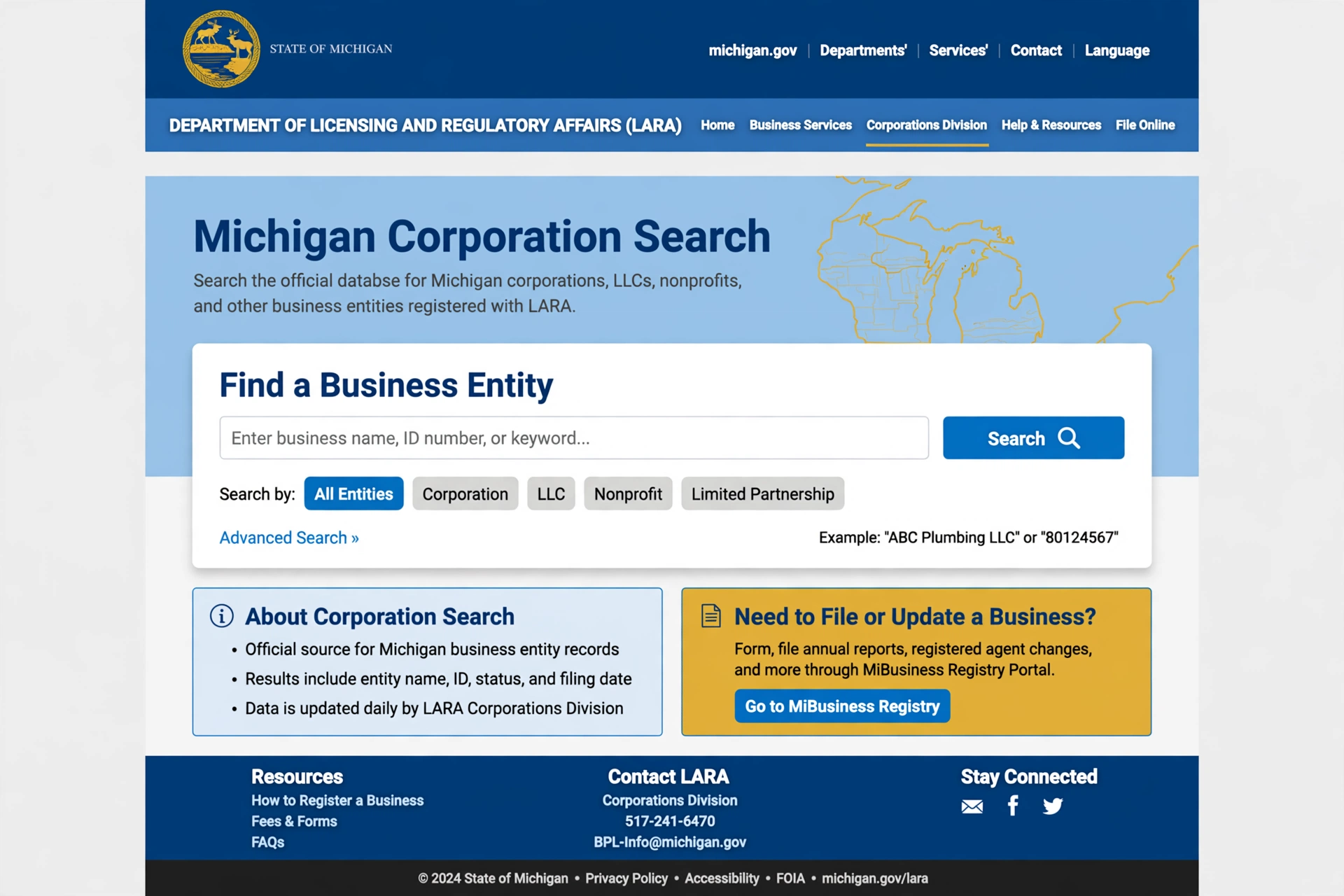
The Michigan Department of Licensing and Regulatory Affairs (LARA) serves as the main source for looking up registered businesses, with its Corporations Division providing access to official entity records. Its online business search system allows users to look up companies by name and access available registration information.
Using the official state system is generally the best starting point because it provides information drawn from Michigan’s business registration records rather than relying on third-party directories that may contain outdated or incomplete details. Depending on the business and the records available, a search may reveal the entity’s legal name, identification number, formation date, current status, registered office information, and other filing details.
How to Perform a Michigan Corporation Search
Step 1: Open the Official Business Search System
Begin by accessing the Michigan Department of Licensing and Regulatory Affairs website and locating its Corporations Division business entity search tool. This system is designed to help the public find businesses registered or recorded in Michigan.
Before relying on information from another website, confirm that the records come from the state’s official business database. Government-maintained records are valuable for confirming a company’s registered name, verifying its current standing, and ensuring business paperwork contains accurate information.
Step 2: Enter the Business Name
Enter the business’s name in the designated search box. If you know the complete legal name, enter it first; if the search does not return a result, try a shorter version or a distinctive word from the name.
Spelling variations, punctuation, abbreviations, and legal endings such as LLC, Inc., or Corporation can affect the results. Searching with fewer terms may help locate a company whose registered name differs slightly from the name used on its website, storefront, or marketing materials.
Step 3: Review the Search Results
Examine the list of matching businesses and compare the available information to identify the correct entity. Similar company names can belong to separate businesses, so avoid selecting a record based only on a familiar word or brand name.
Pay particular attention to the complete legal name, entity identification number, business type, and any location or registration details shown. If multiple results appear, use these details to distinguish the company you want from similarly named entities.
Step 4: Open the Business Record
Select the appropriate result to review the entity’s available record. Depending on the company’s filing history and the information provided by the state, the record may contain its formation date, status, registered office details, registered agent information, and links or options for viewing filed documents.
Read each field carefully and note the date on which you conducted the search. Business information can change, so a record reviewed today may not reflect a later amendment, address change, dissolution, or reinstatement.
Step 5: Confirm Important Details
If the search is connected to a significant decision, verify the information most relevant to that decision rather than relying on the company name alone. For example, a prospective customer may want to confirm that the business exists in state records, while a lender or contracting party may need additional documentation to establish its legal status.
When necessary, review the available state filings or request official documentation through the appropriate state process. A basic search is a useful first step, but it does not replace a complete legal, financial, or regulatory review.
What Information Can You Find in a Michigan Corporation Search?
Legal Business Name
The legal business name is the name under which an entity is registered with the state. It may differ from a company’s trade name, brand name, website name, or the name displayed on a physical location.
Checking the registered name helps avoid confusion when drafting contracts, issuing invoices, preparing applications, or communicating with government agencies. It can also help establish whether two businesses with similar public-facing names are separate legal entities.
Entity Identification Number
Michigan assigns business entities identifying information that can be used to distinguish one record from another. The entity identification number is especially useful when several businesses have similar names or when you need to locate a particular company’s record again.
Storing this identifier alongside your company records can simplify future lookups and routine administrative work. It may also help when communicating with the state about a filing or requesting information about a specific entity.
Business Status
A company’s status is one of the most important details to review. Depending on the terminology displayed in the state system, a record may indicate that an entity is active, dissolved, withdrawn, or otherwise no longer operating in its previous registered form.
An active status generally indicates that the entity remains in an active state registration category, but it does not automatically prove that the company is financially sound, properly licensed for every activity, or currently conducting business. Likewise, a dissolved or withdrawn record should be interpreted in context, particularly if the company has filed subsequent documents or undergone a change in legal structure.
Formation or Registration Date
The formation date can help establish when a domestic entity was created or when a foreign entity registered to conduct business in Michigan. These dates are not necessarily the same as the day a company began selling products, hiring employees, or serving customers.
Understanding the distinction can be useful when reviewing a business’s history, assessing its experience, or confirming details supplied in a commercial application. A company’s age alone, however, is not evidence of reliability or financial strength.
Registered Agent and Registered Office
A registered agent is the person or organization designated to receive official legal and administrative communications on behalf of a business where required. The registered office is the designated address associated with that role under the applicable state requirements.
This information can help users identify the appropriate channel for formal correspondence or legal notices. It should not automatically be treated as the company’s main place of business, customer service address, or the personal residence of an owner.
Filing History and Public Documents
Some business records provide access to filing information and documents submitted to the state. These may include formation documents, amendments, annual filings, changes to registered information, or documents related to dissolution and other organizational events.
Reviewing available filings can provide a clearer picture of a company’s administrative history than examining its current record alone. The documents available vary by entity, filing type, and the state’s recordkeeping practices.
How to Check Whether a Michigan Business Is Active
To check a business’s status, search for its legal name in the official Michigan business entity database and open the matching record. Review the status field and any relevant filing information, paying attention to whether later filings may have changed the entity’s standing.
If the record does not clearly establish the company’s current status, consult the underlying filings or seek clarification from the Corporations Division. Do not assume that a business is fully compliant simply because its name appears in the database.
State registration status also differs from professional licensing, tax compliance, local permits, and authorization to perform regulated work. A company may need additional approvals depending on its industry and activities, so those requirements should be checked separately when they matter.
Michigan LLC Search vs. Corporation Search
Michigan’s business entity search can be used to find different types of registered organizations, including LLCs and corporations. The basic search process is similar, but the legal structure shown in the record determines which rules and documents may apply.
A limited liability company is generally organized under Michigan’s LLC laws and may be managed by its members or appointed managers. A corporation is a separate legal structure that typically has shareholders, directors, and officers, although its specific governance arrangements depend on the applicable law and organizational documents.
When researching a business, confirm the entity type instead of assuming that every registered company is a corporation. This distinction matters when reviewing ownership arrangements, governance documents, contractual relationships, or requirements for making changes to the business.
How to Check Whether a Business Name Is Available in Michigan
Entrepreneurs planning to register a new business can use the Michigan corporation search to identify existing names that may conflict with their proposed name. Begin by searching the exact wording, then try distinctive words and reasonable variations to find similar registered entities.
A search that produces no obvious match is a useful preliminary indication, but it is not a guarantee that the name will be approved. Michigan’s naming rules, differences between entity types, reserved names, and potential conflicts with other protected names may affect whether a proposed name can be registered.
Before committing to branding, advertising, signage, or website development, review the applicable state naming requirements and confirm availability through the appropriate official process. If the name is important to a product or brand, consider separate trademark research because business entity registration and trademark rights are not the same thing.
Searching for a Business by Identification Number
Searching by an entity identification number can be more precise than searching by name, especially when the business has a common name or several similarly named entities appear in the results. Enter the number into the relevant search field, if supported, and confirm that the resulting record matches the intended company.
This approach is useful when reviewing contracts, state correspondence, previous filings, or internal business records. If the number does not return a match, verify that it was copied correctly and that it corresponds to the type of identifier accepted by the search system.
How to Obtain Michigan Corporation Documents
A business search may display basic entity details without providing every document needed for a legal or commercial transaction. When more complete evidence is necessary, determine which documents the state makes available and whether certified copies or an official certificate are required.
Depending on the purpose, you may need formation documents, amendments, annual filings, or documentation establishing an entity’s status. A certified document or official certificate may carry greater evidentiary value than a screenshot or an informal copy of an online record.
Before submitting a request, identify the exact entity and document you need. This can help prevent delays and reduce the risk of paying for a document that does not satisfy the requirements of a bank, licensing authority, court, contracting party, or other recipient.
Common Problems With Michigan Corporation Searches
No Search Results
A company may not appear because its name was entered incorrectly, the search terms were too restrictive, or the entity is registered under a different legal name. Try searching for a distinctive word, removing punctuation, or using a known identification number.
It is also possible that the business is registered in another state, operates under a trade name, or is not required to appear in the particular database being searched. A missing result does not, by itself, prove that the business is fraudulent or unlawfully operating.
Too Many Similar Results
Businesses often use overlapping words such as consulting, transport, construction, holdings, or services. When several results appear, compare the complete names, entity types, identification numbers, dates, and available addresses before deciding which record is relevant.
If the business supplied a registration number or legal name on a contract, use that information to narrow the search. Avoid assuming that two businesses are affiliated merely because their names look alike.
Outdated or Conflicting Information
A company may have changed its name, address, registered agent, or organizational status after an older document was issued. When information conflicts, review the most recent relevant filings and check whether the state record has been updated.
For time-sensitive transactions, repeat the search shortly before completing the transaction or obtaining the official document required by the recipient. This is particularly important when the information will be used for legal notices, lending decisions, compliance checks, or formal agreements.
Difficulty Accessing Documents
Some documents may require an additional request, fee, or separate procedure. If the online record does not include the material you need, review the state’s instructions for document orders and official certificates rather than assuming the information is unavailable.
Keep a copy of the relevant record and note the date of retrieval for your files. If a document will be used in a formal proceeding or transaction, confirm any certification, delivery, or freshness requirements in advance.
Why a Michigan Corporation Search Matters
A business search is a practical due diligence tool because it helps people verify basic registration information before making commitments. Customers can use it to check a company’s registered identity, entrepreneurs can investigate potential names, and businesses can review suppliers, partners, or contractors before entering into an agreement.
For established companies, periodic checks can also help keep internal records accurate and identify administrative issues that may require attention. However, public registration information is only one part of a broader assessment and should be combined with appropriate checks of licensing, financial information, references, contracts, and other relevant records.
The value of the search depends on how its results are interpreted. A registered entity is not automatically trustworthy, and an incomplete record does not necessarily indicate misconduct; the information should be evaluated in light of the decision being made.
Frequently Asked Questions About Michigan Corporation Search
Is the Michigan corporation search free?
Basic searches of public business entity records are generally available through the state’s online system without a charge. Fees may apply when requesting certain official documents, certified copies, or other services, so check the current state requirements before placing an order.
Can I search for a Michigan LLC using the same system?
Yes. The state’s business entity search can be used to locate LLCs as well as corporations and other covered entity types. Select the matching record and confirm the entity’s legal structure before interpreting its details.
Does an active status mean a company is trustworthy?
No. An active registration status is not a guarantee of good financial standing, honest conduct, professional qualifications, or regulatory compliance. Additional research is appropriate when you are evaluating a company for a substantial purchase, investment, contract, or other important decision.
Can I find the owner of a Michigan corporation?
A business record may contain certain names or organizational details, but it does not necessarily provide a complete list of owners or beneficial owners. Ownership information may require reviewing additional filings or documents, and the information available depends on the entity and applicable disclosure requirements.
Can I register a business name just because no matching name appears?
Not necessarily. The absence of an obvious match is only a preliminary search result, not a final approval. The proposed name must satisfy Michigan’s applicable requirements and may also raise trademark or other legal concerns that a basic entity search does not resolve.
How often should I check a company’s record?
The appropriate frequency depends on the purpose. A one-time check may be sufficient for preliminary research, while businesses managing ongoing supplier relationships, regulated activities, or important contractual arrangements may need to verify records at key decision points.
Final Thoughts
The Michigan corporation search is a useful starting point for verifying registered businesses, reviewing entity status, researching filing histories, and investigating potential business names. By using the official state database, checking identifying details carefully, and distinguishing registration information from licensing or financial evidence, users can make better-informed business decisions.
For the most reliable results, search by the exact legal name or entity identification number whenever possible, review the relevant record rather than relying on a search-result snippet, and obtain official documents when a formal transaction requires stronger proof. A few minutes spent confirming the correct entity can prevent confusion and unnecessary complications later.
