


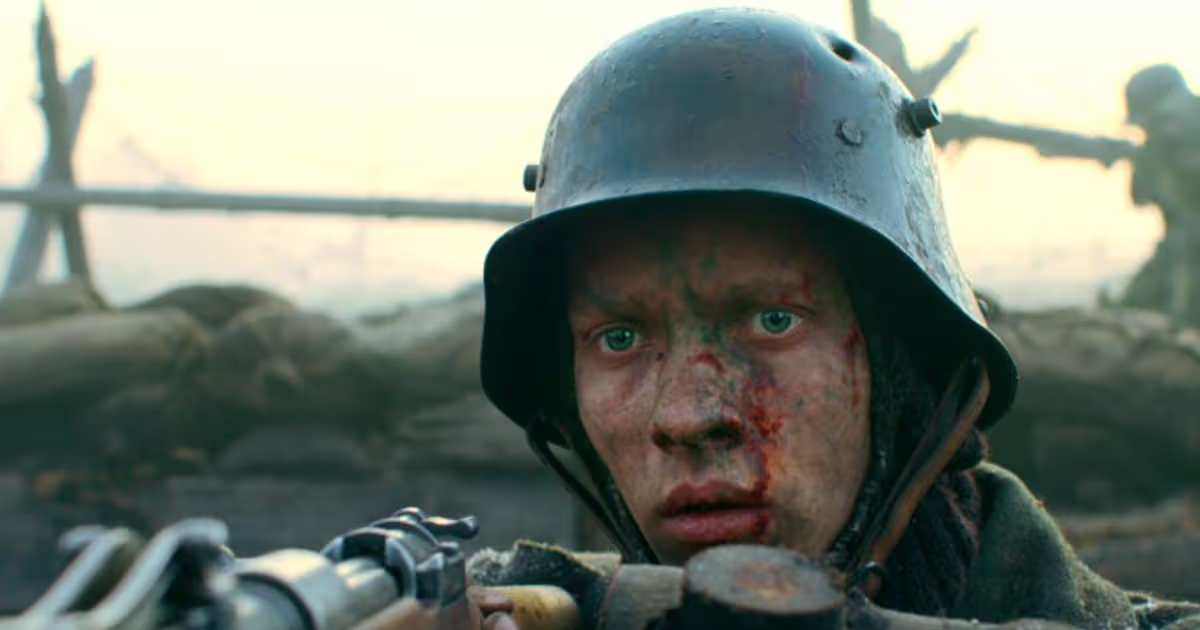
The France Western Front was one of the most important battlefronts of the Second World War in Western Europe. It refers to the military campaigns fought primarily in France, Belgium, Luxembourg, and neighboring regions after the Allied invasion of Nazi-occupied France in 1944.
The Western Front became the stage for some of history’s largest military operations, including the D-Day landings, the Liberation of Paris, and the final Allied advance into Germany. These campaigns played a decisive role in defeating Nazi Germany and ending World War II in Europe.
Understanding the France Western Front helps explain how Allied cooperation, strategic planning, and technological superiority changed the course of modern history. This guide explores its origins, major battles, key commanders, significance, and lasting legacy.
What Was the France Western Front?
The France Western Front refers to the major theater of war in Western Europe where Allied and German forces fought from the Allied invasion of Normandy on June 6, 1944, until Germany’s surrender in May 1945.
Although the term “Western Front” is often associated with World War I, historians also use it to describe the Western European campaigns during World War II. In WWII, the front reopened when Allied forces landed in Normandy after years of planning and preparation.
The objective was straightforward yet enormously challenging: liberate France from German occupation, weaken Hitler’s military, and advance into Germany from the west while Soviet forces attacked from the east.
Why France Was So Important During WWII
France held tremendous strategic value during World War II because it served as Germany’s primary defensive shield against any invasion from Britain.
After France fell in 1940, Nazi Germany controlled much of Western Europe’s coastline, giving Hitler access to Atlantic ports while denying them to the Allies.
France also possessed extensive railway networks, roads, industrial centers, and ports that were essential for moving troops, tanks, ammunition, and supplies. Regaining control of these transportation systems became a major Allied objective.
Liberating France would also restore an important Allied nation, strengthen resistance movements, and create the staging ground for the final invasion of Germany.
The German Occupation of France
Germany invaded France in May 1940 during its rapid Blitzkrieg campaign.
Using fast-moving armored divisions supported by aircraft, German forces bypassed many traditional defenses and overwhelmed French and British armies in only a few weeks.
Following France’s surrender in June 1940, northern France came under direct German occupation, while southern France was initially governed by the collaborationist Vichy regime.
For four years, France remained under Nazi control. During this period, French Resistance groups secretly gathered intelligence, sabotaged German infrastructure, and assisted Allied operations.
Planning the Allied Invasion
By 1943, Allied leaders recognized that defeating Germany required opening a major Western Front in France.
The United States, the United Kingdom, Canada, and other Allied nations spent months preparing what would become the largest amphibious invasion in history.
The invasion required enormous coordination involving naval fleets, air forces, intelligence agencies, engineers, and millions of soldiers.
To increase the chances of success, the Allies launched Operation Fortitude, an elaborate deception campaign that convinced German commanders the invasion would occur near Calais instead of Normandy.
D-Day: The Beginning of the France Western Front
On June 6, 1944, Allied forces launched Operation Overlord, commonly known as D-Day.
More than 150,000 Allied soldiers crossed the English Channel and landed on five Normandy beaches: Utah, Omaha, Gold, Juno, and Sword.
Despite fierce German resistance, particularly at Omaha Beach, Allied troops secured crucial beachheads that allowed additional soldiers, tanks, vehicles, and supplies to enter France.
D-Day marked the official reopening of the Western Front in Europe and became one of the most significant military operations ever conducted.
The Battle of Normandy
Following the beach landings, fierce fighting continued across the Normandy countryside.
German defenders used hedgerows, villages, and fortified positions to slow Allied progress. Every mile gained required intense combat and careful coordination between infantry, armor, artillery, and aircraft.
Weeks of heavy fighting gradually weakened German defenses as Allied air superiority disrupted supply lines and reinforcements.
By late August 1944, German forces had suffered severe losses, allowing Allied armies to break out of Normandy and begin advancing rapidly across France.
The Liberation of Paris
Paris was liberated on August 25, 1944, after years of German occupation.
French Resistance fighters launched an uprising inside the city while advancing Allied forces approached from the west.
The arrival of Allied troops was welcomed by massive crowds celebrating the end of occupation. The liberation restored France’s capital and provided an enormous boost to Allied morale.
It also symbolized the beginning of the collapse of German control throughout Western Europe.
Major Allied Commanders
Several influential military leaders directed operations on the France Western Front.
General Dwight D. Eisenhower served as Supreme Commander of the Allied Expeditionary Force, coordinating multinational operations across Western Europe.
General Bernard Montgomery led British forces during key phases of the Normandy campaign, while General Omar Bradley commanded large American formations advancing through France.
General George S. Patton became famous for his rapid armored advances after the Normandy breakout, helping accelerate the liberation of much of France.
German Defensive Strategy
German commanders attempted to stop the Allied advance through heavily fortified positions and rapid counterattacks.
Hitler believed the Normandy invasion could still be defeated if German armored divisions destroyed the Allied beachheads before additional reinforcements arrived.
However, Allied control of the skies severely limited German movement during daylight hours, making it increasingly difficult to transport troops, tanks, and supplies.
Combined with fuel shortages and constant bombing, Germany’s defensive capabilities steadily weakened.
The Battle of the Bulge
Although much of France had already been liberated, Germany launched one final major offensive in December 1944.
The Battle of the Bulge occurred mainly in Belgium and Luxembourg but directly affected the Western Front campaign originating in France.
German forces attempted to split Allied armies through the Ardennes Forest in hopes of forcing a negotiated peace.
After weeks of intense winter combat, Allied forces repelled the offensive, exhausting Germany’s remaining strategic reserves.
The Advance into Germany
After defeating the German counteroffensive, Allied armies resumed their advance toward Germany.
They crossed the Rhine River, captured major industrial regions, and linked up with advancing Soviet forces from the east.
Facing attacks from multiple directions, Germany’s military structure rapidly collapsed.
On May 8, 1945, Germany officially surrendered, ending the war in Europe.
The Role of Air Power
Air superiority was one of the Allies’ greatest advantages during the France Western Front campaign.
Thousands of aircraft attacked German railways, bridges, communication centers, fuel depots, and troop concentrations before and after D-Day.
Fighter aircraft protected Allied bombers while also providing close air support to advancing ground forces.
This constant pressure limited Germany’s ability to reinforce defensive positions and significantly accelerated Allied victories.
The Importance of Logistics
Winning the Western Front required more than battlefield success.
The Allies developed one of history’s largest logistical operations, transporting millions of soldiers along with food, fuel, ammunition, vehicles, medical supplies, and construction equipment.
Temporary harbors known as Mulberry Harbours enabled massive quantities of supplies to reach Normandy before major French ports became available.
Efficient logistics allowed Allied armies to maintain momentum throughout the liberation of France.
The French Resistance
The French Resistance played a crucial supporting role throughout the Western Front campaign.
Resistance members sabotaged railways, cut telephone lines, destroyed bridges, gathered intelligence, and guided Allied troops through occupied territory.
They also disrupted German troop movements during the Normandy invasion, making it harder for enemy reinforcements to reach the battlefield.
Their contributions greatly strengthened Allied military operations and demonstrated the importance of civilian resistance during wartime.
Why the France Western Front Was Historically Significant
The France Western Front marked the beginning of Nazi Germany’s final defeat in Western Europe.
It restored French independence, reopened democratic government, and enabled Allied forces to invade Germany from the west.
The campaign also showcased unprecedented international military cooperation among American, British, Canadian, French, Polish, and many other Allied forces.
Its success fundamentally reshaped Europe’s political landscape after World War II.
Legacy of the France Western Front
Today, the France Western Front remains one of the most studied military campaigns in modern history.
Historic beaches, cemeteries, museums, memorials, and preserved battlefields across Normandy continue to educate millions of visitors about the sacrifices made during the liberation of Europe.
Military historians still analyze the campaign for its innovations in planning, logistics, intelligence, deception, airborne operations, and combined-arms warfare.
The lessons learned continue to influence modern military strategy around the world.
Frequently Asked Questions (FAQs)
What was the France Western Front?
The France Western Front was the Allied campaign in Western Europe during World War II, beginning with the Normandy invasion in June 1944 and continuing until Germany surrendered in May 1945.
Why was France important during World War II?
France provided strategic ports, transportation networks, industrial resources, and access to Germany, making it essential for both Axis and Allied military operations.
What was D-Day?
D-Day was the Allied invasion of Normandy on June 6, 1944, and marked the beginning of the liberation of Western Europe from Nazi occupation.
When was Paris liberated?
Paris was liberated on August 25, 1944, after Allied forces and the French Resistance forced German troops to surrender.
Why is the France Western Front remembered today?
It is remembered because it led to the liberation of France, the defeat of Nazi Germany in Western Europe, and ultimately helped bring World War II in Europe to an end.
Conclusion
The France Western Front was a turning point in World War II and one of the most significant military campaigns in history. Beginning with the D-Day invasion of Normandy, Allied forces fought through difficult terrain, overcame determined German resistance, and liberated France from four years of Nazi occupation.
Beyond its military victories, the campaign demonstrated the power of international cooperation, strategic planning, and civilian resistance. Its success paved the way for the final defeat of Nazi Germany, restored freedom to occupied nations, and left a lasting legacy that continues to shape historical research, military doctrine, and public remembrance today.
