


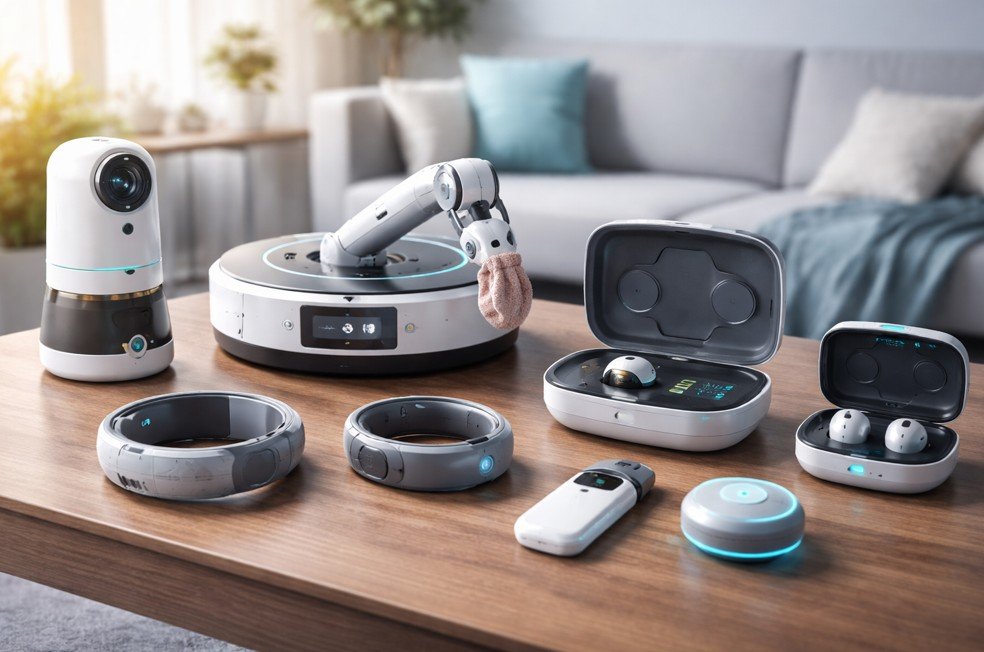
Artificial intelligence is moving beyond phones and computers in Canada, becoming part of the devices people wear, use at home, and carry throughout the day. In 2026, some of the most interesting AI gadgets trending in Canada include smart glasses, AI-powered rings, connected home systems, intelligent earbuds, smart watches, and devices that can understand information from multiple sensors.
The biggest change is that AI gadgets are becoming less like standalone technology and more like assistants that work in the background. Instead of simply displaying information, newer devices can interpret voice commands, recognize objects, analyze health and activity data, translate conversations, automate household functions, and provide personalized recommendations. Current Canadian technology coverage shows that smart glasses are moving toward mainstream consumer products, while Samsung and TELUS are also building AI into wearable and smart-home ecosystems.
AI Smart Glasses Are One of Canada’s Biggest Gadget Trends
Smart glasses are arguably the most visible category in the current AI-gadget boom. Unlike traditional augmented-reality headsets, many of today’s AI glasses are designed to look like ordinary eyewear while adding cameras, microphones, speakers, voice assistants, and AI-powered features.
Canadian technology coverage in 2026 highlights smart glasses as a rapidly expanding category, with products ranging from camera-equipped AI glasses to display-based AR devices. The appeal is straightforward: users can interact with an assistant without constantly reaching for a smartphone.
The most established examples include the Ray-Ban Meta family, which combines conventional eyewear with cameras, open-ear audio, microphones, and Meta AI. The second-generation model has received particularly strong reviews in 2026, with Forbes Vetted naming it its best overall smart glasses after testing multiple contenders.
For Canadian users, smart glasses can be useful for hands-free photography, calls, music, navigation-related assistance, translation, and asking AI questions while moving around. They are particularly interesting for travellers, commuters, creators, and people who want technology to feel less intrusive than constantly looking at a phone.
Why AI Glasses Are Becoming More Popular
The attraction of AI glasses is not necessarily that they replace smartphones. Their real advantage is that they reduce the number of times you need to take your phone out.
Imagine walking through a Canadian city and asking an AI assistant about a building, reading a sign in another language, capturing a photo without stopping, or listening to information while keeping your hands free. These are relatively simple interactions, but the glasses make them feel more natural.
Current 2026 reviews indicate that the category is becoming more mature, with better cameras, audio, battery performance, and AI integration. Tom’s Guide’s latest testing similarly identifies the Ray-Ban Meta Gen 2 as its top AI-glasses choice while highlighting the broader convergence of AI and wearable technology.
The technology is still evolving, however. Battery life, dependence on a smartphone, internet connectivity, and privacy remain important considerations for Canadian buyers.
Privacy Is a Major Issue With AI Glasses
The same cameras and microphones that make AI glasses useful also create one of their biggest challenges.
Because the glasses can capture photographs, video, and audio from the wearer’s perspective, people nearby may not always know when technology is being used. Recent reporting has highlighted growing concerns about privacy, social etiquette, and whether recording indicators are sufficiently obvious.
This is particularly important in workplaces, schools, healthcare environments, restaurants, public transportation, and other situations where people may reasonably expect greater privacy.
Canadian consumers should therefore treat AI glasses as cameras and microphones first, not simply as fashionable accessories. Asking permission before recording people and following the rules of a particular location are sensible habits even when the device itself permits recording.
AI Smart Rings Are Growing in Canada
Smart rings are another important part of the AI gadgets trending Canada conversation.
Unlike smartwatches, rings have no large display competing for attention. Their appeal is continuous, relatively discreet tracking of activity, sleep, heart rate, and other wellness measurements.
Samsung’s Canadian Galaxy Ring is an established example. Samsung describes it as an AI-powered wellness tracker with three sensors, titanium construction, water resistance, and a battery rated for up to seven days. Its collected data can be analyzed through Samsung Health and Galaxy AI to generate personalized wellness and sleep insights.
The category is particularly attractive to people who want wearable data without wearing a traditional smartwatch around the clock. A ring can remain on the finger while sleeping, working, travelling, or exercising without requiring users to interact with a screen constantly.
AI Wearables Are Becoming More Personal
The larger trend behind smart rings and AI glasses is the personalization of wearable technology.
Older wearables primarily collected information and displayed graphs. Newer AI-powered devices increasingly attempt to interpret that information and turn it into recommendations or summaries.
Samsung’s Galaxy Ring, for example, uses Galaxy AI within Samsung Health to provide personalized wellness insights rather than simply presenting raw sensor readings. Samsung also positions its broader Canadian AI ecosystem around connected smartphones, watches, earbuds, tablets, and home devices.
This represents an important change in the user experience. Instead of asking consumers to become experts at interpreting data, AI systems increasingly attempt to explain what the information means in everyday language.
However, wellness insights should not automatically be treated as medical advice. Wearables can be useful for tracking personal patterns, but they should not replace qualified healthcare professionals when someone has a medical concern.
AI-Powered Smart Homes Are Taking Off
The next major category is the AI-powered smart home.
Traditional smart-home technology often required multiple apps, individual device controls, and complicated automation rules. AI is now being used to make those systems easier to manage through natural-language commands and centralized interfaces.
This trend is particularly relevant in Canada because homes can contain a large number of connected devices, including thermostats, cameras, doorbells, lighting systems, televisions, appliances, locks, and security equipment.
TELUS made a notable Canadian move in March 2026 when it launched its SmartHome Assistant. The company says the system can process voice, images, sensor feeds, and video in real time and provide a unified interface for more than 2,000 compatible device models.
The significance is less about one particular smart-home assistant and more about where the category is heading. Canadians increasingly want their connected devices to work together rather than forcing them to manage every product separately.
AI Thermostats and Energy Management
Energy efficiency is another area where AI can have a practical impact in Canadian homes.
Smart thermostats have existed for years, but AI can make them more responsive by learning patterns, considering occupancy, and adjusting settings according to changing conditions.
For Canadian households, this can be especially relevant during winter, when heating can represent a substantial part of household energy use. An intelligent system that understands routines and occupancy may help avoid heating empty rooms unnecessarily while maintaining comfort when people return home.
Samsung’s Canadian AI ecosystem also emphasizes smart appliances and energy-related functionality, including AI-powered home products designed to improve convenience and efficiency.
The most useful AI home devices are therefore not necessarily the ones with the flashiest demonstrations. Devices that quietly automate repetitive tasks may provide greater everyday value.
AI Security Cameras and Doorbells
Home security is another area where artificial intelligence is becoming increasingly important.
Modern cameras can use AI-based recognition to distinguish between people, animals, vehicles, and other movement. This can reduce the number of meaningless alerts and make security systems easier to manage.
Instead of receiving notifications every time a tree moves in the wind or an animal crosses the yard, an intelligent system can potentially prioritize events that are more relevant.
However, homeowners should carefully review how camera footage is stored and processed. AI-powered security devices can collect sensitive information about people, movements, and routines, so privacy settings and data policies deserve as much attention as camera resolution.
AI Earbuds Are Becoming Smarter
Wireless earbuds are also evolving into AI accessories.
Modern earbuds already handle calls, music, noise cancellation, and voice assistants. The next step is deeper integration with AI services that can summarize information, translate conversations, answer questions, and provide contextual assistance.
Samsung’s Canadian Galaxy AI ecosystem includes AI-enabled earbuds alongside smartphones, watches, tablets, and other connected devices.
This category is particularly practical because earbuds are already familiar products. Consumers do not necessarily need to adopt a completely new type of hardware to gain access to AI-assisted interactions.
The most useful AI earbuds are likely to be those that make existing activities easier rather than demanding constant attention.
AI Smartwatches Continue to Evolve
Smartwatches remain one of the most established forms of wearable technology.
The difference in 2026 is that AI is increasingly being used to interpret information collected by watches rather than simply display notifications. Fitness patterns, sleep data, activity levels, and other measurements can be combined to produce more personalized insights.
Samsung’s Canadian AI lineup includes Galaxy Watch models alongside Galaxy Ring and other connected devices, showing how manufacturers are building AI ecosystems that share information across multiple products.
The smartwatch therefore remains an attractive option for people who want one wearable device to handle notifications, fitness tracking, communication, and AI-assisted features.
AI Robots and Home Assistants
Robotics is another emerging area worth watching.
AI-powered robots are becoming more capable of understanding environments, responding to voice instructions, and performing increasingly sophisticated tasks. Consumer robotics is still less mature than smartphones or smart speakers, but improvements in computer vision and AI reasoning are making household robots more interesting.
The long-term goal is a device that can understand not only what a person says but also the context surrounding the request.
For example, instead of requiring a precise command, a future home robot could potentially understand that a person is preparing dinner, identify what they need, and assist with a sequence of related tasks.
For Canadian consumers, this category remains more emerging than mainstream, but it is one of the most closely watched areas of AI hardware development.
AI Devices Are Becoming Multimodal
One of the biggest technology trends behind these gadgets is multimodal AI.
Rather than understanding text alone, newer systems can combine information from cameras, microphones, sensors, location data, and other inputs.
That allows an AI gadget to understand more of the user’s immediate environment. Smart glasses can see what the wearer sees, smart-home systems can combine camera and sensor information, and wearables can combine activity measurements with contextual data.
Research published in 2026 is also exploring how AI agents can work across multiple devices while maintaining context over time. This suggests that the future may involve one AI assistant moving between a smartphone, glasses, watch, home system, and other connected hardware rather than each gadget operating as an isolated product.
The Rise of AI Agents Across Devices
The next phase of smart technology may be less about individual gadgets and more about AI agents that control multiple gadgets.
Imagine an assistant that knows you are leaving home, adjusts the thermostat, checks your calendar, sends a message, gives you directions through earbuds or glasses, and then prepares your home for your return.
That kind of cross-device intelligence is becoming a major research direction. Recent academic work on unified agents specifically examines how AI systems can maintain context across different devices and moments rather than treating every interaction as a separate request.
For consumers, this could eventually mean fewer apps and fewer manual controls. The AI would become the interface connecting different devices.
AI Smart Home Security Still Needs Improvement
More intelligent devices do not automatically mean safer devices.
A recent 2026 research project examining AI-powered smart-home agents found that systems can struggle to distinguish genuine commands from speech or information coming from televisions, conversations, and other ambient sources. The researchers specifically examined prompt-injection and command-confusion risks in multimodal smart-home environments.
This matters because an AI system that can see and hear its environment also has to determine which information it should trust.
Canadian consumers should therefore consider security features, software updates, account protection, local processing options, and manufacturer privacy policies when purchasing connected AI devices.
On-Device AI Is Becoming More Important
Another important trend is the movement toward processing more AI information directly on devices.
On-device AI can potentially reduce dependence on cloud processing, improve responsiveness, and give users greater control over certain types of personal data.
Samsung, for example, highlights the ability to choose where some Galaxy AI data is processed, either locally on the device or in the cloud, through its privacy settings.
For Canadian consumers, this is an increasingly important purchasing consideration. A gadget should not be judged only by what its AI can do but also by what information it collects, where that information goes, and how much control the user has over it.
AI Gadgets and Accessibility
AI gadgets can also have significant accessibility applications.
Smart glasses can potentially describe surroundings, recognize objects, read text aloud, or provide hands-free information. Recent reporting on Meta’s AI glasses has highlighted their potential benefits for people with visual or hearing impairments, even as questions remain about privacy and reliability.
This is an important reminder that AI hardware is not only about convenience or entertainment.
For some users, hands-free access to information can make everyday tasks significantly easier. The best accessibility-focused applications are likely to be those developed around real user needs rather than technology demonstrations.
What Makes an AI Gadget Worth Buying?
The rapid growth of AI gadgets means consumers have more choices than ever.
The most important question is not whether a device contains AI. Almost every modern technology company can now attach an AI label to a product.
Instead, consider whether the AI actually improves the device. A smart ring should provide useful insights rather than simply generate impressive graphs. Smart glasses should make hands-free tasks easier. A smart-home system should reduce complexity rather than add another application to manage.
Battery life, compatibility, privacy, subscription fees, repairability, software support, and availability in Canada are equally important.
Do AI Gadgets Require Subscriptions?
Subscription costs are becoming an important part of the AI gadget market.
Some hardware products provide their core functions without recurring fees, while advanced AI services may require a subscription or depend on a manufacturer’s broader software ecosystem.
This can substantially change the real cost of a device over several years.
Before buying an AI gadget, check whether its most important features are included in the purchase price. A relatively inexpensive device can become much more expensive if essential AI functionality is locked behind a monthly or annual subscription.
AI Gadgets for Work and Productivity
AI wearables can also become useful productivity tools.
Smart glasses and AI earbuds can provide hands-free access to information while travelling or moving around a workplace. Smart rings and watches can help users monitor routines, while AI assistants can summarize information and organize tasks.
The advantage is particularly noticeable when the user needs information without interrupting another activity.
However, productivity gadgets should reduce distraction rather than create more of it. Constant notifications and AI prompts can become another source of digital overload if they are not carefully controlled.
AI Gadgets for Travel in Canada
Travel is another natural use case for smart AI devices.
Smart glasses can assist with translation, navigation-related information, photography, and hands-free communication. Earbuds can provide audio assistance without requiring a user to constantly look at a screen.
For Canadian travellers heading abroad, real-time translation is particularly interesting because AI can potentially interpret signs, menus, and conversations more naturally than traditional translation apps.
Battery life becomes especially important during travel. A device that requires frequent charging may be less useful on long journeys, particularly when users are moving between airports, trains, hotels, and outdoor destinations.
AI Gadgets for Canadian Homes
For households, the most practical AI gadgets are likely to be devices that automate routine activities.
Smart thermostats, security cameras, connected appliances, AI assistants, smart displays, and intelligent lighting can work together to create a more automated environment.
The Canadian market is already moving in this direction. TELUS’s SmartHome Assistant is one example of a Canadian service attempting to bring multiple smart-home devices into a unified AI interface.
Samsung is taking a similar ecosystem approach, positioning AI across home appliances, televisions, smartphones, watches, earbuds, and other devices available to Canadian consumers.
The Future of AI Gadgets in Canada
The biggest shift may be the move from screen-based AI to ambient AI.
Instead of opening an app and typing a question, people will increasingly speak to AI through earbuds, watches, glasses, cars, appliances, and other devices.
The technology will also become more contextual. AI systems will increasingly combine information from multiple sensors and devices to understand what a person is doing and provide assistance at the appropriate moment.
Research into AI glasses and multimodal agents already points toward this direction, although many of the most ambitious applications remain experimental rather than everyday consumer products.
AI Gadgets Trending Canada: What to Watch in 2026
The AI gadgets trending in Canada in 2026 can broadly be divided into several categories: AI glasses, smart rings, intelligent watches, AI earbuds, connected-home systems, security devices, and emerging robots.
Smart glasses currently stand out because they combine familiar eyewear with cameras, audio, and AI assistance. Smart rings are becoming increasingly interesting because they make health and wellness tracking more discreet, while AI-powered homes are attempting to connect multiple devices through a single intelligent interface.
The broader direction is clear: AI is becoming less dependent on a single screen.
Final Thoughts on AI Gadgets in Canada
The most exciting AI smart tech and devices in Canada are not necessarily the gadgets with the longest list of artificial-intelligence features. The real winners will be products that use AI to solve everyday problems more naturally.
Smart glasses can provide hands-free assistance, smart rings can turn health measurements into easier-to-understand insights, and connected-home platforms can simplify an increasingly complicated collection of household devices.
At the same time, Canadians should approach AI hardware with realistic expectations. Privacy, security, battery life, subscription costs, compatibility, and reliability all matter just as much as AI capability.
The next generation of gadgets is likely to make AI feel less like an application and more like an invisible layer surrounding everyday life. In Canada, that transition is already underway through smart wearables, connected homes, AI-powered appliances, and increasingly capable glasses and earbuds.
