

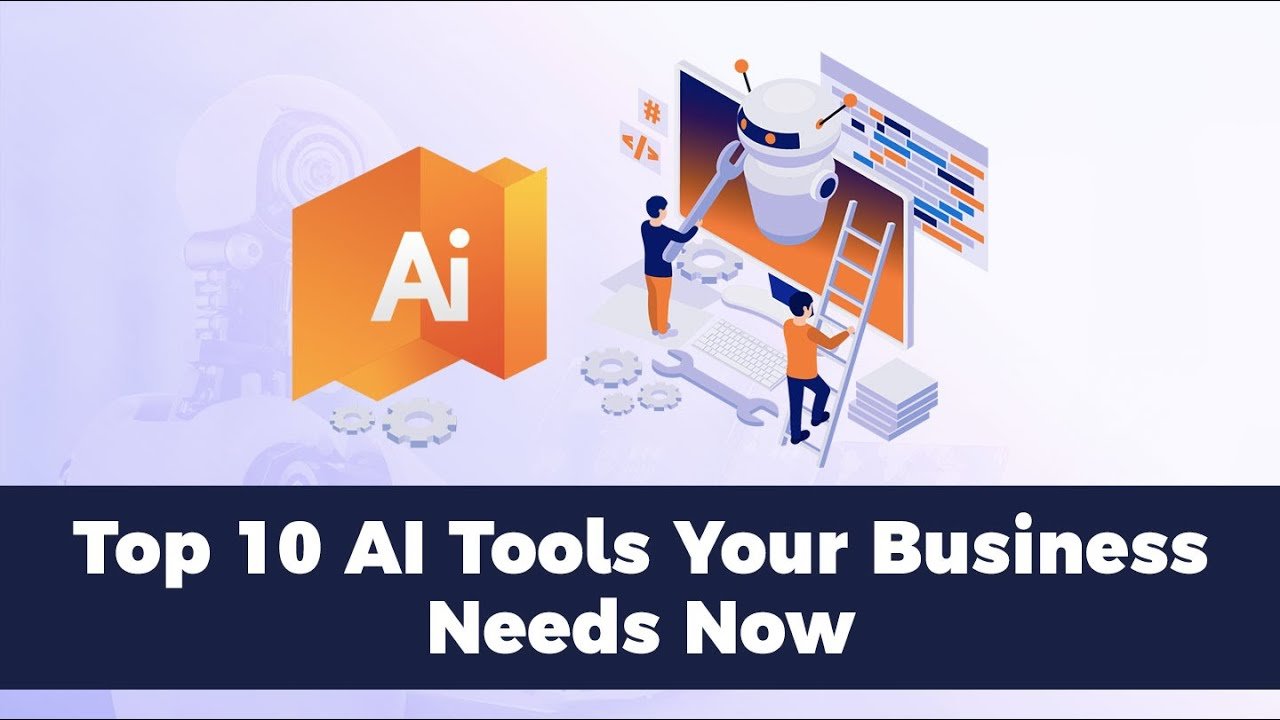
Artificial intelligence has moved from an experimental technology to a practical business tool for small companies across the United States. In 2026, small-business owners can use AI software to write marketing content, analyze spreadsheets, answer customer questions, automate repetitive tasks, create graphics, manage projects, summarize meetings and assist with accounting.
The biggest change is that businesses no longer have to assemble complicated AI systems from scratch. Many of the most useful tools are now integrated directly into software small companies already use, including email, office suites, accounting platforms, project-management systems and automation services.
This guide reviews the best AI software for small business in the USA in 2026, focusing on practical business value rather than simply listing the most technically advanced AI models. Pricing and features can change frequently, so the figures and capabilities discussed here reflect information available in August 2026.
Top AI Software for Small Businesses in 2026: Best Tools to Boost Productivity
The strongest options cover different business needs, so there is no single AI application that is ideal for every company. ChatGPT Business is one of the best general-purpose choices, while Microsoft 365 with Copilot is particularly compelling for businesses already operating inside Word, Excel, Outlook and Teams.
Google Workspace with Gemini is a strong alternative for companies built around Gmail, Docs, Sheets and Meet, while Claude is well suited to writing, research, document analysis and complex knowledge work.
For workflow automation, Zapier is one of the most useful choices, while Notion AI combines documentation, project management, knowledge management and AI agents. Canva is particularly useful for visual marketing, social media and branded content.
Best Overall AI Software: ChatGPT Business
For many small businesses, ChatGPT is the strongest all-purpose AI tool in 2026 because it can support a wide range of everyday business activities from one interface. Teams can use it for drafting emails, preparing proposals, analyzing documents, researching markets, brainstorming campaigns, creating reports, summarizing information and working with structured data.
The business version provides a shared workspace with centralized billing and administration, company context, connections to services such as Microsoft 365, Google Drive, Slack, GitHub, Linear and Figma, plus features including Deep Research, interactive tables and charts, image generation and custom GPTs. According to OpenAI, business data is not used for model training by default.
ChatGPT Business currently costs $20 per user per month when billed annually or $25 per user per month when billed monthly, with a minimum of two standard seats. OpenAI also provides enterprise-level options for larger organizations that need additional controls such as SCIM, role-based access controls, data residency and enhanced support.
For a five-person company, the annual-billing price would represent $100 per month before taxes or additional usage costs. That can be relatively inexpensive if employees use the software for multiple workflows rather than treating it as a simple chatbot.
The biggest advantage is versatility. A small business can use the same AI platform for sales, marketing, operations, research, customer communications and internal knowledge work instead of purchasing a separate AI application for every department.
Best AI for Microsoft-Based Businesses: Microsoft 365 Copilot
For companies already dependent on Microsoft 365, Copilot can be one of the most logical AI investments because the technology is integrated into familiar business applications. Instead of asking employees to copy information into a separate chatbot, AI assistance can operate within the Microsoft environment they already use.
Copilot can assist with tasks across applications such as Word, Excel, Outlook, PowerPoint and Teams, making it particularly relevant to businesses that spend significant amounts of time writing documents, analyzing spreadsheets, preparing presentations or managing meetings.
Microsoft made its new Microsoft 365 Business with Copilot offerings generally available on July 1, 2026. Current listed annual-billing prices include $23.50 per user per month for Business Standard with Copilot and $32 per user per month for Business Premium with Copilot, while a promotional Business Basic plus Copilot Business combination was listed at $21 per user per month through December 2026.
The major benefit is integration rather than simply model capability. A business that already pays for Microsoft 365 may find that adding Copilot produces more practical value than introducing a completely separate AI platform.
Microsoft 365 Copilot is therefore particularly attractive for professional-services companies, sales organizations, consultants, accountants, agencies and other teams whose daily operations revolve around Microsoft documents, email, meetings and spreadsheets.
Best AI for Google Workspace Users: Gemini
Businesses built around Gmail and Google Workspace should seriously consider Gemini before purchasing a separate general-purpose AI platform. Google has integrated Gemini capabilities directly into Workspace applications, allowing employees to use AI within familiar productivity tools.
Current Google Workspace plans include Gemini AI assistance in Gmail, with higher-tier plans extending Gemini into applications such as Docs, Meet and other Workspace services. Google Workspace Standard currently lists 2 TB of pooled storage per user and Gemini assistance across Gmail, Docs, Meet and more.
As of August 2026, Google lists promotional pricing on some Workspace plans, including Business Standard at $9.80 per user per month for a limited introductory period before returning to its regular $14 monthly price. Business Plus is listed at $11 during its promotional period before returning to $22 per user per month.
For a small company already using Gmail, Google Docs, Sheets, Drive and Meet, this integrated approach can reduce software duplication. Employees can use AI where the underlying business information already lives rather than constantly moving documents between different applications.
Gemini is therefore one of the best choices for Google-centric businesses that want AI to become part of their existing productivity environment rather than another disconnected subscription.
Best AI for Writing and Research: Claude
Claude is particularly strong for businesses where written communication, research and long documents are central to the workflow. It can be useful for consultants, attorneys, agencies, researchers, marketers, analysts and other professionals who regularly work with large amounts of text.
Anthropic’s current Claude plans include features such as Projects, Research, Google Workspace connections, extended thinking and integrations with everyday tools. Its Team plan is designed for organizations and provides increased usage, centralized administration and collaboration features.
Anthropic currently lists Claude Team at $25 per person per month when billed annually or $30 per person per month when billed monthly, with a five-member minimum. Enterprise is available for organizations that need additional capabilities such as SSO, SCIM, audit logs and enhanced context.
Claude can be particularly useful when the task involves analyzing lengthy documents rather than producing short answers. Businesses can use it to compare contracts, summarize research, review internal documentation, develop reports or turn complicated source material into clearer explanations.
Its strongest use case is not necessarily replacing every other business application. Instead, Claude can function as a high-quality knowledge-work assistant for employees who spend a significant portion of their day reading, writing and reasoning.
Best AI Automation Tool: Zapier
AI becomes much more valuable when it can trigger actions rather than merely generate text. That is where Zapier can be especially useful for small businesses.
Zapier connects business applications and allows companies to build automated workflows across thousands of apps. Its platform can connect AI assistants and AI actions with business systems, allowing information to move automatically between tools.
Zapier currently offers a free plan with 100 tasks per month, while its Pro plan starts at $19.99 per month when billed annually. The platform uses task-based pricing, meaning the amount of automation a business performs influences its cost.
Its AI functionality also uses different model tiers, with Standard, Advanced and Premium options carrying different task multipliers. Zapier says Advanced is the default for new AI steps, while Premium is intended for more complex tool workflows.
A small company could use Zapier to create workflows such as capturing website leads, adding them to a CRM, generating personalized follow-up material, notifying a salesperson and updating a spreadsheet without requiring an employee to perform every step manually.
That makes Zapier particularly valuable when the objective is not merely to make employees faster but to eliminate repetitive administrative work altogether.
Best AI for Project Management and Company Knowledge: Notion AI
Notion AI is a strong choice for small businesses that want to combine documentation, project management, internal knowledge and AI assistance in one platform. It is particularly useful for teams that have information spread across meeting notes, project documents, databases and operating procedures.
Notion’s Business plan includes Notion Agent, AI Meeting Notes and Enterprise Search. Its AI agents can work with context from Notion, connected applications and the web, while Custom Agents can perform multi-step tasks across a company’s workspace and connected tools.
Notion says AI is included with its Business and Enterprise plans, while Custom Agents can use additional Notion credits based on their activity. The company also states that contractual agreements with its AI subprocessors prohibit the use of customer data to train their models.
For a growing business, the knowledge-management aspect can be just as important as the AI writing capabilities. Instead of keeping procedures in scattered documents and relying on employees to remember how things work, a company can build a central knowledge base that AI can help search and use.
Notion is therefore particularly attractive to startups, agencies, remote teams and professional-services businesses that need a structured internal operating system.
Best AI Design Software: Canva
Small businesses frequently need professional-looking graphics without having a full-time graphic designer. Canva addresses this problem by combining templates and visual-design tools with a growing collection of AI capabilities.
Canva introduced Magic Studio as an AI-powered collection designed to help users generate content, accelerate first drafts, automate tasks and create visual material without requiring advanced design expertise. Canva specifically positions the technology for individuals, teams and organizations.
This makes Canva particularly useful for social-media posts, promotional graphics, presentations, advertisements, simple videos, branded documents and other marketing materials.
The value for a small business is speed. An owner or employee can begin with an idea, generate a first concept and then adapt it to the company’s branding without having to outsource every small design task.
Canva is not a replacement for a professional creative department on sophisticated campaigns, but it can dramatically reduce the time and cost involved in routine visual content.
Best AI for Accounting and Finance: QuickBooks
Accounting is another area where AI can provide practical value, particularly when it is built directly into the financial software a business already uses. Small companies can benefit from AI-assisted categorization, financial analysis, forecasting, invoicing and administrative tasks.
QuickBooks is one of the most prominent small-business accounting platforms in the United States, and Intuit has increasingly incorporated AI capabilities into its ecosystem.
The important consideration is that financial AI should be treated as an assistant rather than an unquestioned authority. Bookkeeping records, tax classifications, payroll information and financial reports can have significant consequences, so business owners should review AI-generated recommendations and maintain appropriate human oversight.
For a small business that already uses QuickBooks, using its built-in AI capabilities can also be more practical than buying a separate financial AI application and then attempting to connect the two systems.
Best AI for Small-Business Marketing
Marketing is one of the easiest areas for a small company to apply AI because much of the work involves repetitive content creation. Businesses can use AI to brainstorm campaigns, draft email newsletters, create social-media variations, develop advertising concepts, summarize customer feedback and repurpose existing content.
A combination of ChatGPT or Claude with Canva can be particularly effective. The AI assistant can help develop the strategy and copy, while Canva can turn the resulting concepts into social posts, advertisements, presentations or other visual assets.
Google Workspace and Microsoft 365 can also play important roles because marketing teams often spend significant amounts of time working with documents, spreadsheets, presentations and email.
The goal should not be to publish AI-generated material without review. Human editing remains important for accuracy, brand voice, originality and compliance, particularly when content makes claims about products, prices, financial matters or regulated industries.
Best AI for Sales and Customer Service
AI can also reduce the administrative burden on small sales teams. A business can use AI to draft prospecting emails, summarize customer conversations, prepare meeting briefs, analyze sales data and create follow-up messages.
For customer service, AI-powered chatbots and automated workflows can handle routine questions while escalating complicated or sensitive cases to human employees. Zapier can be used to connect these workflows with CRM systems, forms, email platforms and other business applications.
The most effective setup usually combines AI generation with structured business data. Instead of asking an AI tool to invent an answer, the system should provide approved product information, policies, pricing and frequently asked questions.
That distinction is important because a customer-service AI that confidently provides incorrect information can create more work and reputational risk than it eliminates.
Best AI Software for a One-Person Business
Solo entrepreneurs should generally avoid purchasing too many specialized AI subscriptions. A small stack consisting of one general-purpose AI assistant, one productivity platform and one design or automation tool can often cover a surprisingly large proportion of daily business needs.
ChatGPT or Claude can handle writing, research, brainstorming and analysis, while Google Workspace or Microsoft 365 can provide email, documents, spreadsheets and meetings. Canva can then cover routine visual marketing needs.
A solo business owner who needs serious automation can add Zapier once repetitive workflows become large enough to justify the expense.
The objective should be to create a simple technology stack where each application has a clear job rather than accumulating multiple tools that perform essentially the same function.
Best AI Software for a Small Team
A small team should think differently from a solo entrepreneur because collaboration, administration and data governance become more important. Once several employees are using AI, the company should ideally establish shared accounts, appropriate permissions and clear policies about what information can be entered into AI systems.
ChatGPT Business, Claude Team, Microsoft 365 with Copilot and Google Workspace with Gemini all provide business-oriented options that go beyond individual consumer accounts. Their administrative and collaboration capabilities can make them more appropriate for organizations than simply purchasing separate personal subscriptions for every employee.
The best platform often depends on the company’s existing software ecosystem. A Microsoft-heavy company may get more value from Copilot, while a Google-centric company may find Gemini more natural.
A company already using Notion extensively may find Notion AI particularly efficient because the AI can work with information already organized inside the business’s workspace.
How Much Should a Small Business Spend on AI?
There is no universal AI budget because the appropriate spending level depends on employee count and the value of the workflows being automated. A solo business might need only one paid AI subscription, while a ten-person company could justify several integrated AI services.
The most useful way to calculate AI spending is through return on investment rather than subscription price alone. If a $20-per-user tool saves an employee several hours each month and improves the quality of their work, the cost can be relatively small compared with the value generated.
Automation deserves particularly close attention because it can eliminate recurring administrative tasks rather than merely accelerating them. If an automated workflow saves 20 minutes every business day, its annual value can quickly exceed the cost of the software.
However, businesses should avoid paying for overlapping tools. Two AI writing assistants may provide only marginally more value than one, while a writing assistant plus an automation platform can cover two fundamentally different business needs.
AI Security and Privacy for Small Businesses
Small businesses should consider data security before employees begin entering customer information, contracts, financial records or proprietary business information into AI systems. The fact that an AI tool is convenient does not automatically mean every type of company data should be entered into it.
Business plans can provide additional administrative and privacy controls compared with consumer accounts. OpenAI, for example, states that it does not train on ChatGPT Business workspace data by default, while Notion says it has contractual arrangements with AI subprocessors prohibiting the use of customer data to train their models.
Companies should establish basic rules covering confidential information, customer data, passwords, financial records, intellectual property and regulated information. Employees should also understand that AI-generated content can contain errors and should not automatically be treated as verified business information.
The strongest AI strategy is therefore not simply “use more AI.” It is to use AI where the benefits are clear while maintaining appropriate human review, security controls and accountability.
How to Choose the Best AI Software for Your Business
Start with the business problem rather than the AI brand. If employees spend hours writing emails and reports, a general-purpose AI assistant may provide the greatest immediate benefit.
If administrative tasks consume substantial time, automation software may deliver a stronger return. If marketing is the bottleneck, an AI design and content stack could be more useful.
Next, look at the software your company already pays for. Businesses using Microsoft 365 should evaluate Copilot before adding another disconnected productivity AI, while Google Workspace customers should examine Gemini’s built-in capabilities.
Finally, test the workflow with real but appropriately protected business scenarios. A tool that looks impressive in a demonstration may provide little value in your company’s actual processes, while a seemingly ordinary feature such as automated meeting notes or spreadsheet analysis could save employees hours every week.
Final Verdict: Best AI Software for Small Business USA 2026
The best overall AI software for small businesses in the USA in 2026 is ChatGPT Business because it provides a broad combination of writing, analysis, research, image generation, workflow assistance, company context and integrations in one business-oriented workspace. OpenAI currently lists Business at $20 per user per month when billed annually or $25 monthly, with a two-seat minimum.
Microsoft 365 Copilot is the better choice for companies deeply invested in Microsoft’s productivity ecosystem, while Google Workspace with Gemini is especially attractive to businesses built around Gmail, Docs, Sheets, Drive and Meet. Current Google Workspace plans incorporate Gemini directly into the productivity suite.
Claude is a strong choice for research-heavy and writing-intensive businesses, particularly when employees work with long documents and complex knowledge tasks. Its Team plan currently starts at $25 per member per month with annual billing and requires at least five members.
Zapier is the leading choice when the priority is connecting applications and automating repetitive workflows, while Notion AI is particularly valuable for businesses that want AI integrated with internal documentation, projects, meeting notes and company knowledge.
Canva is one of the best AI tools for small-business marketing and visual content, while accounting platforms such as QuickBooks can be more practical for financial workflows because AI capabilities are increasingly being incorporated directly into the systems businesses already use.
Ultimately, the best AI software for a small business is the platform that solves a measurable problem rather than the tool with the most impressive list of AI features. Start with one or two high-value workflows, measure the time or money saved, establish sensible data-handling rules, and expand the AI stack only when the results justify the additional cost.
As of August 2026, the small-business AI market is increasingly moving toward integrated AI inside existing business software, rather than requiring companies to replace their entire technology stack. That trend makes 2026 a particularly favorable time for small businesses to adopt AI selectively, focusing on practical productivity, automation and customer value rather than adopting AI simply for its own sake.
