

Looking for ways to earn extra money alongside your studies, full-time job, or daily responsibilities? Starting a side hustle in 2026 is one of the practical ways to develop new skills, build an additional income stream, and potentially turn a small project into a full-time business.
The good news is that you do not need a large investment, professional experience, or an expensive office to get started. Many side hustles can be started from home using a smartphone, laptop, internet connection, and free online tools.
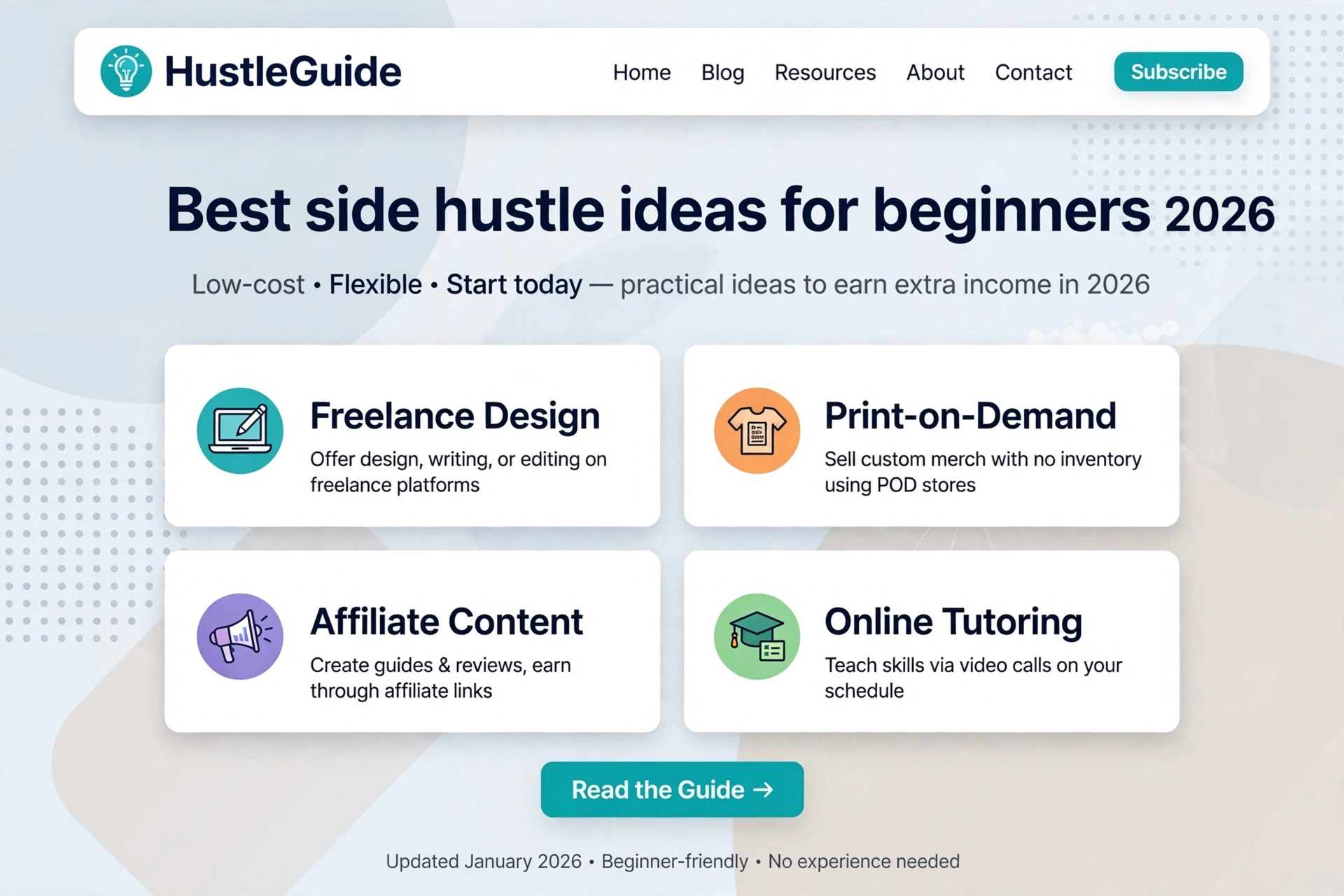
Some of the best side hustle ideas for beginners in 2026 include freelancing, blogging, affiliate marketing, video editing, online tutoring, selling digital products, social media management, virtual assistance, and YouTube content creation. These opportunities allow you to start small, learn while working, and gradually increase your earning potential.
However, not every side hustle is suitable for everyone. Some require creative skills, others involve building an audience, and a few can generate income by providing services directly to customers.
In this guide, we will explore 15 beginner-friendly side hustle ideas, how they work, what you need to get started, and how to choose the right opportunity for your goals.
1. Freelancing – Best Side Hustle for Beginners

Popular freelance skills include content writing, graphic design, video editing, website development, translation, data entry, SEO, and virtual assistance. You can start with one service and gradually expand your offerings as your experience increases.
Platforms such as Fiverr and Upwork allow freelancers to connect with potential customers. You can also find clients through LinkedIn, Facebook communities, and direct outreach to small businesses.
To get started, select a skill, create a few sample projects, and build a simple portfolio. Your first projects may take time to secure, but delivering quality work and communicating professionally can help you develop a strong reputation.
Startup cost: Potentially zero if you already have a suitable device and internet access.
Best for: Students, beginners, professionals, and people who want flexible working hours.
2. Blogging – Best for Long-Term Online Income

Popular blogging niches include technology, education, personal finance, travel, lifestyle, health, and digital marketing. The best approach is to choose a subject that interests you and has an audience searching for helpful information.
You can start publishing through free platforms such as Blogger and WordPress.com. As your audience grows, potential monetization methods include display advertising, affiliate marketing, sponsored articles, and selling your own products.
Blogging usually requires patience because building search traffic takes time. Rather than publishing dozens of generic articles, focus on creating original, informative content that answers real questions.
Startup cost: Zero with a free publishing platform, although a custom domain and hosting may eventually cost money.
Best for: Writers, researchers, students, and people interested in building a long-term online asset.
3. Affiliate Marketing – Earn Through Product Recommendations

This business model is attractive because you do not need to manufacture products, maintain inventory, or manage shipping. Your main responsibility is connecting relevant products with people who may genuinely benefit from them.
You can promote products through a blog, YouTube channel, Instagram account, Facebook page, or email newsletter. For example, a technology creator might review laptops and software, while an education blogger could recommend learning resources and online courses.
Affiliate programs and networks include Amazon Associates and Impact. Their eligibility requirements, commission rates, payment methods, and country availability vary.
The most important factor is trust. Create useful reviews, comparisons, and tutorials instead of posting random affiliate links. Clearly disclose affiliate relationships and provide honest recommendations.
Startup cost: Potentially zero using existing social media or free publishing platforms.
Best for: Bloggers, YouTubers, social media creators, and niche content publishers.
4. Video Editing – Best Creative Side Hustle

As a beginner video editor, you can offer services such as trimming footage, adding subtitles, creating transitions, improving audio, and converting longer videos into short-form clips.
You can learn basic editing using free or freemium applications such as CapCut and DaVinci Resolve. Start by creating sample videos using your own recordings or appropriately licensed footage.
Once you have a small portfolio, approach YouTubers, podcasters, coaches, and small businesses that regularly publish video content. You can initially charge for individual projects and eventually offer monthly editing packages.
Video editing is particularly attractive because you can work remotely and manage projects around your existing schedule.
Startup cost: Low or zero if you already own a capable computer or smartphone.
Best for: Creative beginners, students, and people interested in digital media.
5. Graphic Design – Turn Creativity Into Extra Income

You do not need to become an expert designer before starting. You can learn basic design principles and practice creating logos, Instagram posts, YouTube thumbnails, flyers, and business cards.
Free tools such as Canva make it easier for beginners to create professional-looking designs. As your skills improve, you can explore more advanced software and develop a distinctive design style.
You can find customers through freelancing platforms, social media, and direct contact with small businesses. Creating a portfolio with several sample designs is a good way to demonstrate your abilities and attract your first clients.
Startup cost: Zero with free design tools and an existing device.
Best for: Creative individuals, students, and aspiring digital designers.
6. Social Media Management – Help Businesses Grow Online

As a social media manager, you can help businesses create posts, write captions, schedule content, respond to basic customer messages, and monitor account performance. Some clients may also need assistance with short videos, promotional campaigns, and content planning.
Start by learning how platforms such as Instagram, Facebook, TikTok, and LinkedIn work. Practice creating sample content for a fictional business or a local shop to demonstrate what you can offer.
You can approach restaurants, clothing stores, salons, fitness trainers, and small online businesses that need help improving their social media presence. Once you secure a client, you can offer a monthly service package instead of charging separately for every post.
This side hustle can grow into a digital marketing agency if you eventually work with multiple clients or collaborate with other freelancers.
Startup cost: Zero to low, depending on your equipment and internet access.
Best for: Social media users, creative individuals, and people interested in digital marketing.
7. Online Tutoring – Earn Money by Teaching Others
Online tutoring is a rewarding side hustle for people who are knowledgeable about academic subjects or professional skills. If you are good at mathematics, English, science, programming, or another subject, you can turn that knowledge into an income opportunity.
Students and parents regularly look for additional learning support outside traditional classrooms. You can offer individual lessons, group classes, examination preparation, language instruction, or specialized skill training.
Platforms such as Preply and Superprof provide ways to connect tutors with potential learners, subject to regional availability and platform requirements. You can also find students through local communities and social media.
To begin, choose a subject you understand well and prepare a short demonstration lesson. Explain your teaching approach, the topics you cover, and the type of students you can help.
Online tutoring offers flexibility because you can schedule lessons around your existing responsibilities. As you gain experience, you may expand into group sessions, recorded lessons, or downloadable educational resources.
Startup cost: Potentially zero if you have a smartphone or computer and internet access.
Best for: Teachers, university students, subject experts, and language speakers.
8. Virtual Assistant – Provide Remote Business Support

Typical tasks include managing emails, organizing documents, scheduling meetings, researching information, updating spreadsheets, and handling customer inquiries. Some clients may also need help with social media scheduling, data organization, and online store administration.
You can start learning these skills through free tools such as Google Docs, Google Sheets, Google Calendar, and Trello. You do not need advanced qualifications for every virtual assistant role, although good communication, time management, and attention to detail are essential.
Create a list of services you can provide and prepare a simple portfolio or service description. You can then search for clients on freelance platforms or approach small business owners directly.
As you gain experience, consider specializing in areas such as e-commerce assistance, executive support, customer service, or podcast management. Specialization can help you offer more valuable services and develop long-term client relationships.
Startup cost: Zero if you already have a suitable device and internet access.
Best for: Organized beginners, students, and people seeking remote part-time work.
9. Sell Digital Products – Create Once and Sell Multiple Times

Examples include ebooks, study planners, budget spreadsheets, printable calendars, presentation templates, social media designs, and educational worksheets.
For instance, a student with good organizational skills could create a study planner. A graphic designer could develop editable Instagram templates, while someone experienced in personal finance could prepare a simple budgeting spreadsheet.
You can create many digital products using Canva, Google Docs, and Google Sheets. Platforms such as Gumroad and Payhip offer ways to distribute and sell digital downloads, depending on their supported payment methods and regional availability.
The biggest challenge is finding customers. You need to identify a specific audience, create a product that solves a real problem, and promote it through relevant content and communities.
Start with one product, collect feedback, and improve it before creating a larger collection.
Startup cost: Potentially zero using free creation tools and suitable free selling options.
Best for: Designers, writers, students, educators, and creative entrepreneurs.
10. YouTube Content Creation – Build an Audience and Earn

You do not need an expensive camera to begin. A smartphone, basic lighting, and a clear recording environment can be enough for your first videos.
You can also create videos without showing your face by using screen recordings, tutorials, presentations, animations, or narration. However, faceless content still needs original ideas, useful information, and engaging editing.
YouTube offers monetization through its Partner Program, subject to eligibility requirements and content policies. Creators may also earn through sponsorships, affiliate marketing, and other eligible features.
The main challenge is consistency. You need to understand your target audience, publish useful videos, improve your titles and thumbnails, and study which topics generate genuine interest.
Startup cost: Low or zero if you already own a smartphone.
Best for: Creative people, educators, storytellers, and aspiring influencers.
11. Print-on-Demand – Sell Custom Products Without Inventory
 Print-on-demand allows you to sell customized products without purchasing large quantities of stock in advance. You create original designs for products such as T-shirts, mugs, posters, tote bags, and phone cases, while a production partner handles printing and fulfillment.
For example, you might create motivational T-shirt designs, personalized gifts, or artwork for a particular hobby community. When someone orders a product, the provider produces and ships it according to the arrangement.
Services such as Printful and Printify offer free account options that allow beginners to explore this business model.
However, free registration does not mean the entire business is cost-free. Production, shipping, marketplace fees, and sometimes payment-processing costs still apply. You should understand how these expenses affect your profit before accepting orders.
Start with a small collection of original designs and research the interests of your target customers. Avoid copyrighted characters, logos, and artwork that you do not have permission to use.
Startup cost: Low, although some selling and fulfillment arrangements require working capital.
Best for: Designers, artists, and people interested in e-commerce.
12. Transcription and Translation – Earn Through Language Skills

Transcription involves listening to recorded speech and converting it into accurate text. Translation involves communicating the meaning of written or spoken material in another language while maintaining its context and accuracy.
You can begin by practicing with publicly available audio recordings and developing your typing speed and proofreading skills. Tools such as Google Docs can help organize your work, while AI transcription applications can assist with initial drafts when the client permits their use.
Potential opportunities include podcast transcription, interview documentation, educational recordings, subtitles, and general translation projects. You can look for clients through freelancing platforms and professional communities.
Accuracy is extremely important, especially when working with legal, medical, technical, or confidential material. Only accept specialized work when you have the necessary knowledge and qualifications.
Startup cost: Potentially zero with existing equipment.
Best for: Language learners, bilingual individuals, and people with strong typing skills.
13. Sell Photography and Digital Artwork Online
If you enjoy taking photographs or creating digital artwork, you can turn your creative hobby into a side hustle. Businesses, website owners, advertisers, and content creators regularly need high-quality images for their projects.
You can take photographs of landscapes, architecture, food, everyday objects, travel destinations, and other subjects that have commercial or editorial value. Digital artists can also create illustrations, backgrounds, icons, and other original visual assets.
Stock photography platforms such as Adobe Stock and Shutterstock offer opportunities for eligible contributors to license their work. Each platform has its own submission, quality, and payment requirements.
You do not necessarily need an expensive camera. Modern smartphones can produce useful images when lighting, composition, and image quality are handled properly.
Building a portfolio takes time, and individual image sales may generate relatively small amounts. Focus on producing original, technically strong work and learning which types of images customers need.
Startup cost: Zero if you already have a smartphone or camera.
Best for: Photography enthusiasts, digital artists, and creative beginners.
14. Podcast Editing – Help Creators Produce Better Audio

As a beginner editor, you can offer services such as audio trimming, noise reduction, volume balancing, intro and outro placement, and basic show-note preparation.
You can learn the fundamentals using free audio software such as Audacity. With practice, you can develop a workflow that makes editing faster and improves the listening experience.
Start by editing a few sample recordings and creating before-and-after demonstrations. Then approach independent podcasters, online educators, interview channels, and small production teams.
As you gain experience, you can offer additional services such as video podcast editing, short-form clips, transcription, and episode publishing support.
Startup cost: Zero or low if you already have a computer and headphones.
Best for: Audio enthusiasts, detail-oriented beginners, and video editors.
15. Online Reselling – Buy and Sell Products for a Profit
Online reselling involves purchasing or sourcing products and selling them to customers at a higher price. It can be a flexible side hustle for people who understand product demand, pricing, and customer preferences.
You can begin by selling items you already own but no longer need. Clothing, books, electronics, accessories, home decorations, and collectible products are examples of items that may have resale value.
As you learn what customers want, you can explore sourcing secondhand goods, refurbished products, or other suitable inventory. Social media marketplaces and local selling platforms can help you connect with potential buyers.
In Pakistan, beginners may explore Facebook Marketplace, WhatsApp groups, and local online selling channels. Daraz is another option for sellers who meet its marketplace requirements.
Start with products that are easy to photograph, describe, store, and deliver. Calculate your purchase price, delivery costs, packaging, platform fees, and other expenses before deciding on a selling price.
Unlike freelancing, reselling may require some initial working capital, so selling your existing belongings is a sensible way to test the idea without buying inventory.
Startup cost: Zero when selling your existing items; higher if purchasing stock.
Best for: Beginners interested in e-commerce, product research, and sales.
Quick Comparison: 15 Best Side Hustles for Beginners in 2026
Here is a simple comparison to help you identify which opportunity matches your skills, available time, and budget.
|
Side Hustle |
Initial Investment |
Best For |
|---|---|---|
|
Freelancing |
Very low |
Selling professional skills |
|
Blogging |
Low |
Long-term content income |
|
Affiliate marketing |
Very low |
Product promotion |
|
Video editing |
Low |
Creative work |
|
Graphic design |
Very low |
Visual creativity |
|
Social media management |
Very low |
Digital marketing |
|
Online tutoring |
Very low |
Teaching and education |
|
Virtual assistance |
Very low |
Administrative work |
|
Digital products |
Very low |
Creative entrepreneurs |
|
YouTube |
Low |
Content creation |
|
Print-on-demand |
Low |
Custom product designs |
|
Transcription and translation |
Very low |
Language skills |
|
Photography |
Low |
Creative photography |
|
Podcast editing |
Low |
Audio production |
|
Online reselling |
Variable |
Buying and selling |
Very low means you may be able to start with equipment and resources you already own. It does not mean every business has zero operating costs.
How to Choose the Right Side Hustle for Your Lifestyle
The best side hustle is not necessarily the one with the highest advertised earning potential. It is the one that matches your skills, available time, financial situation, and interests.
Before choosing an opportunity, consider these factors.
1. Consider Your Existing Skills
Think about what you can already do. If you are good at writing, freelancing or blogging may be suitable. If you enjoy teaching, online tutoring could be a better option.
Starting with existing skills can reduce the time required to become ready for your first customer.
2. Decide How Much Time You Can Commit
Some side hustles require regular communication with clients, while others allow you to work whenever you have free time.
For example, virtual assistance and social media management may involve ongoing responsibilities. Blogging, photography, and digital product creation can offer more flexible schedules, although they still require consistent effort.
3. Understand the Initial Costs
If you have limited money, prioritize opportunities that use equipment and software you already own.
Freelancing, tutoring, and transcription are often easier to start without purchasing inventory. Print-on-demand and reselling may require money to cover production, shipping, or stock.
4. Think About Long-Term Growth
Some side hustles provide payment for individual tasks, while others can develop into larger businesses.
Freelancing can grow into an agency, blogging can become a content business, and digital product sales can expand into a complete online store. Choose an opportunity that offers room to improve and expand if that is part of your goal.
Best Side Hustles for Different Types of Beginners
If you are still unsure which idea to choose, consider these recommendations.
-
For students: Freelancing, online tutoring, graphic design, and video editing.
-
For people with full-time jobs: Blogging, affiliate marketing, digital products, and photography.
-
For beginners with no experience: Virtual assistance, online reselling, transcription, and basic social media services.
-
For creative individuals: Graphic design, video editing, photography, and YouTube.
-
For people with limited budgets: Freelancing, tutoring, and selling existing belongings.
-
For long-term income opportunities: Blogging, YouTube, affiliate marketing, and digital products.
-
For people who prefer working from home: Virtual assistance, online tutoring, podcast editing, and freelance writing.
How to Start Your First Side Hustle in 30 Days
You do not need to wait until you have mastered every skill before getting started. A simple 30-day plan can help you turn an idea into a practical side project.
Choose one side hustle
Identify your strongest skills, research potential customers, and select one opportunity that fits your schedule and budget.
Learn and prepare
Practice the necessary skills, explore free tools, and create sample projects or a basic portfolio.
Find potential customers
Create a professional profile, publish examples of your work, contact relevant businesses, and apply for suitable opportunities.
Work toward your first payment
Follow up with potential customers, improve your offer, complete initial projects, and request feedback from clients.
Your first month should be about learning, testing, and finding opportunities. Earning money within 30 days is possible for some people, but it is not guaranteed.
Best Free Tools to Help You Start a Side Hustle
You can reduce your initial expenses by using free software for everyday business activities.
|
Tool |
Main Purpose |
|---|---|
|
ChatGPT |
Ideas, writing, and research assistance |
|
Canva |
Graphic design |
|
CapCut |
Video editing |
|
Google Docs |
Writing and documents |
|
Google Sheets |
Tracking income and expenses |
|
Trello |
Task and project management |
|
Audacity |
Audio editing |
|
Notion |
Organizing projects and notes |
Most of these tools offer free plans, although advanced features and usage limits vary.
Common Side Hustle Mistakes Beginners Should Avoid
Starting a side hustle can be exciting, but several common mistakes can prevent beginners from making progress.
Trying too many ideas at once: Focus on one opportunity instead of switching between different business models every few days.
Expecting instant money: Most side hustles require time to develop skills, attract customers, and establish trust. Avoid unrealistic income promises.
Ignoring skill development: Even simple services require practice. Spend time improving the quality of your work rather than focusing only on finding customers.
Spending too much initially: Avoid purchasing expensive equipment, courses, and subscriptions before validating your idea.
Falling for online scams: Be careful with opportunities that promise guaranteed income, require suspicious upfront payments, or ask you to recruit others to earn commissions.
Neglecting your main responsibilities: A side hustle should fit around your studies, job, and personal life. Create a realistic schedule that you can maintain.
Final Thoughts: Which Side Hustle Should You Start in 2026?
The 15 side hustle ideas discussed in this guide offer different opportunities for beginners to earn extra money, develop valuable skills, and explore entrepreneurship in 2026.
Freelancing, video editing, graphic design, and virtual assistance are practical choices if you want to offer services and work directly with customers. Blogging, YouTube, affiliate marketing, and digital products may be better suited to people interested in building an audience and developing longer-term income opportunities.
Our recommendation: If you are a complete beginner with little or no money, start with freelancing, online tutoring, or social media management. These options allow you to use existing skills, find customers, and build experience without purchasing inventory.
If you prefer creating content, consider blogging or YouTube. If you enjoy designing things, explore graphic design and digital products.
Remember that a side hustle is not a shortcut to becoming rich. It is an opportunity to turn your spare time into something productive, develop skills, and gradually create another source of income.
Start with one idea, remain consistent, learn from your mistakes, and improve your work. Your first small project could eventually become a valuable business opportunity.
