

A Michigan business entity search is an essential tool for entrepreneurs, small business owners, investors, legal professionals, and anyone interested in verifying a company registered in the state of Michigan. By searching the state’s official business records, users can find information about existing businesses, check the availability of a proposed business name, verify an entity’s registration status, and review publicly available corporate information.
Whether you are planning to start a limited liability company (LLC), establish a corporation, register a nonprofit organization, or conduct due diligence on an existing business, understanding how the Michigan business entity search works can help you make informed decisions. The process is particularly useful before filing formation documents, entering into a business agreement, or investing in a company.
Michigan maintains business registration records through the Michigan Department of Licensing and Regulatory Affairs (LARA), which oversees the state’s Corporations Division. Its online business services allow users to access business entity information and complete various registration-related tasks.
This complete guide explains how to perform a Michigan business entity search, check business name availability, understand entity records, interpret registration statuses, and navigate the process of starting or verifying a business in Michigan.
What Is the Michigan Business Entity Search?
The Michigan business entity search is an online records lookup service that helps users locate businesses registered with the state. Depending on the information available for a particular entity, search results may include the business’s legal name, identification number, entity type, formation or registration date, current status, and registered office information.
These records are useful because they provide an accessible way to verify a business’s identity and confirm whether it appears in the state’s official registration database. They can also help distinguish between businesses with similar names, reducing the risk of confusion when researching a company or preparing legal documents.
The search service is administered through Michigan LARA, which is responsible for business entity filings and related corporate records. Users should begin with the department’s official website to ensure they are consulting the appropriate state source rather than relying solely on third-party directories or commercial search websites.
Why You Should Search Michigan Business Entities
Conducting a business entity search is an important step when establishing a new company or researching an existing organization. One of its most common purposes is to determine whether a proposed business name is distinguishable from names already recorded by the state.
A name search can help entrepreneurs identify potential conflicts before investing in branding, website development, marketing materials, or legal filings. However, finding no exact match does not automatically guarantee that a name will be approved, because Michigan’s naming requirements and the details of existing records may affect the final determination.
Business searches are also valuable for due diligence. Before signing a contract, extending credit, entering a partnership, or engaging a service provider, individuals and organizations may want to confirm that the business exists in state records and review its reported registration status.
Investors, lenders, suppliers, and professional advisers can use available entity information as one part of a broader verification process. A state registration record alone does not establish that a company is financially sound, properly licensed for every activity, or free from legal disputes.
Another important reason to search business records is to identify the correct legal entity. A company may operate under a trade name that differs from its registered legal name, and a search can help users locate the underlying entity when sufficient identifying information is available.
How to Perform a Michigan Business Entity Search
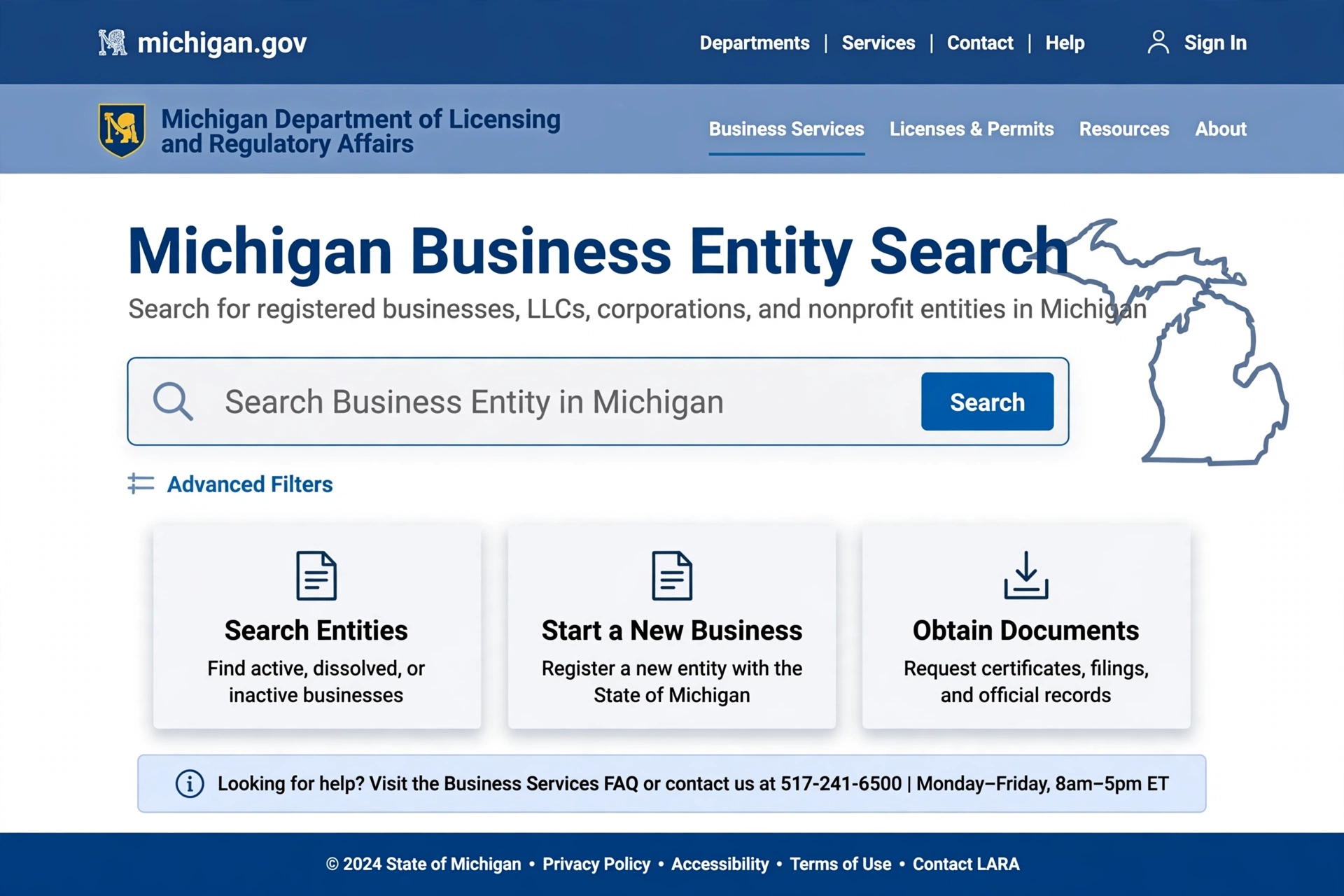
Searching for a business in Michigan is generally straightforward when you have the company’s legal name or identification number. The most reliable approach is to use the official LARA business services portal and follow the available instructions for accessing business entity records.
Begin by visiting the Michigan LARA website and navigating to its Corporations Division or business entity search services. Use the official search interface provided by the department, as website layouts and available search options may change over time.
Step 1: Open the Official Michigan Business Search Portal
locate the Corporations Division section. Look for the business entity search or online business services option that provides access to registered business records.
Using the official state portal helps reduce the likelihood of relying on outdated information or websites that charge fees for information available through government resources. If the portal redirects you to a dedicated state business services platform, follow that official link to continue.
Step 2: Enter the Business Name
Enter the business’s legal name in the search field, using the spelling that appears on contracts, invoices, formation documents, or other reliable records. If the first search does not produce a result, try a shorter portion of the name or remove punctuation and other nonessential characters.
For example, if you are looking for a company named “Great Lakes Technology Solutions LLC,” you might try searching for “Great Lakes Technology Solutions” or a distinctive portion of that name. Search options and matching rules can vary, so trying reasonable variations may help identify the correct record.
Step 3: Search by Identification Number When Available
If you know the company’s Michigan identification number or another identifier accepted by the search portal, use it to narrow the results. An identification number can be especially useful when multiple entities have similar names or when a company has changed its legal name.
Before relying on a result, compare the displayed name and other available details with the information supplied by the business. Matching an identification number and legal name provides a stronger basis for identifying the correct entity than relying on a similar name alone.
Step 4: Review the Search Results
Examine the results for the business’s exact legal name, entity type, registration status, and other available identifying information. If multiple businesses appear, compare the details carefully instead of assuming the first result is the intended company.
Select the relevant record to review any additional information made available through the state portal. Depending on the entity and the records accessible online, you may be able to find information about filing history, registered office details, or other business record entries.
Step 5: Verify Important Information
Once you have located the business, confirm that the information is consistent with the documents or details you already possess. Pay particular attention to the entity’s legal name, identification number, current status, and any relevant filing dates.
For legal transactions, financing decisions, or formal compliance work, consider obtaining the appropriate official document or certificate when a basic online search result is insufficient. A search result is useful for preliminary verification, but it should not be treated as a substitute for a certified record when formal evidence is required.
How to Check Michigan Business Name Availability
Checking business name availability is an important step before forming an LLC or corporation in Michigan. A proposed name must comply with applicable state naming rules and be distinguishable from existing names in the relevant business records.
Start by searching the proposed name through the official Michigan business entity search service. Search the complete name and several meaningful variations to identify existing entities that may create a potential naming conflict.
For example, an entrepreneur planning to establish “Northern Trail Consulting LLC” should search that exact phrase and may also want to search “Northern Trail Consulting” without the entity designation. This broader approach can reveal similarly named businesses that deserve closer examination.
If no conflicting name appears, the proposed name may be a candidate for registration, but search results do not guarantee acceptance. The state makes the final determination based on the applicable requirements, and name availability can change as new filings are submitted.
Business owners should also consider trademarks, domain names, and other branding concerns. A name that is acceptable for state business registration may still raise trademark issues or conflict with another company’s established brand.
Before committing to a name, review the relevant Michigan naming rules and consider whether a federal or state trademark search is appropriate. Separately check whether the desired website domain and social media usernames are available if they are important to the business’s marketing strategy.
Michigan LLC Name Search
An LLC name search is particularly important for entrepreneurs who want to establish a limited liability company in Michigan. The chosen name must satisfy the state’s applicable LLC naming requirements, including any required designation indicating that the business is a limited liability company.
Search the proposed name in the official state database before preparing the Articles of Organization. If similar names appear, review the available details and consider alternative names that are more distinctive.
A distinctive LLC name can make a business easier to identify in public records and may help reduce confusion among customers, suppliers, and business partners. However, a state-approved name does not automatically provide exclusive trademark rights or prevent every other business from using similar branding.
After selecting an appropriate name, applicants can review the Michigan LARA instructions for forming an LLC and submitting the required documents. They should also consider other startup requirements, such as obtaining an employer identification number when applicable, opening a business bank account, and meeting relevant tax or licensing obligations.
Michigan Corporation Name Search
Businesses planning to establish a corporation in Michigan should perform a corporate name search before submitting formation documents. The proposed corporate name must satisfy the naming rules that apply to the intended type of corporation and must be acceptable under the state’s registration requirements.
A preliminary search can identify corporations with identical or similar names and help applicants decide whether an alternative name is necessary. Searching by distinctive words rather than only by the full proposed name may reveal related records that would otherwise be overlooked.
Entrepreneurs should distinguish between a corporation’s legal name and any assumed name or trade name it uses in commercial activities. A corporation may advertise under a different name, so identifying the underlying legal entity is important when reviewing contracts, invoices, licenses, and official records.
Once a suitable name has been identified, applicants should consult Michigan LARA’s corporate filing instructions for the appropriate formation documents. Corporations may also have governance, reporting, tax, and licensing responsibilities that differ from those of LLCs and other business structures.
Understanding Michigan Business Entity Types
Michigan’s business records may include several types of legal entities, each designed for different ownership arrangements, operational needs, and regulatory obligations. Understanding the type of entity associated with a search result can help users interpret the record and determine what additional information they need.
Limited Liability Company (LLC)
A limited liability company is a popular structure for small businesses because it combines flexible management arrangements with liability protections that generally separate the business’s obligations from the personal assets of its owners, subject to applicable legal exceptions. LLCs may be managed by their members or by appointed managers, depending on their governing arrangements.
When reviewing an LLC record, users should confirm the legal name and registration status and check any additional information relevant to the transaction. State registration alone does not establish the LLC’s tax classification, financial position, or compliance with every regulatory requirement.
Corporation
A corporation is a separate legal entity that generally operates under a more formal governance structure involving shareholders, directors, and officers. Corporations may be appropriate for businesses seeking outside investment, issuing shares, or establishing a defined ownership and management framework.
A corporate entity search can help identify the registered company and confirm its recorded status. For more extensive due diligence, users may also need corporate documents, financial records, licensing information, and other materials not necessarily included in the public search results.
Nonprofit Corporation
Nonprofit corporations are formed for purposes that may include charitable, educational, religious, scientific, or other eligible activities. Their formation and governance obligations can differ from those of for-profit corporations.
A Michigan business entity search may help verify a nonprofit corporation’s state registration. However, state nonprofit incorporation does not automatically establish that the organization has federal tax-exempt status or qualifies for every available tax benefit.
Organizations and donors seeking to verify charitable status should consult the relevant federal and state resources in addition to Michigan’s corporate records.
Limited Partnerships and Other Entities
Michigan records may also include partnerships and other legal entities formed or registered under applicable state laws. The responsibilities of owners and managers, filing requirements, and available legal protections depend on the specific entity type.
When reviewing one of these records, users should confirm the entity classification and consult the governing rules that apply to it. The correct legal structure can influence ownership rights, taxation, liability, and reporting responsibilities.
How to Understand Michigan Business Entity Status
A business entity’s status is one of the most important details to review during a Michigan business search. Status information helps indicate how the entity is represented in the state’s records, but the meaning of a particular label depends on the terminology used by the portal and the entity’s circumstances.
An entity displayed as active or in good standing may generally be represented as current in the relevant state records. Nevertheless, the precise meaning of a status label should be confirmed through the state’s definitions and any related filing information.
A dissolved, withdrawn, or otherwise inactive entity may no longer be authorized to conduct business in the same manner as an active entity, depending on the entity type and the applicable legal circumstances. Some records may remain available even after an entity ceases operations, which is why finding a business in the database does not automatically mean it is currently operating.
If a record indicates that a business is not in good standing or has an unresolved filing issue, review the available details before drawing conclusions. The underlying reason may relate to a missed filing, an administrative action, or another matter requiring further verification.
For transactions that depend on current legal status, check the most recent official record and consider obtaining a certificate of good standing or the corresponding certificate available for the entity type. A certificate may provide more appropriate evidence than a search result when a bank, contracting party, regulator, or other institution requires formal verification.
Michigan Registered Agent and Registered Office Information
A registered agent is a designated person or organization responsible for receiving certain official communications and legal documents on behalf of a business. Registered agent requirements and related terminology vary by entity type, so users should consult the rules that apply to the specific business they are researching.
Michigan business records may provide registered office information and other related details, depending on the entity and the public information available. These details can help users identify the appropriate destination for formal correspondence or verify information supplied by a company.
It is important to distinguish a registered office from a company’s primary operating location. A registered office may be used to satisfy legal requirements and receive official documents, while the business may conduct its everyday operations elsewhere.
When contacting a business or delivering formal documents, verify the current information and follow the applicable legal procedures. A search result should not be used as the sole basis for assuming that a particular address is the company’s only business location or that every type of communication can be sent there.
How to Find a Michigan Business Identification Number
A Michigan business identification number helps distinguish one registered entity from another. It can be especially useful when searching for businesses with similar legal names or reviewing records associated with a company that has undergone a name change.
To locate the number, search for the business by its legal name through the official state portal and review the resulting record. If several similar entities appear, compare their names and other available details before identifying the correct number.
Once you have the identification number, retain it for future reference and use it when the state portal or a relevant filing process requests it. This can make subsequent searches more efficient and reduce the chance of confusing one business with another.
A Michigan business identification number should not automatically be treated as interchangeable with a federal employer identification number (EIN). The EIN is issued by the Internal Revenue Service for federal tax administration, while state business identifiers serve a different administrative purpose.
How to Check Michigan Business Filing History
A company’s filing history can provide useful context about its registration and administrative activity. Where available, historical records may help users understand when an entity was formed, whether it has submitted subsequent documents, and whether its recorded information has changed.
To review a filing history, locate the business through the official Michigan business search service and open its record. Look for available document listings, filing dates, or links to additional records, keeping in mind that the amount of detail available online may vary.
Filing history can be particularly helpful during due diligence when a business has changed its name, amended its formation documents, or experienced a change in its recorded status. Reviewing the chronology of available records may help users identify questions that should be addressed before entering a transaction.
However, a filing history is not a complete account of a company’s financial performance, ownership arrangements, contractual obligations, or legal disputes. Users conducting significant due diligence should request appropriate supporting documents and consult qualified professionals when necessary.
How to Obtain Official Michigan Business Documents
Sometimes, a basic entity search does not provide enough evidence for a formal business transaction. In those situations, users may need to obtain official copies of filed documents, certificates, or other records through the Michigan LARA services available for the relevant entity type.
The documents required depend on the purpose of the request. For example, a lender may require evidence of good standing, while a business owner may need a copy of formation documents or a filed amendment to complete another administrative process.
Begin by identifying the exact document you need and checking the official state instructions for ordering or downloading it. Review any applicable fees, processing options, eligibility requirements, and delivery methods before submitting the request.
If the document will be used in a legal proceeding, financial transaction, or filing with another government agency, confirm whether an ordinary copy, a certified copy, or a specific certificate is required. Obtaining the correct document at the outset can help avoid unnecessary delays.
Michigan Business Entity Search Fees
The cost of searching for a business depends on the service being used and the type of information requested. Basic access to state business search information may be available without a separate search fee, while certain documents, certificates, filings, or expedited services may involve charges.
Users should distinguish between looking up an existing entity and submitting a new filing. Searching a company’s record is a research activity, whereas forming an LLC, incorporating a company, reserving a name where permitted, or requesting official documents may be subject to separate requirements and fees.
Third-party websites may also charge for business information or assistance with state filings. Before paying for a service, compare its offering with the official Michigan LARA resources and determine whether the additional convenience is worth the cost.
Because fees and procedures can change, consult the current state fee schedule or the instructions for the specific service you need. Avoid relying on an old article or an unofficial website as the final authority on current filing costs.
Common Problems With Michigan Business Entity Searches
Although online business searches are generally simple, users may occasionally have difficulty locating the correct record. One common issue is entering a business’s marketing name rather than its registered legal name, which can produce incomplete or unexpected results.
To address this problem, search for alternative spellings, distinctive words, and known legal designations. If the business operates under a trade name, look for information connecting that name to the underlying legal entity, and consider checking other relevant official records when appropriate.
Another issue occurs when several businesses have similar names. In these cases, the identification number, entity type, recorded address, and other available details can help distinguish the correct business from unrelated entities.
Search results may also be affected by recent filings, processing times, or differences between the information displayed by various websites. If a new filing does not appear immediately, consult the state’s processing guidance or contact the appropriate department rather than assuming that the filing has been rejected.
Finally, users sometimes mistake the presence of a record for proof that a business is licensed, financially healthy, or legally authorized to perform a particular regulated activity. Business registration is only one component of verification, and additional checks may be necessary depending on the industry and purpose of the search.
Michigan Business Entity Search vs. Federal Business Search
A Michigan business entity search focuses on records maintained by the state for businesses formed or registered under its laws. It is particularly relevant when verifying a Michigan LLC, corporation, or another entity whose registration is handled through the state’s business filing system.
Federal business-related searches serve different purposes. For example, the Internal Revenue Service administers federal tax identification and tax-related matters, while the United States Patent and Trademark Office maintains federal trademark records.
These systems are not interchangeable, and no single search establishes every fact about a company. A business may be registered in Michigan while also having federal tax obligations, trademark registrations, industry-specific licenses, or registrations in other states.
The most effective verification process uses the source appropriate to the question being asked. Check Michigan’s official business records for state entity information, federal resources for federal tax or trademark matters, and relevant state or federal licensing authorities for regulated business activities.
What to Do After Finding a Michigan Business Entity
After locating a business in the state database, determine whether the available record answers your original question. If you only needed to confirm that an entity appears in the state’s records, the basic search may be sufficient for preliminary research.
If you are preparing to form a company, use the results to assess potential naming conflicts and then review the official formation requirements for your chosen entity type. You should also evaluate tax registration, permits, licenses, insurance, and other obligations relevant to your proposed activities.
If you are researching another company, compare the record with information from the business itself and other reliable sources. For a contract, investment, loan, or significant purchase, consider requesting additional documents and verifying the company’s authority to conduct the relevant activity.
Maintain a record of the information you reviewed and the date of your search when the research forms part of a formal due diligence process. Because business records can change, repeat the search when current status is important to a later decision.
Frequently Asked Questions About Michigan Business Entity Search
Is the Michigan business entity search free?
Basic business entity lookup services may be accessible without a separate search charge through official state resources. However, filing documents, ordering certificates, obtaining certain copies, and using additional services may involve fees, so review the current Michigan LARA instructions before proceeding.
How do I check whether a business name is available in Michigan?
Search the proposed name through the official Michigan business entity search service and review any identical or similar names. The absence of an obvious conflict is only a preliminary indication, because the state makes the final determination under its applicable naming rules.
Can I search for a Michigan LLC online?
Yes. The official state business records service can be used to look for registered LLCs and review available entity information. Searching by the legal name or an available identification number can make it easier to locate the correct company.
How do I know whether a Michigan business is active?
Locate the entity in the official state database and review its displayed status and related record information. If the distinction is important for a legal or financial transaction, confirm the meaning of the status and consider obtaining the appropriate official certificate.
Can I find a company’s owner through a Michigan business search?
A basic entity search may not disclose every owner, member, shareholder, or beneficial owner. The information available depends on the entity type, the filings made, and the records accessible through the state portal, so additional documentation may be needed to establish ownership.
Does a Michigan business search provide an EIN?
A state business record may display a state identification number, but that number is not necessarily the company’s federal employer identification number. EIN-related information should be verified through appropriate IRS processes or documentation supplied by the business, subject to applicable access and disclosure rules.
Can I search for a dissolved Michigan business?
Historical business records may remain available for entities that have dissolved or otherwise ceased active registration. The record’s status and available filing history can help explain its administrative history, but further documentation may be necessary to establish the legal consequences of dissolution.
How often should I check a Michigan business record?
The appropriate frequency depends on the purpose of the search. A preliminary lookup may be enough for casual research, while lenders, contracting parties, investors, and compliance teams may need to verify records again before a transaction or other important decision.
Conclusion
The Michigan business entity search is a valuable resource for entrepreneurs, business owners, investors, and anyone who needs to verify a company’s state registration. By using the official Michigan LARA resources, searching carefully by legal name or identification number, and reviewing available status and filing information, users can make better-informed decisions about business formation and verification.
The search is especially useful for checking potential LLC and corporation names, identifying registered entities, and conducting preliminary due diligence. Nevertheless, it should be treated as one part of a broader verification process rather than definitive proof of a company’s financial condition, licensing, ownership, or legal compliance.
For the most reliable results, start with Michigan’s official business services, confirm important details against current records, and obtain the appropriate certificates or supporting documents when formal evidence is required. Taking these steps can help reduce administrative errors, avoid preventable naming problems, and support more confident business decisions in Michigan.
