


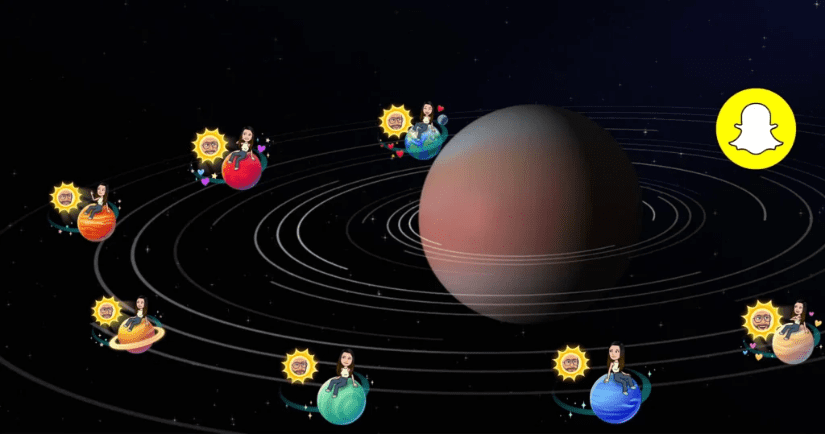
Snap.Planets is a term commonly used online to describe Snapchat’s Friend Solar System, a feature associated with Snapchat+. It transforms friendship rankings into a solar-system-style display, placing the user at the center while representing their closest Snapchat connections as individual planets.
The idea is designed to make Snapchat’s Best Friends relationships easier to understand visually. Instead of simply viewing a conventional list, eligible Snapchat+ users can see where a friend falls within their top eight connections through a planet-based ranking system.
What Is Snap.Planets?
Snap.Planets is not the official name of a separate Snapchat social network or standalone application. The term is generally used by websites and users when referring to Snapchat’s Friend Solar System and the eight planet positions associated with it.
Snapchat’s Friend Solar System follows the traditional planetary sequence from Mercury through Neptune. Your assigned planet indicates your position in another user’s friendship ranking based on the way Snapchat organizes these connections.
How Does Snapchat’s Friend Solar System Feature Work?
The basic concept is relatively simple. You appear at the center as the Sun, while as many as eight of your closest Snapchat friends are shown as planets positioned around you.
Mercury represents position number one, Venus represents number two, and the sequence continues through Earth, Mars, Jupiter, Saturn, Uranus, and Neptune. In this planetary ranking, Neptune corresponds to the eighth and final position in the Friend Solar System.
The ranking is connected to interaction activity on Snapchat rather than simply measuring how long two people have known each other. Snapchat does not publicly disclose the complete formula used to calculate the ranking, so claims about the exact weighting of individual activities should be treated cautiously.
Snapchat Planets in Order
The eight planets are arranged according to their normal order from the Sun. The sequence starts with Mercury as the nearest position and continues through Venus, Earth, Mars, Jupiter, Saturn, Uranus, and finally Neptune.
Within the Friend Solar System, each planet represents a specific friendship rank, ranging from the first position through the eighth. Therefore, seeing Mercury generally indicates the number-one position in that particular friendship ranking, while Neptune represents the eighth position.
What Does Mercury Mean?
Mercury marks the top position in Snapchat’s Friend Solar System. When you are shown as Mercury in relation to another user, it indicates that you hold the first spot among the friends included in that person’s ranking.
This does not necessarily describe the overall quality or importance of a real-world friendship. It indicates a Snapchat friendship ranking influenced by patterns of interaction and activity between users.
What Does Venus Mean?
Venus corresponds to the second spot in Snapchat’s planetary sequence, showing that the person holds the second position within the relevant Friend Solar System ranking.
The assigned planet may shift over time as users’ interaction and activity patterns evolve. Consequently, a person who appears as Venus at one point may occupy another position later.
What Does Earth Mean?
Earth occupies the third spot in the Friend Solar System, corresponding to the third friendship position. Its recognizable blue-and-green design also makes it particularly easy to identify within the visual display.
As with the other planetary positions, Earth reflects a ranking based on Snapchat interactions and should not be viewed as an indicator of the personal closeness or quality of a friendship.
What Does Mars Mean?
Mars represents the fourth position. When Mars appears for a specific Snapchat connection, it signifies that the person currently holds the fourth position within that Friend Solar System ranking.
This position can change over time as Snapchat interactions and relationship activity evolve.
What Does Jupiter Mean?
Jupiter represents position number five. As the fifth planet from the Sun in this system, it represents the fifth position among the eight ranked Snapchat connections.
These planetary positions represent the first through eighth places within Snapchat’s Friend Solar System ranking.
What Does Saturn Mean?
Saturn corresponds to the sixth spot in Snapchat’s Friend Solar System sequence. Its recognizable ring makes it visually distinctive from most of the other planets.
As with the other positions, Saturn indicates a ranking within Snapchat rather than a formal statement about the strength of a person’s real-life relationship.
What Does Uranus Mean?
Uranus corresponds to the seventh spot in Snapchat’s Friend Solar System ranking. It is therefore closer to the outer edge of the eight available planet positions.
As interaction levels shift, the person’s position within the ranking may also change over time. The ranking is generated by Snapchat rather than manually selected by users.
What Does Neptune Mean?
Neptune marks the eighth and final position in Snapchat’s standard Friend Solar System. It is the final planet in the Mercury-to-Neptune sequence.
Being represented by Neptune simply indicates that the person holds the eighth position in that specific Snapchat ranking. It does not necessarily suggest that the friendship is less meaningful or that the connection is coming to an end.
Is Snap.Planets an Official Snapchat Service?
The phrase “Snap.Planets” is used by independent websites and online guides, while Snapchat itself refers to the relevant feature as the Friend Solar System. Several websites using names such as Snap Planets explicitly describe themselves as independent resources rather than official Snapchat services.
For that reason, users should distinguish between third-party websites discussing Snapchat Planets and features that are actually provided inside the official Snapchat application.
Is Snapchat+ Required for Planets?
The Friend Solar System is associated with Snapchat+, Snapchat’s subscription service. Current guides describing the feature identify Snapchat+ as a requirement for accessing the planet-based friendship view.
The exact availability of features can change as Snapchat updates its service, so users should check their current Snapchat+ settings and the official Snapchat app for the most accurate account-specific information.
How to See Your Snapchat Planet
To check a planet position, users generally begin by opening Snapchat and going to a friend’s profile or Friendship Profile. When the relevant Friend Solar System feature is available, Snapchat provides access through the appropriate friendship badge.
The appearance and layout of the feature may vary as Snapchat introduces new app updates. If the feature does not appear, possible explanations include subscription status, feature settings, account eligibility, or changes to Snapchat’s current interface.
Do Snapchat Planets Change?
Yes, the ranking can change as interaction patterns change. The Friend Solar System is not intended to be a permanently fixed list.
For example, if your interaction with one person increases while your interaction with another decreases, their relative positions may change. Snapchat has not publicly provided a complete formula explaining exactly how every interaction affects the ranking, so precise claims about how many snaps or messages are required to move between planets should not be treated as official rules.
Are Snapchat Planets the Same as Real Friendship?
Not necessarily. Snapchat Planets represent activity and ranking within the platform, not a comprehensive measurement of someone’s personal relationships.
A person can have a close real-world friendship with someone while interacting more frequently with another person on Snapchat. As a result, the planet system should be understood as a Snapchat-based ranking rather than a definitive assessment of friendship.
Is There a Ninth Snapchat Planet?
The standard Friend Solar System described in current guides contains eight planet positions, from Mercury through Neptune. There is no documented standard ninth position in the feature.
Online discussions sometimes speculate about additional planets or hidden positions, but users should distinguish those claims from documented Snapchat functionality.
Snap.Planets and Third-Party Websites
A number of independent websites use names such as Snap Planets and provide explanations, planet guides, or calculators. Some explicitly state that they are not affiliated with, authorized by, or endorsed by Snapchat or Snap Inc.
These websites can provide educational information, but users should not assume that a third-party calculator can reproduce Snapchat’s private ranking algorithm. Snapchat does not publicly disclose every factor used to determine the Friend Solar System ranking.
Privacy and Safety Considerations
Because Snapchat Planets relate to personal interaction patterns, users should be cautious when third-party websites ask for account credentials, personal information, or access to their Snapchat account.
A website that claims it can directly reveal private Snapchat ranking information should not automatically be considered legitimate. Avoid providing passwords or account access to unofficial services simply to obtain a planet result.
Frequently Asked Questions
What is Snap.Planets?
Snap.Planets is a commonly used term for information and tools related to Snapchat’s Friend Solar System. The official Snapchat feature uses planets to represent positions among a user’s top eight relevant Snapchat connections.
What is the official name of Snapchat Planets?
The feature is generally referred to by Snapchat as the Friend Solar System. “Snapchat Planets” or “Snap Planets” are common informal terms used to describe the feature and its planet rankings.
How many Snapchat planets are there?
The standard Friend Solar System contains eight positions: Mercury, Venus, Earth, Mars, Jupiter, Saturn, Uranus, and Neptune. They represent rankings from one through eight.
Which planet represents number one?
Mercury represents the number-one position in the Friend Solar System. Neptune represents the eighth position.
Does a Snapchat planet prove someone is your best friend in real life?
No. The planet represents a Snapchat-based ranking connected to interaction activity. It does not measure every aspect of a personal relationship.
Can your Snapchat planet change?
Yes. Rankings can change as interaction patterns change, although Snapchat does not publish a complete formula or fixed schedule explaining exactly when every position will change.
Final Thoughts
Snap.Planets is best understood as a popular term surrounding Snapchat’s Friend Solar System rather than as a separate official social platform. The feature turns a user’s top eight Snapchat friendship rankings into a visual solar-system arrangement, with Mercury representing the first position and Neptune representing the eighth.
The most important point is that these planets describe activity and ranking within Snapchat rather than providing a complete measure of someone’s real-world friendship. Since Snapchat can update its features and does not publicly reveal every detail of its ranking system, users should rely on the current app and official Snapchat information for account-specific functionality.
