


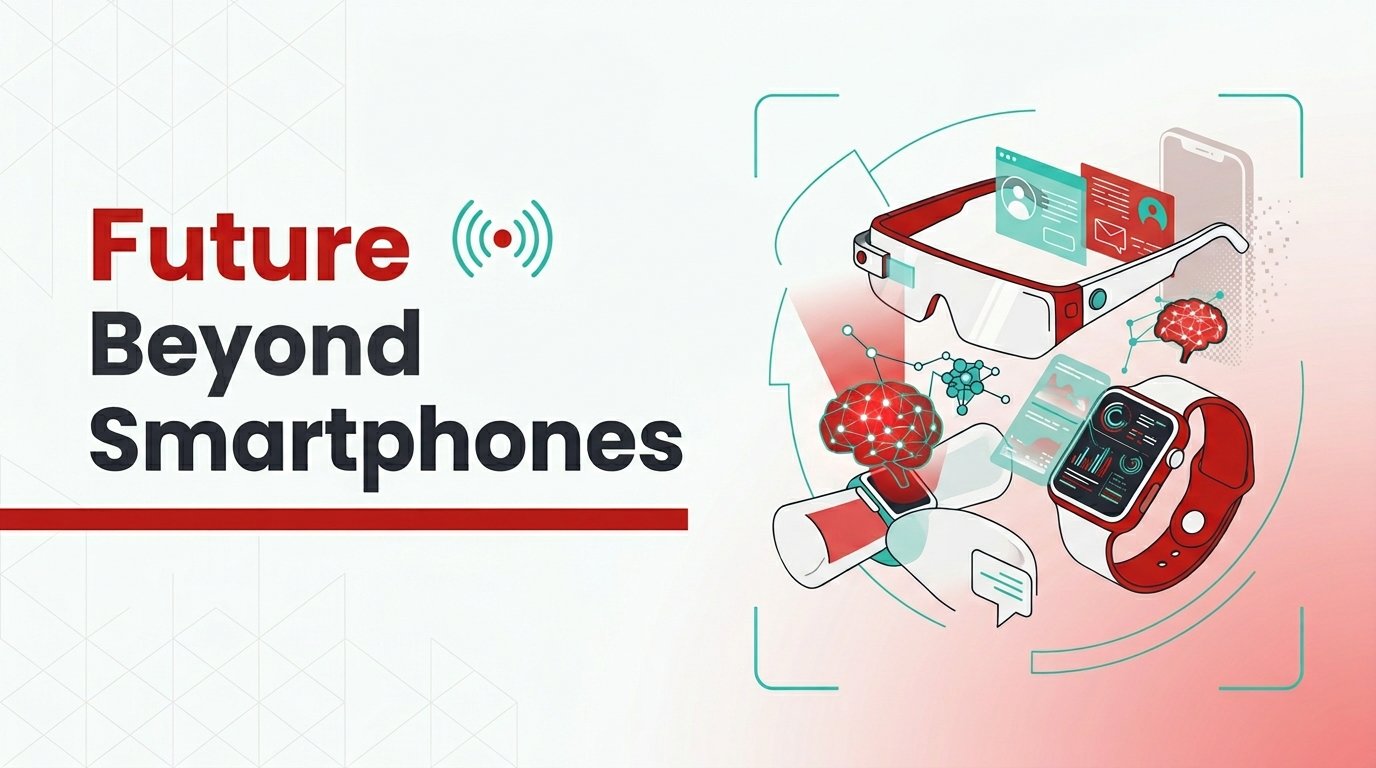
For more than a decade, the smartphone has been the central device in modern digital life. It brought communication, photography, navigation, entertainment, payments, work, shopping, and artificial intelligence together in a single pocket-sized computer.
Now, the world’s largest technology companies are increasingly exploring what could come after the smartphone. Rather than simply building another phone with a larger screen or faster processor, companies are investing in artificial intelligence, smart glasses, wearable computers, voice interfaces, ambient computing, robotics, and other technologies that could change how people interact with digital services.
Why Tech Companies Are Looking Beyond Smartphones
The smartphone market is mature compared with the explosive growth seen during the early years of the iPhone and Android era. Modern smartphones are extremely capable, but their basic design has remained familiar: users carry a rectangular touchscreen, open applications, interact with visual interfaces, and use wireless networks to access cloud services.
Technology companies now see an opportunity to make computing less dependent on screens. Instead of requiring users to take a phone out of their pocket for every task, future devices could provide information through voice, audio, cameras, displays built into eyewear, or intelligent assistants that anticipate what a user needs.
Artificial intelligence is particularly important to this transition because AI can interpret natural language, images, surroundings, and context. That makes it possible to imagine devices that respond more naturally instead of requiring users to navigate menus and apps manually.
Artificial Intelligence as the Foundation
AI is arguably the most important technology behind the move beyond smartphones. Generative AI can already write text, summarize information, analyze images, translate languages, answer questions, and assist with software development.
The next stage is expected to involve AI becoming more deeply integrated into everyday hardware. Instead of opening a dedicated application, a person may simply ask an assistant to perform a task, summarize something they are seeing, find information from previous conversations, or interact with connected services.
This could change the role of the smartphone itself. Rather than being the primary interface through which every digital task is performed, the phone could increasingly become a powerful background computing hub that supports a wider ecosystem of intelligent devices.
Smart Glasses and the Rise of Wearable Computing
Smart glasses are one of the most visible candidates for a post-smartphone future. Unlike a phone, glasses can remain in front of the user’s eyes while providing information without requiring the user to hold a separate device.
Products such as Ray-Ban Meta smart glasses demonstrate how cameras, microphones, speakers, and AI can be incorporated into familiar-looking eyewear. Instead of placing a large screen directly in front of the eyes, these glasses can emphasize hands-free interaction, photography, audio, and voice-based AI.
The longer-term vision is more ambitious. Future augmented-reality glasses could potentially overlay navigation directions, translations, notifications, contextual information, or digital objects onto the user’s physical environment.
Meta’s Vision for AI Wearables
Meta Platforms has invested heavily in wearable computing and AI, making smart glasses a major part of its hardware strategy.
Its collaboration with EssilorLuxottica has produced Ray-Ban Meta glasses, combining conventional eyewear design with cameras, microphones, speakers, and AI features. This approach is significant because it does not require users to wear a traditional-looking computer headset.
The broader concept is that wearable AI should feel natural rather than like another piece of complicated technology. If smart glasses can become as comfortable and socially acceptable as ordinary glasses, they could provide a practical alternative interface for certain smartphone functions.
Google’s Long-Term Wearable Ambitions
Google has experience with wearable computing through products such as Google Glass and Wear OS. Its broader AI ecosystem also gives the company a potential foundation for integrating assistants into future wearable devices.
Google’s work in computer vision, maps, search, voice recognition, and AI could be particularly relevant to augmented-reality glasses. A wearable assistant that understands what a person is looking at could combine visual recognition with Google’s extensive information and mapping systems.
The challenge is turning these capabilities into a product that people actually want to wear all day. Battery life, privacy, comfort, social acceptance, and display technology remain important obstacles.
Apple’s Approach to the Post-Smartphone Era
Apple has not abandoned the iPhone, and the smartphone remains central to its ecosystem. However, Apple’s investment in wearables, spatial computing, health technologies, and on-device intelligence suggests that the company’s future strategy extends well beyond a single device category.
The Apple Watch already demonstrates how some smartphone functions can move to the wrist. Notifications, health monitoring, communication, payments, navigation, and fitness tracking can be handled without constantly interacting with an iPhone.
Apple’s Vision Pro also represents another direction: spatial computing. Rather than replacing the phone directly, spatial computers explore an environment in which digital applications and information can occupy three-dimensional space around the user.
Spatial Computing and Mixed Reality
Virtual reality, augmented reality, and mixed reality are frequently grouped under the broader concept of spatial computing. The goal is to make digital information feel more integrated with physical surroundings.
A spatial computer can provide large virtual displays without requiring a physical monitor. It can also allow applications to respond to the user’s environment, movements, gaze, and gestures.
However, headsets remain heavier and more intrusive than smartphones or conventional glasses. This makes them more likely to become specialized computing devices in the near term rather than immediate replacements for smartphones.
Wearables Could Become More Personal
Another major advantage of wearables is that they can remain physically connected to the user throughout the day. A watch, ring, or pair of glasses can continuously collect certain types of information and provide contextual assistance.
Health-focused wearables are especially promising because they can monitor movement, heart-related metrics, sleep patterns, exercise, and other measurements depending on the device.
AI could turn these measurements into more useful insights. Instead of merely showing raw statistics, future systems could explain patterns, identify changes, and provide personalized recommendations.
This also introduces significant privacy concerns. A device that constantly listens, sees, or monitors physiological information could collect much more sensitive data than a traditional smartphone.
The Importance of Voice Interfaces
The smartphone revolution was driven largely by touchscreens. The next computing shift may involve voice and conversational interfaces becoming much more important.
Voice is particularly useful when a person cannot or does not want to look at a screen. Someone walking, driving, cooking, exercising, or working with their hands could interact with an AI assistant naturally through spoken commands.
Generative AI makes these interactions more flexible because users do not necessarily need to memorize exact commands. They can describe what they want in ordinary language and allow the system to determine the appropriate action.
The challenge is reliability. People will only trust voice-first computing if assistants can understand context accurately and perform tasks consistently.
AI Could Change the Meaning of an App
Smartphones popularized the app model. If users wanted to perform a task, they typically opened a dedicated application.
AI assistants could reduce the importance of this model. Instead of opening several apps to plan a trip, a user could ask an AI system to compare options, organize information, and complete the relevant steps across multiple services.
In this model, the AI becomes an intermediary between the user and applications. The user focuses on the desired outcome rather than knowing which individual app should perform each part of the task.
That could represent one of the most important changes in consumer computing because it shifts the interface from app-centric interaction to intent-based interaction.
Robotics as Another Post-Smartphone Frontier
The future beyond smartphones is not limited to devices people wear. Technology companies are also investing in robots capable of interacting with the physical world.
AI has made robots better at interpreting environments, recognizing objects, following natural-language instructions, and adapting to changing situations. Companies are exploring humanoid robots, warehouse automation, home robotics, and other forms of intelligent machines.
A robot could ultimately become another interface between humans and digital intelligence. Instead of asking an application to perform a task, a person could ask an AI-powered physical system to perform it in the real world.
This remains a developing field, but advances in AI, computer vision, sensors, batteries, and robotics are making it increasingly relevant to discussions about the future of computing.
The Smartphone May Not Disappear
One of the biggest misconceptions about the post-smartphone future is that smartphones will suddenly vanish. A more realistic possibility is that their role will gradually change.
The smartphone could become a central connectivity and computing hub while many interactions move to other devices. It might store data, provide cellular connectivity, perform intensive computing, and coordinate wearables even when users rarely interact with its screen.
This would resemble how personal computers evolved after smartphones became widespread. PCs did not disappear; instead, they became one part of a larger ecosystem of computing devices.
The same thing could happen to smartphones.
The Challenges of a Post-Smartphone World
Technology alone will not determine whether new devices replace smartphones. Battery life remains one of the biggest challenges for wearable computers. A smartphone can accommodate a relatively large battery, while glasses, rings, and other compact devices have far less physical space.
Privacy is another major concern. Cameras and microphones embedded in glasses can potentially capture information about people who never agreed to be recorded.
Social acceptance also matters. A device may be technically impressive but still fail if people find it uncomfortable, distracting, unattractive, or inappropriate to use in public.
Cost is another barrier. New hardware needs to provide enough value to justify purchasing another device when smartphones already perform so many tasks effectively.
The Privacy Question
The more intelligent and context-aware computing becomes, the more data it may require.
An AI assistant that understands a user’s surroundings may need access to camera feeds. An AI health coach may need access to physiological information. A personalized assistant may need access to calendars, messages, locations, purchases, and other personal information.
This creates a difficult balance between personalization and privacy. Consumers may welcome technology that understands them better, but they also need meaningful control over what is collected, where it is processed, and how long it is retained.
Companies that want to succeed beyond smartphones will therefore need to make privacy and security central parts of their product design rather than treating them as secondary features.
What the Future Could Look Like
The most likely future is not one single device replacing the smartphone. Instead, computing could become distributed across an ecosystem of devices.
A person might wear AI glasses for visual information and communication, use a smartwatch for health and quick interactions, rely on earbuds for private audio, and keep a smartphone nearby as a powerful connectivity and processing device.
AI could connect these devices together, allowing users to move between interfaces without thinking about which device is performing a particular task.
In this environment, the most important technology may not be the individual device at all. The AI system connecting everything could become the primary interface.
Will AI Replace the Smartphone?
It is too early to say that AI will replace smartphones completely. AI is more likely to change how smartphones are used before it eliminates the category.
Modern smartphones already provide powerful AI capabilities, and their combination of cameras, displays, connectivity, processing power, storage, and mature software ecosystems makes them difficult to replace.
For a true successor to emerge, another device or combination of devices would need to provide comparable utility while offering a more convenient and natural user experience.
That is why smart glasses, AI assistants, wearables, and spatial computing are best viewed as competing or complementary interfaces rather than guaranteed smartphone replacements.
The Next Era of Personal Technology
The technology industry appears to be moving toward a world where computing is more ambient, conversational, wearable, and intelligent.
Instead of constantly looking down at a screen, people may increasingly interact with digital systems through speech, gestures, cameras, displays embedded in the environment, and AI agents that understand context.
The smartphone is unlikely to become irrelevant overnight. But as AI and wearable technology mature, the phone may gradually become less visible in everyday interactions.
Final Takeaway
Tech giants are exploring a future beyond smartphones by investing in AI, smart glasses, wearables, spatial computing, voice interfaces, and robotics. The goal is not necessarily to eliminate the smartphone immediately, but to make digital technology more natural, contextual, and accessible.
AI is the key technology connecting many of these developments. It can transform wearable devices from simple sensors and accessories into intelligent assistants capable of understanding language, images, surroundings, and user intent.
The next major computing platform may therefore not be a single “iPhone killer.” It could be an ecosystem of AI-powered devices that work together, with smartphones serving as one component rather than the center of the entire digital experience.
The transition will take time, and significant challenges remain around privacy, battery life, cost, reliability, social acceptance, and security. But the direction is clear: the future of personal technology is increasingly being imagined as something that is less screen-dependent, more intelligent, and more deeply integrated into everyday life.
